It’s been a week since the coming and going of another Oscar night. Dreams came true, hopes were dashed and cymbals were clanged. It was definitely a better show than last year, though a pretty middling one in general. Still, we must debrief. Or at least, I must debrief. You’re under no obligation to join me.
THE AWARDS
The inevitability of The Artist came to pass, though interestingly it scored the same number of wins as Hugo, with five each. Not that it matters now, but I just don’t get it. I thought The Artist was fresh and charming, but Best Picture? I never saw that, and I still don’t. It’s too much of a trifle. Enjoyable as it is, it’s also paper thin…and I don’t mean that to be a criticism of the movie. It’s not like it aimed high and fell short. It had no lofty ambitions, and accomplished exactly what it wanted to. But a Best Picture winner should have more meat on its bones. Best Director I can understand even if I wouldn’t have gone that way, but not Best Picture. And certainly not Best Actor, all respect to a delightful performance by Jean Dujardin. Seriously, Best Actor?!? The more I consider it, the less sense it makes.
My emotions are mixed around Best Actress. Meryl Streep’s win can’t be called a surprise exactly, since everyone agreed that the race had boiled down to her and Viola Davis. But most predictions also agreed that Davis would take it, so hearing Colin Firth announce Streep’s name was a curveball of sorts. I feel badly for Davis. She and Streep were both deserving, but Davis – as I said in my predictions post – is going to have a harder time finding roles that will bring her back to the Oscars. And even then, becoming a frontrunner again is always a stroke of luck. Davis is good enough and respected enough in the industry that she’ll probably be back sooner or later. But it would have been nice for her to ride this wave of acclaim all the way.
Yet at the same time…Meryl Streep!!! At last!! It’s been said before – by me, and others – that no one but Meryl Streep could already have two Oscars and still be considered overdue. But it’s been a long drought – 12 nominations since her last win, in 1982 for Sophie’s Choice. Every few years she’s back, and a part of that season’s narrative becomes, “Will this be Meryl Streep’s year?” It feels surreal, in a way, that it finally happened. You know that scene near the end of Terms of Endearment, where Jeff Daniels says to Debra Winger, “I’m thinking about my identity and not having one anymore. I mean, who am I if I’m not the man who’s failing Emma?” It’s kinda like that…who is Meryl Streep if she’s not the actress who keeps getting nominated for Oscars and keeps losing? And how long will it be before she’s overdue again? It was confirmed within the last few weeks that later this year she will begin filming an adaptation of the play August: Osage County, a Tony Award and Pulitzer Prize winning play in which Streep will take on the dynamic lead role of a dysfunctional Oklahoma family’s pill-addicted matriarch. The actress who originated the part on Broadway won a Tony, and if Streep isn’t back in the race next year for the comedic drama Great Hope Springs (due out this summer), surely she’ll be in the 2013 hunt. And probably several more after that.
Anyway, it can’t be denied that it was great to see her holding an Oscar again. As usual, she gave a down to earth and self-deprecating speech in which she paid tribute to the many friends she has made over her 35 years in the movie biz. Incidentally, Streep joins a select group of actors who have collected three Oscars: Jack Nicholson, Walter Brennan and Ingrid Bergman. She’ll need one more to tie the record of four acting wins, held by Katherine Hepburn.
No major surprises going down the line. I only managed a middling 15 correct predictions out of 24 his year, but admittedly I knew I was going against the grain in my picks for Best Actor (I stuck with Clooney), Best Adapted Screenplay (I followed my first instinct – Moneyball – instead of going with the favored The Descendants) and Best Visual Effects (where I should have known that Rise of the Planet of the Apes wouldn’t be able to fend off the more Academy-favored Hugo). In the below-the-line categories, the biggest surprise was The Girl with the Dragon Tattoo‘s win for Best Editing. Few pundits saw that coming. Even winners Kirk Baxter and Angus Wall – who became the first back-to-back editing winners since 1936 (they won last year for The Social Network) – didn’t see that coming, and were so stunned that they could barely muster a speech.
Speaking of speeches, other highlights included Asghar Farhadi, writer/director of Best Foreign Language Film winner A Separation, offering a gentle and heartfelt reminder that Iran does not exist solely in a political context, and that there are plenty of people from that nation who respect all cultures and want to share experiences through art. (Of course, Iran’s political leaders were celebrating the win because it came at the expense of Israel’s nominated film. I prefer Farhadi’s point of view…and Jon Stewart’s as well). It was also nice to see The Artist‘s Ludovic Bource, winner of Best Original Score, stop on his way to the stage to hug or shake hands with his fellow nominees Alberto Iglesias, Howard Shore and John Williams, and then acknowledge them in his speech.
I was a little surprised by Hugo taking both sound awards, and by The Artist taking Best Costume Design despite the black-and-white that I thought would derail its chances. And while Hugo undoubtedly sported some fine cinematography from Robert Richardson, that award so should have gone to The Tree of Life. Pretty soon Emmanuel Lubezki may join Roger Deakins as one of recent history’s most unjustly Oscar-less lensers.
THE HOST Billy was back, and it was like he’d never left. Literally. He stuck to his traditional schtick, and it was just like a plate of comfort food, though perhaps one left sitting out to cool just a touch too long. Crystal is one of Oscar’s all-time great hosts, and part of the fun of having him there is watching him do his usual bits. I like seeing him insert himself into nominated movies for the opening gag…but the last few times he’s done it, he’s played the angle of, “Should I go back and host the Oscars again?” That gets a little old. I did like the Justin Bieber cameo though, a cleverly executed jab at the Academy’s foolish efforts to lure younger viewers. And Crystal’s deliberately cheesy Best Picture medley is always fun, but none of this year’s lyrics were too memorable (whereas, über-Oscar nerd that I am, I can still sing parts of his medleys from the early 90s, which had great lyrics for The Godfather Part III, JFK and The Prince of Tides, among others). Plus, couldn’t the song’s writers have come up with a better way to address Moneyball than just calling attention to Jonah Hill’s weight loss?
The monologue was surprisingly brief, with most of the time yielded to the opening film and the medley. Usually Crystal banters with the audience a little more, but he got right down to business this time. He had plenty of good one-liners throughout the show, but there wasn’t anything special for him to work with. No Jack Palance one-armed-pushups, no non-stop flow of New Zealanders winning in nearly every category (though NZ was represented by a win for “Man or Muppet” songwriter Bret McKenzie). It was a dry show by and large, fitting for a ho-hum year of movies, and Crystal did what he could with it. As we’d all hoped for and expected, it was an improvement over last year’s misguided Franco/Hathaway experiment.
THE PRESENTERS
It was a pretty good slate this year. We got some stalwarts like Tom Hanks, Michael Douglas and an ageless Tom Cruise, along with plenty of funny presentations that I thought worked well. Best in Show goes to Chris Rock for his hilarious introduction to Best Animated Feature…
…followed by Will Ferrell and Zach Galifianakis emerging from the orchestra pit to present Best Original Song.
Great stuff…but no joke about there only being two nominees for Best Song?
I enjoyed the bits by Ben Stiller and Emma Stone (preceded by a funny intro with Crystal and Melissa McCarthy), as well as the Robert Downey, Jr. and Gwyneth Paltrow presentation, though each one seemed to play only decently in the room. In fact, the audience seemed pretty stiff this year overall, which is too bad, because I thought these presenters did well. Kudos to Paltrow too, for selling her part of the stint with Downey. Award show banter often lives or dies on the strength of the straight-man – or straight-woman, in this case. If they can’t sell the joke, the awkwardness can be painful. But Gwyneth’s got the goods.
It was great to see Kermit the Frog and Miss Piggy on the show, if only briefly. Next time, give them a bit more to do and invite some of the other Muppets to join them. (In fact, why not have Statler and Waldorf in the balcony all night, lobbing insults at the host?) The show also made smart use of the Bridesmaids cast by having the six women present a string of connected awards in pairs of two, rather than having them present one award and utter a single line each. Kristen Wiig and Maya Rudolph did an amusing “size does matter” riff about Best Live Action Short Film, while Rose Byrne and Melissa McCarthy carried forth a joke from the SAG Awards in which the Bridemaids ladies discussed a drinking game based around the mention of “Scorsese.”
Angelina Jolie seemed to get a lot of humorless attention for the leg-flashing stance she took upon reaching the microphone to present the Best Adapted Screenplay award, but it seemed obvious to me that she was just trying to be playful; same with Cameron Diaz and Jennifer Lopez when they did their little spin-around before announcing the Best Makeup winner. But as I said, the crowd wasn’t so receptive to playfulness this year. Nor was the entertainment media apparently, as I read numerous comments in the day or two after the show about how Jim Rash, one of the adapted screenplay winners for The Descendants, was insulting Jolie when he mimicked her leggy pose. I read one headline that blared something like, “Award Winner Savagely Mocks Jolie.” Jesus people, bring it down a few notches. There was nothing savage about it. Jolie did something kinda funny, and Rash played with it. I doubt anybody’s feelings were hurt, and both Rash and Jolie’s gestures were all in good fun.
The most disappointing among the presenters – not that it was her fault – was Tina Fey. She’s been a highlight of the show in recent years, but this time she was given almost no material to work with. They had her out there to present three awards, but didn’t come up with anything funny for her to do. What a waste. Her co-presenter Bradley Cooper was funny…but that was more due to his goofy handlebar moustache. (The one joke Fey cracked can be seen in the Best Film Editing clip above.)
And by the way, congratulations to the show’s producers for entrusting Jennifer Lopez with presenting an award that wasn’t for music. She’s presented several times over the years, but I think that was a first.
THE PRODUCTION
-This is the Oscars. It’s the big leagues. It’s also 2012. Can we really not solve the problem of a microphone buzz persisting through the entire telecast?
-There were a handful of montages during the course of the show in which actors, against a simple black screen, talked about the magic of movies. One of the reasons we watch the Oscars is to see movie stars and great actors, so appearances by people like Edward Norton, Philip Seymour Hoffman and Gabourey Sidibe were all well and good, but the Academy has done this self-indulgent “power of the movies” stuff before. I’m a huge movie fan, and even I was rolling my eyes a little bit. On the plus side, the interviews were directed by Bennett Miller, so…that’s cool.
-The pre-filmed Wizard of Oz focus group bit starring Christopher Guest and his amazing troupe of improvisors was an inspired idea. I thought it could have been a little funnier, but it was still a treat to see that gang – Guest, Eugene Levy, Catherine O’Hara, Fred Willard, Jennifer Coolidge and Bob Balaban – together again.
Alas, no Michael McKean, Jane Lynch, Parker Posey, Ed Begley, Jr. or John Michael Higgins. Maybe they’ll do another one next year. Imagine a crowd of similarly uptight characters trying to make sense of 2001: A Space Odyssey? Actually – that should have been a running gag through the show. Instead of listening to actors telling us how movies transport them, there should have been different focus group films with Guest and Company.
-Once again, the show’s director Don Mischer – also the co-producer – seemed to be operating from the booth as if he were blind. The guy seems bizarrely incapable of cutting to famous faces in the audience. He fared a tiny bit better this year than last, capturing some reactions from George Clooney, Steven Spielberg and others here and there. But the number of times the camera cut to a shot of the crowd featuring a bunch of total unknowns was staggering. Where was Gary Oldman all night? Or Rooney Mara, who was seen only when the Dragon Tattoo editors addressed her from stage? Natalie Portman? Viola Davis? Glenn Close? They were hardly featured at all. It’s like Mischer was sending his cameramen into the most remote corners of the audience to capture anonymous members of the crowd and then cutting to the shot that was furthest away from the nearest celebrity at any given time. I don’t care how many years of experience this guy has; any skill he may have once possessed is no more. Mischer has got to go. Somebody get me Louis J. Horovitz stat! (Note the first line of trivia next to his picture. I doubt Mischer will earn any such honors.)
-One thing I will give Mischer credit for – or maybe it goes to his fellow producer Brian Grazer – is letting nearly every winner complete a speech without getting played off the stage by the orchestra. Whenever a category has more than one winner, it seems like whoever talks second is doomed to be cut off. But in almost every case, multiple winners were not only allowed to speak, but actually finish! In fact, the only category where the winners got cut short was Best Documentary. One of the recipients did drop an F-bomb, but it was caught by the delay, and the speech still went on for a bit before they were cut off. They weren’t even up there that long. So obnoxious. Let people have their moment, damnit!
-Having the Best Actor and Best Actress presenters directly address the nominees isn’t working anymore. When it was first introduced for the 2008 awards, it was a neat and novel device: bring out five previous winners in all four acting categories and have each of them salute one of the current nominees. It was a great idea. But it worked because it was unusual and unexpected, and even though the comments were being read from a teleprompter in most cases, the gesture still felt personal and intimate. The next year, they tried for something similar, but it was clunky: dissing the two Supporting categories, the producers brought out former co-stars of each lead acting nominee and had them salute their nominated one-time co-star. Then those presenters exited the stage and the previous year’s acting winner came out to actually open the envelope and hand out the award. This year and last, the presentations were further streamlined by just having the previous year’s winner (opposite gender, in keeping with Academy tradition of one year’s Best Actor presenting the next year’s Best Actress, and vice versa) pay tribute to all five nominees before opening the envelope. But the magic is gone. That first time, it felt special to have, for example, Shirley MacLaine honoring Anne Hathaway, Robert De Niro lauding his friend Sean Penn, Kevin Kline paying tribute to Heath Ledger and Whoopi Goldberg addressing fellow onscreen nun Amy Adams. But now it feels stiff, it drags the presentations out and the presence of the teleprompter feels more noticeable, making the remarks seem less genuine. Next year, let’s just go back to reading the names and showing a clip. Or find another creative way to conduct the presentation. Maybe have video clips of fellow actors – not necessarily former winners, not necessarily former co-stars, but just a small assortment of respected actors discussing all the nominated performances in a given category and what they liked or admired about them. There are videos on the Academy website in which some of this year’s below-the-line categories are reviewed this way. Just an idea. But it’s time to retire this bit for a few years. Oh, and whatever is done, it should be done for the Supporting Actor and Supporting Actress nominees too. Where’s the love?
-The In Memoriam tribute was given an elegant presentation, but once again most of the names came and went without any reference to the films the deceased had worked on. A few clips or sound bytes were included for the most well-known in the montage, like Elizabeth Taylor, Peter Falk and Sidney Lumet. But for all the lesser known folks, particularly those who worked behind-the-scenes, it’s nice to see a sampling of the films they worked on so we have some context.
THE HONORARY AWARDS
Before winning Best Actress, Meryl Streep took the stage to call attention to this year’s honorary Oscars, which were presented back in November. These awards used to be given out on Oscar night, but a new tradition was started a few years ago to honor the recipients at a separate event, known as the Governors Awards. This year’s honorary Oscars, as shown in the highlight clip introduced by Streep, were given to pioneering makeup artist Dick Smith (The Godfather, The Exorcist, Amadeus) and James Earl Jones. Oprah Winfrey received the Jean Hersholt Humanitarian Award, which has been awarded over the years to people like Bob Hope, Audrey Hepburn, Paul Newman and Jerry Lewis. All three were in attendance on Oscar night, and while I do miss having these honors incorporated into the ceremony, the Governors Awards evening really allows them to be properly celebrated, without having to abbreviate the tributes so as to cater to an impatient TV audience. The acceptance speeches and clips of the presenters are available on the Academy’s website and are worth checking out. I especially enjoyed J.J. Abrams’ tribute to Smith:
THE DRESSES
When I arrived at the Oscar party I was attending, the TV was already tuned to the red carpet, though thankfully the sound was muted. I can’t abide the vacuous comments and stupid questions posed by most of the interviewers, but I do like looking at the beautiful belles in their dresses and gowns. Natalie Portman pretty much took my breath away when I first saw her on the carpet. Seriously, I think I lost my balance and had to grope for the wall behind me to steady myself. Dear lord, she looked good. I liked the Grace Kelly hairdo sported by Penelope Cruz, and Jessica Chastain’s dress was a standout as well. I haven’t looked up how the fashion police rated Jennifer Lopez, but I had absolutely no problem with her seashellish get-up. Michelle Williams, Cameron Diaz, Viola Davis, Kristen Wiig, Milla Jovovich, Maya Rudolph, Tina Fey and Gwyneth Paltrow all looked nice, and it has to be said: Janet McTeer? Totally hot. She was in disguise as a hulkin’ dude in Albert Nobbs, but in reality she’s a serious cougar. Anyway, to preserve my memory, here’s a sampling. It’s okay…I respect them all for their intelligence and acting chops as well as their ability to look good.
FINAL THOUGHTS
Every year, Oscar night leaves in its wake reviews about how the show is boring and stale, how the Academy is irrelevant and out of touch (complaints that also spring up after nominations are announced and provocative films like Shame are inevitably omitted) and how it can all be fixed. I wanted to weigh in on that, but I also want to get this post finished while this year’s show is still reasonably fresh in our memories. So I’ll save it for another time…not a bad idea anyway, since there’s more than enough to say on the topic to fill its own post. Instead, we’ll just end this Oscar season with a polite smile, and hope that the films in contention next year will be a stronger lot. Based on how 2012 is looking, that shouldn’t be a problem. (I’ll have more to say on that in the next few weeks.)
A final reminder of this year’s Oscar night, this clip comes not from the broadcast, but from the red carpet. It was a moment that merited unmuting the TV: Sacha Baron Cohen, in character for his new film The Dictator, encountering a legitimately unsuspecting Ryan Seacrest. General, I salute you.
Alright, we’re two days from the big night and it’s time to lay the cards on the table. As usual, the outcome of some categories seems set in stone, while others still have some suspense going for them. Other Oscar pundits are saying that all but two or three categories are completely sewn up, yet it’s never as cut and dry as they’d like to claim it is. There are always more races that could fall in different ways than anybody ever seems willing to admit. Which are which this year? Let us see…
BEST PICTURE
When the Academy announced last summer that they were reconfiguring the Best Picture competition such that the number of nominees would fall somewhere between a minimum of five films and a maximum of ten, they pointed out that they applied the calculation model to the previous ten years worth of ballots and found that some years would still have yielded only five nominees, while others would have seen six, seven, eight or nine make the list. Considering that this was a somewhat underwhelming year for movies, most pundits were expecting seven, maybe eight. But we got nine. And now that the ceremony is upon us, there’s only one being talked about. With the full muscle of Oscar maestro Harvey Weinstein behind it, The Artist is the film to beat on Oscar night. It collected plenty of critics awards during the season, and its standing was affirmed by wins from the Producers Guild of America, the Directors Guild of America, the British Academy of Film and Television (BAFTA) and its win for Best Picture (Musical or Comedy) at the Golden Globes. Some might argue that The Help has a chance as well, based on its three wins at the Screen Actors Guild Awards and the fact that it’s the most commercially successful film of the bunch. It clearly has the love of actors – the largest voting block within the Academy – but that won’t be enough to carry it all the way, especially when it missed out on key nominations for Best Director, Best Screenplay and Best Editing. The only nominees that might surprise are The Descendants and Hugo, but The Artist is the movie that seems to be making everyone and their mother feel that special feeling. As a paean to the early days of Hollywood and the magic of moviemaking, I think Hugo is a more successful film, and certainly one with more depth than The Artist. But by this point the silent charmer’s victory seems assured. And I suppose it’s nice that the movie was made without any aspirations for awards whatsoever. It’s a small film made from a place of love and affection, whose entire creative team has been genuinely overwhelmed by the outpouring of acclaim. That’s kinda nice.
Personal Choice: None of the nine movies truly captured my heart, but Moneyball is the one that most closely meets my barometer for what a Best Picture winner should be.
BEST DIRECTOR
This award, of course, usually goes hand in hand with Best Picture. I don’t imagine this year will see a split, despite some saying that Scorsese may win his second. The legendary lion did take the Golden Globe, but the better indicator is the DGA award, and that went to Michel Hazanavicius for The Artist. I expect the Academy will follow suit.
Personal Choice: The Tree of Life is too imperfect to deserve Best Picture, but in this category I’m less inclined to fault a movie’s flaws than I am to reward a director with vision and ambition. In that respect, none of this year’s nominees can match Terrence Malick.
BEST ACTOR
A category that was looking reasonably predictable in mid-January is much more in flux now. George Clooney had been out ahead, but Jean Dujardin has closed in tight. Not only did he snag trophies from SAG and BAFTA (both of which share some members with the Academy), but he’s kept visible these last couple of weeks with an amusing Funny or Die video in which he auditions for the villain role in a number of high-profile franchises, as well as a cameo in an Artist-inspired, French-themed Saturday Night Live sketch. Clooney and Dujardin are both charmers who would be enjoyable at the microphone, so no help determining who has the edge on that score. And even with the two of them seemingly neck and neck, this is the category that feels to me most poised for an upset. Brad Pitt stars in two Best Picture nominees, did great – many have said career-best – work in both of them, and has continually pushed himself as an actor. The personal investment he had in getting Moneyball made and the struggles he endured in doing so were well documented, and they add a nice, emotional narrative to his nomination. Toss in his charity work and general good humor and graciousness, and I think he could pull off a surprise victory. Gary Oldman is a longer shot, but some voters may want to reward him for an incredible career thus far. As for Demián Bichir, his nomination and the attention it brings to a film that puts the complex immigration issue in a personal light will be the extent of his reward. (An essay by journalist Jose Antonio Vargas about the importance of Bichir’s film and his nomination was published recently in Entertainment Weekly.) So…Dujardin’s victory in the more recent contests may tip the scales in his favor, making him the smart bet. But whether it’s because my gut tells me Clooney has broader support, or because I personally don’t see Dujardin’s performance as Oscar-caliber (not that personal feelings should ever govern these picks) or because I’m an idiot…I’m sticking with Clooney for the win.
Personal Choice: Again, there’s nothing here that I can passionately go to bat for, but I was probably most affected by Bichir’s performance. And if Pitt somehow takes it, I’ll be all smiles.
BEST ACTRESS
This year, it’s the Best Actress category that best exemplifies the change of winds that can occur between the first half of the awards season – dominated by the regional critics awards – and the second half of the season, where the guilds, Golden Globes and national critics awards (mainly the Broadcast Film Critics Association prizes) are handed out. The first half of the season indicated that Michelle Williams was the force to be reckoned with for her impressive take on Marilyn Monroe in My Week with Marilyn. But it only takes a few key events to change the course the race; it’s down to Meryl Streep and Viola Davis now. Davis took the awards from SAG and the BFCA, while Streep won the BAFTA award and the Golden Globe (for a drama; Williams won the musical/comedy Globe). So this thing is pretty evenly split.
Streep gives another great performance (no surprise), especially in her many scenes as the elderly Margaret Thatcher. This is her record 17th nomination, and she hasn’t won since 1982; she’s lost the last 12 times. The Hollywood community has undying adoration and reverence for her, and whenever she wins an award at another event (and she’s won many in the last decade alone), she’s always funny and down to earth. The crowd loves seeing her up there. But they always know that Meryl Streep will be back within a couple of years and they’ll have another chance. The same can’t be said for Viola Davis, who will have a much harder time finding another lead role that could put her back in the Oscar race anytime soon. It’s unfortunate, but that’s the way the industry works. Davis is a wonderful actress who has earned the love and respect of many filmmakers over the years, but the opportunities for her to play rich leading roles are few and far between. She might not have even gotten the part in The Help if it hadn’t been for 2008’s Doubt, which earned her a Best Supporting Actress nomination for just two scenes (both opposite Streep). Davis has given heartfelt and moving speeches at her other wins this season, and her peers seem thrilled that she’s finally getting her moment to shine. And lest we forget, she’s excellent in The Help as a maid weary from years of service and dehumanization. She carries it in every step she takes, suggesting so much more internally than she ever has the chance to say out loud. Meryl Streep’s time could be upon us again, but it feels more like Davis’ moment…and I’d wager that even Streep is voting for her.
Personal Choice: Streep is overdue for Oscar #3, and she rocks it in The Iron Lady, but I’m rooting for Davis. I’d be fine with Williams too. She’s terrific in a part that seems so unlikely for her. It’s easy to imagine Meryl Streep will hit a bullseye playing Margaret Thatcher. It’s harder to imagine Michelle Williams hitting a bullseye as Marilyn Monroe, but she absolutely does.
BEST SUPPORTING ACTOR
I like Kenneth Branagh, but I still can’t figure out what he’s doing here. He gives a nice performance in My Week with Marilyn, but hardly one for the books. Likewise, Jonah Hill does good, understated work in Moneyball, but an Oscar nomination seems a bit much. So let’s go ahead and remove them from the equation.
Given his track record all season long, it would be foolish to bet against Christopher Plummer. Aside from the facts that he delivers a wonderful performance with little screen time and has been charming and funny in previous acceptance speeches, this category often doubles as a lifetime achievement award of sorts, and Plummer’s time has come. (Surely there are those who still feel he was robbed of a nomination for The Insider.) But he isn’t the only veteran in the category who’s never won. At 82, he’s the same age as Max von Sydow, who has a similarly long and rich career full of great films and performances. Plummer represents the only nomination for Beginners, while von Sydow’s Extremely Loud & Incredibly Close had enough support in the Academy to crack the Best Picture race. So a win for von Sydow is not unfathomable.
And though ten years their junior, Nick Nolte is no spring chicken either. He’s another respected veteran who probably came very close to winning for his two previous nominations (Best Actor for The Prince of Tides and Affliction). In predicting the nominations, I suggested that Nolte’s presence in commercials for HBO’s series Luck was helping to keep him visible. Now the show is in the middle of its run, so he’s still got a spotlight on him. Further complicating things is that all three of these performances are right in Oscar’s sweet spot: they’re touching examinations of vulnerable characters dealing with life at its most promising and punishing. Were they not competing against each other, any one of them could be a winner. In the end though, Nolte’s Warrior is unlikely to have reached enough voters, and since the same sentiments that could benefit von Sydow apply to Plummer as well, it would be odd if the momentum Plummer has built up over the course of the season suddenly shifted. So while a von Sydow surprise isn’t out of the question, I hold to my initial statement: it would be foolish to bet against Plummer.
Personal Choice: I’d be really happy to see any of these three guys win, though I didn’t think Plummer or von Sydow had enough screentime to explore their characters deeply enough to merit an Oscar.
BEST SUPPORTING ACTRESS
Janet McTeer and Bérénice Bejo are the also-rans this year. While the first half of the season suggested this would be a wide-open race – 11 actresses were named amongst 34 critics groups – momentum at this point has solidified around Octavia Spencer. I do think Melissa McCarthy has spoiler potential, and Jessica Chastain a little less so, but all signs point to Spencer.
Personal Choice: The sheer range demonstrated this year by Chastain is extraordinary. The Academy could just as easily have cited her for The Tree of Life or Take Shelter, but going with The Help was the right call. It’s a showier performance, but a wonderfully multifaceted one. I’d also be smiling wide if McCarthy got it for fleshing out the category’s most unpredictable and original character.
BEST ORIGINAL SCREENPLAY
A tough category filled with good work. While The Artist is poised to do quite well on Oscar night, I don’t think its reach will extend here. Margin Call and A Separation have probably gone unseen by too many voters, which leaves Bridesmaids and Midnight in Paris. The former will surely have a flood of supporters, but given the Academy’s conservative tendencies, the more refined comedy of Woody Allen is likely to triumph, bringing him his fourth Oscar and his first in over 25 years (not that he’ll show up to accept it). Do watch out for The Artist, though; it definitely has a shot.
Personal Choice: I’d be happy with really anything except The Artist, which I like but find to be the least impressive of the bunch from a screenwriting point of view (and no, not because there’s no typical dialogue). I’m torn between A Separation and Bridesmaids. A Separation is so exquisitely constructed, yet comedy is so hard to pull off as brilliantly as Bridesmaids does, especially while still offering character depth and dramatic undercurrents.
BEST ADAPTED SCREENPLAY The Descendants or Moneyball would be the frontrunner if they weren’t competing against each other. I really can’t decide which way it might go. The Descendants took the Writer’s Guild of America prize this week, as well as an editing award from the American Cinema Editors, which shows that the movie has support across disciplines. Still, the WGA award – while a strong indicator – doesn’t mean the chips won’t fall elsewhere. Both movies racked up 11 wins from the various critics groups I’ve tracked, both are Best Picture nominees, both are admired and respected…I just don’t know. To buy me some time, let’s rule out The Ides of March, which is just padding. I don’t see Hugo breaking out here either. Tinker Tailor Soldier Spy, however, has a small shot. It was ineligible for the WGA awards, removing it as a factor. Plus, this category has offered surprises in the past, including Precious beating Up in the Air, The Pianist scoring against The Hours and Adaptation, and The Lord of the Rings: The Return of the King trumping Mystic River. Tinker Tailor has admirers, and no doubt the novel by John le Carré poses daunting challenges. There’s also the emotional hook that Bridget O’Connor wrote the script with her husband Peter Straughan, then died of cancer before the movie was made. Still, I think the dense and complex narrative will prove too impenetrable for too many voters. Which brings us back to The Descendants and Moneyball. I should give the edge to The Descendants because of the WGA win; most pundits are predicting it here. But my first instinct was to go with Moneyball…so for better or worse, that’s where I’m landing.
Personal Choice: Moneyball. You have to admire the way Stan Chervin, Steven Zaillian and Aaron Sorkin took Michael Lewis’ stats-oriented book and turned it into the most human of stories.
BEST ANIMATED FILM
I wasn’t able to catch A Cat in Paris or Chico & Rita, but I suspect the same can be said for most Academy members. Neither film will be able to compete with the commercial juggernauts of Rango, Kung Fu Panda 2 and Puss in Boots. And the latter two, solid as they are, can’t compete with the originality of Rango. Poor Dreamworks Animation. They get two movies in the race this year, they don’t have to contend with the Pixar behemoth…and they’re still going to lose. C’est la vie. The lizard takes it.
Personal Choice: Rango
BEST CINEMATOGRAPHY
Any one of these five nominees could conceivably win, but by rights it should be a no-brainer victory for Emmanuel Lubezki’s ravishing work in The Tree of Life, which virtually swept the critics awards and took home the American Society of Cinematographers prize. But particularly in these below-the-line categories, the general membership of the Academy can never be depended on to do what’s right. Indeed, Lubezki has entered the Oscar race before – in 2006, for Children of Men – armed with a stack of critics awards and the guild’s top honor, only to lose the Oscar. The Tree of Life being a less popular movie in the wider ranks of the Academy than some of its competitors here could well result in Lubezki missing out once again. In Contention‘s Kris Tapley – one of the smarter Oscar pundits out there – pointed out that it’s been over 60 years since a movie has won this award without being nominated in at least one other below-the-line category. That would spell trouble for The Tree of Life, but here’s the thing: so what? People who spend time predicting the Oscars – myself included – are always trying to reason through our choices with facts and figures like this. Some of this logic is legitimate. For example, it’s true that the DGA’s Best Director nominees and the Academy’s Best Director nominees rarely line up 5-for-5. It’s also true that most DGA winners will go on to win the Best Director Oscar. But when we start getting around to “no movie has ever won Best Sound Mixing without being nominated by the sound mixers guild, therefore…” or “only one movie since 1971 has won X and Y but not Z, so that means…” or “it’s been 60 years since a movie has won Best Cinematography without being nominated in at least one other below-the-line category,” that’s when it’s time to slap ourselves in the face and reset. No Oscar voter is sitting with their ballot and thinking about their vote in these insignificant terms. So while a winner might indeed uphold a particular statistic, that statistic is probably not dictating the winner. If The Tree of Life loses this award, it’s not going to be because it wasn’t nominated in any other below-the-line categories.
If voters do pass it over, a case could be made for why any of the other four – The Artist, War Horse, Hugo and The Girl with the Dragon Tattoo – might speak more to them. But my gut tells me that even people who found The Tree of Life to be pretentious, boring, confusing or all of the above will nevertheless concede that from a photographic standpoint, it’s a work of art. It should be a safe bet, but strangely it doesn’t feel that way. Let’s hope it gets its due.
Personal Choice: The Tree of Life
BEST FILM EDITING
I don’t get the sense that any of the nominees are standouts or coming into the race with a great deal of momentum. The only one I feel confident in ruling out is The Descendants, even though it won the American Cinema Editors award in the Drama category. It beat fellow Oscar contenders Hugo, Moneyball and The Girl with the Dragon Tattoo, all of which nevertheless seem more plausible on Oscar night. But the absence of an obvious frontrunner leads me to suspect that voters will pencil in The Artist (which took the guild’s prize in the Musical/Comedy category) for lack of knowing any better.
Personal Choice: For its deft weaving of Billy Beane’s personal backstory into his present day circumstances, as well as the smooth incorporation of archival footage, I’d give it to Moneyball.
BEST ART DIRECTION Hugo is the movie to beat here, being a period piece that also has flourishes of fantasy. It’s certainly a deserving choice, with its elaborate train station setting and massive clock gears hidden in the walls. Yet if voters stop to get sentimental – or to even consider what has and hasn’t been honored in the past – they may take this last opportunity to award Stuart Craig for Harry Potter and the Deathly Hallows Part 2. Craig has been one of the Potter series’ consistent creative voices, serving as art director on all eight movies. He’s been nominated for three of the earlier films, but has yet to win for any of them. He’s done tremendous work, and a win for the last movie would be a well-deserved tribute. But unfortunately, most voters probably don’t think about these things. Taking the five nominees (The Artist, Midnight in Paris and War Horse round out the category) on their individual merits, I expect the Academy will go with Hugo.
Personal Choice: I can’t argue with Hugo, but I’d really love to see Harry Potter honored for the culmination of a decade’s wondrous work translating J.K. Rowling’s imagined world so successfully into reality.
BEST COSTUME DESIGN
The striking outfits in W.E. won in the Period category at the Costume Designers Guild Awards, but it’s doubtful the movie has been seen by enough of the larger, more diverse voting bloc in the Academy. Ditto for Anonymous, although that movie is set much further in the past, making for even more elaborate clothes. And Academy members love to vote for elaborate clothes. Jane Eyre is a more admired film than Anonymous, and probably a more widely seen one. The combination of its period and the design of the clothes gives it a strong chance, but the muted color palette might hurt its chances. The outfits have all the right frills, but they’re predominantly drab. I think voters favor costumes that are not just elaborate, but also colorful, meaning the black and white of The Artist will also face an uphill battle…though the movie’s general front-runner status and evocation of old Hollywood glamour could help it here; a number of pundits are expecting as much. Then there’s Hugo, and the possibility that the standout uniform worn by Sacha Baron Cohen’s station inspector could seal the deal. This is one of the year’s tougher categories to call. Jane Eyre and The Artist are good guesses, but I’m going out on a bit of a limb for Hugo.
Personal Choice: Hugo
BEST ORIGINAL SCORE
The absence of dialogue in The Artist not only necessitates a huge amount of music score, but means the music has to do much more of the work than in any of the competition. While the themes may not be memorable enough to get voters humming as they fill out their ballots, none of the other nominees – War Horse, The Adventures of Tintin, Hugo or Tinker Tailor Soldier Spy – can claim any better (at least not by this film score enthusiast’s standards). Given how prevalent the score is, and how versatile and charming as well, I think The Artist will take it.
Personal Choice: The Artist
BEST ORIGINAL SONG
Well, we’ve got a 50/50 shot here, as the music branch saw fit to nominate only two songs. It’ll either be the humorous “Man or Muppet” from The Muppets, or the bouncy “Real in Rio,” which appears during the opening and closing sequences of the animated film Rio. General affection and popularity for Kermit and company would appear to give “Man or Muppet” the edge (not that Kermit or any of the best-known Muppets actually sing this song), but don’t underestimate the name recognition of Sergio Mendes, a music legend who is one of the nominees for Rio. Then again, the nominees’ names don’t appear on the ballot, which means Mendes’ involvement may be unknown to many voters. Either way, I’m sticking with my beloved Muppets for the win.
Neither song will be performed on the telecast this year, so if you want to give a listen to the competition, here are clips for “Real in Rio” and “Man or Muppet.” These are taken right from the movies, so beware of spoilers.
For what it’s worth, the music branch has stated that it will once again review its procedures and see what might be done to improve them. (Is it me or does Diane Warren sound like a presumptuous, arrogant brat in that article? Even if the process gets fixed, maybe her songs just won’t get nominated anyway. It’s one thing to hope for a nomination; it’s another thing to expect or feel entitled to it.) Anyway, there’s got to be a simpler way to choose the nominees, because the bizarre scoring system described in The Hollywood Reporter doesn’t seem to make any sense.
Personal Choice: “Man or Muppet”
BEST MAKEUP Albert Nobbs is probably sitting this one out, making it a contest between The Iron Lady and Harry Potter and the Deathly Hallows Part 2. Realistic and aging makeup on one hand, fantasy and creature makeup on the other. Both represent the kind of standout work the Academy likes to honor. There was more variety in Harry Potter, from creating multiple goblins to applying the pale, slit-nosed visage for Ralph Fiennes’ Voldemort. But The Iron Lady‘s work may be harder to ignore, as the viewer is so squarely focused on Meryl Streep and the impressive transition not only between her normal look and the younger Margaret Thatcher, but between young and elderly Thatcher. So while Harry Potter could certainly conjure the win, I’m calling it for The Iron Lady.
Personal Choice: Harry Potter and The Iron Lady are both impressive.
BEST VISUAL EFFECTS
Team Real Steel will have to be content with their nomination, which leaves four viable contenders. Hugo is the lone Best Picture nominee in the category, so it could definitely win just by association. Transformers: Dark of the Moon once again features dazzling work, but if the first two movies in the franchise couldn’t win, I’m not sure this one will. Actually, the second film wasn’t even nominated. The first was…and totally deserved the prize, but these movies are viewed as so silly and bombastic that voters probably don’t want to endorse them. Too bad; the work in question should be all that matters, and the work in these movies is outstanding.
Moving on, this category offers yet another chance for the Harry Potter series to receive a final salute. This is the third of the eight films to be nominated, and none have won. The effects are uniformly excellent throughout, but since there’s nothing that pushes the envelope, the movie may need to reach the Academy on a sentimental level, and I’m not sure it can. That leaves the favorite: Rise of the Planet of the Apes, which once again sees Weta Digital elevating performance capture technology to create an army of photorealistic simians, chief among them the film’s main character Caesar, played by Andy Serkis. Caesar was such a compelling character that many were calling for Serkis – who has pioneered this technology on the acting side with his work in The Lord of the Rings and King Kong (he’s also in The Adventures of Tintin) – to be nominated for Best Supporting Actor (though he’s really the lead). Obviously that didn’t pan out, but the incredible achievement can be recognized in the VFX race. The movie was well received by both audiences and critics, the latter point giving it an edge over Transformers. Still, that may not be enough. Apes being lower on the Academy’s radar, there will almost certainly be lots of voters who blindly check off Hugo because it’s a Best Picture nominee and a movie they’re more familiar with. (Remember when Gladiator beat The Perfect Storm? Well…it did. And it shouldn’t have.) I’m still betting on Apes to take the gold, but affection for the Harry Potter movies or, more likely, the cross-section appeal of Hugo could win the race.
Personal Choice: Rise of the Planet of the Apes is probably most deserving, but I’d be happy to see Harry Potter or Transformers recognized.
BEST SOUND EDITING and BEST SOUND MIXING
And here we are again: the two categories that nobody except the sound artists themselves really understand. As I did in the earlier post where I predicted the nominees, let me link to this Hollywood Reporter article that discusses the sound categories and helpfully sums them up like this: Sound Editors collect, create and prep the sound effects, while the sound mixers take all that – plus music and dialogue – and blend it together for the final soundtrack. Armed with that exceptionally rudimentary understanding of what each category recognizes…we still really have no basis whatsoever for determining what might win.
War Horse, Hugo, The Girl with the Dragon Tattoo and Transformers: Dark of the Moon are nominated in both categories. Drive takes the fifth slot for Editing, and Moneyball rounds out the Mixing race. Most Academy members won’t think of Moneyball as a “sound” movie, and Drive‘s lack of a single other nomination likely kills its chances here. Transformers will probably be considered too loud and too stupid by voters who don’t understand the complexities of sound work, so that’s out too. Most pundits are predicting that both awards will go to the same film: most are guessing Hugo, some are guessing War Horse. I’m not so sure. The movies that have won both sound awards in the past tend to be true sonic showcases, and neither of these seem to fit the bill. So I’m in the school of thought that the awards will split: one for War Horse and one for Hugo. I think anyone who gets the movies right should earn full points in their Oscar pool without having to name which film will win in which category, but in order to keep it all official, my uninformed thought is that the array of sounds gathered for War Horse will help it triumph in the Editing race, while the blend of sounds required for Hugo – trains, clockworks, vocal cacophony, score, dialogue – will give it the edge for the Mixing race. But I have no idea what I’m talking about, and I’m sure I’ve just given these categories more thought than 90 percent of Academy members will, so Godspeed to you.
Personal Choice: Hell, I don’t know.
BEST FOREIGN LANGUAGE FILM
In any given year, there are usually only a few foreign language films that break out slightly beyond the parameters of the art house and enter a more mainstream arena. Sometimes, those movies don’t make it to the Best Foreign Language Film category, but even when they do, there’s no guarantee that the higher profile they’ve attained will pay off with a win. This category is one of just a handful for which only Academy members who have attended screenings of all five films can vote. That means the winner is likely being selected by a relatively small pool of members, and that they are almost certainly older and probably somewhat conservative. I believe that’s why more imaginative movies like Amélie, Pan’s Labyrinth and Waltz with Bashir have lost despite having wider acclaim and more momentum than the films that beat them.
This year’s breakout is A Separation, a powerful drama from Iran about how a seemingly small and ordinary marital dispute balloons into a complicated ordeal that ensnares numerous other people. (For the record, it’s the only nominee of the five that I’ve seen.) The film was also honored with a nomination for Best Original Screenplay, which suggests broader support, but that won’t necessarily matter given how the voting works. That said, I do think the movie is a legitimate favorite this year, since it strikes me as the kind of realistic human drama to which voters gravitate. There’s no obvious turnoff. It’s not violent, it’s not irreverent, it’s not trivial, and though I do wonder if some voters will refuse it because its Iranian, it’s not political at all. But if they don’t go for it, there’s a well-reviewed Holocaust drama called In Darkness among the nominees, and the Academy has certainly been moved by Holocaust films in the past. From what I’ve heard of them, Belgium’s Bullhead and Israel’s Footnote don’t sound like the kind of movies that go the distance here. I’m sticking with A Separation, but noting that Poland’s In Darkness and Canada’s Monsieur Lazhar might also have the right stuff.
BEST DOCUMENTARY
Despite always hoping to do better, I once again failed to take in any of these movies. Ditto for the live action and animated short films. (I don’t think I’ll ever get around to Documentary shorts.) But I can at least relay what I’ve read around the Oscar blogosphere from people who kind of cover this stuff for a living. In this category, many think that Paradise Lost 3: Purgatory will win, as it’s the culmination of years-long work by filmmakers Joe Berlinger and Bruce Sinofsky to expose the injustice behind the incarceration of the West Memphis Three. The prisoners were finally released last fall, and the two earlier films in this series no doubt played a part in that.
BEST DOCUMENTARY SHORT
The subject matters and opinions of what will win run the gamut, but I’ll probably go with Saving Face, about the efforts in Pakistan to address the issue of women being scarred with acid.
BEST ANIMATED SHORT
I hear great things about Pixar’s La Luna, but most predictions I’ve come across are calling it for The Fantastic Flying Books of Morris Lessmore.
BEST LIVE ACTION SHORT
There’s no consenus here that I can see, but I’ve seen predictions for Raju, Pentecost, and The Shore – which, for what it’s worth, has the most recognizable pedigree. It’s directed by Hotel Rwanda‘s Terry George and stars Ciarán Hinds (Munich, Road to Perdition, Tinker Tailor Soldier Spy), Kerry Condon (from HBO’s Rome and Luck) and Conleth Hill (Lord Varys on Game of Thrones).
xx
Now we wait and see how it all unfolds…and hope that the show is a good one. Last year’s was such a mess that it can’t go anywhere but up. I hope. Some may recall that back in November, film director Brett Ratner – who was scheduled to co-produce this year’s ceremony with veteran TV producer Don Mischer – made some obnoxious and homophobic remarks that led him to step down. After he took himself out of the picture, his hand-picked host Eddie Murphy decided to bow out as well. Hollywood power player Brian Grazer stepped in to co-produce, and he quickly locked in Billy Crystal to host, marking the comedian’s first time at the emcee’s microphone in nearly a decade (though he appeared on the show last year, to a rousing standing ovation). It was a smart move. Crystal is one of Oscar’s classic hosts, and while he may not lure in the younger viewers the Academy has been so desperate to court these last few years, he’s the right man for the job, especially this year: a known quantity who will probably deliver a safe and entertaining show. Of course, Mischer will be in the director’s booth, and after the terrible job he did in that post last year, we can only hope he’ll be on his game this time. On the morning the nominations were announced, Grazer told a reporter for E! News that the number of movie star nominees would give Mischer plenty of attractive, famous faces to cut to during the show…which made me snicker, since Mischer had plenty of attractive famous faces to cut to last year as well and yet seemed to be deliberately avoiding all of them. On the bright side, one thing Grazer and Mischer seem to understand is that the trick to keeping the Oscarcast entertaining is comedy. Mischer acknowledged this week in an interview with Entertainment Weekly that the show’s lack of comedy last year was a mistake. So in addition to Crystal as host, presenters will include reliable funny people like Chris Rock, Ben Stiller, Tina Fey, Will Ferrell, Zach Galifianakis, the cast of Bridesmaids and Kermit the Frog and Miss Piggy. Security will be on the lookout for James Franco.
Final words: set your DVR to record beyond the three-hour running time in case the show goes long; remember to stick around for Jimmy Kimmel’s post-show special, which is always good for some great comedy bits; and do a shot every time you hear the word “Hugo.” You’ll be sloshed by the ninety minute mark.
I leave you with a couple of videos. First, an instructional short from the Academy about how to properly care for your Oscar…really just because I’ll take any excuse to remind the world that Kevin Kline won for A Fish Called Wanda. Best. Oscar Win. Ever.
After that, something posted just this morning from Admiral General Aladeen of the Republic of Wadiya (aka Sacha Baron Cohen in character as the lead in his upcoming movie The Dictator), responding to the Academy’s threats to revoke his tickets to the ceremony if he shows up in character, as he intended to do.
I like to take at least a couple of days to weigh in on my reaction to the nominees, so that all the professionals who probably have to fill some quota of posts per day can get their knee-jerk reactions out of the way, and I can try to offer a more measured response that also allows me to call them on their rapidly delivered, unconsidered commentary. Everywhere you turn on nomination day, you see the word “snub.” EW.com was just one site that was all about pointing out the snubs. Every single movie or performance that was considered to have a chance at a nomination but didn’t get there in the end was snubbed. Yet they never go on record to say which performance should have been left off in favor of the snubees. If Fassbender and DiCaprio had made it, then two other people wouldn’t have…and then these writers would be crying foul that those people had been snubbed. On Dictionary.com, the first definition for “snub” is “to treat with disdain or contempt, especially by ignoring.” A snub is personal; these oversights seldom are. I don’t think anybody was leveling Michael Fassbender or Tilda Swinton or Albert Brooks with contempt or disdain. The acting categories have five slots. There are always more than five possible nominees. Someone’s getting left out. Just because someone or something got a Golden Globe nomination or a guild nomination or even both doesn’t mean that getting overlooked by the Academy is “baffling,” as the above article says. Quite the opposite, actually: it’s basic math. This happens every year, folks. It’s how the game works. I’m not saying don’t be disappointed if your beloved contender misses out; we’ve all been there, and it wouldn’t be Oscar season without some griping about who got in and who didn’t. (I was particularly peeved by last year’s omissions of True Grit‘s Matt Damon and Inception director Christopher Nolan. But I also said they deserved to be in their respective categories more than specific people who’d made it. I mean really, Tom Hooper for Best Director?!?). If you’re not at least willing to take it that far, you can’t cry foul that every single possible contender wasn’t nominated.
Anyway…
When you make a game of predicting the Oscar nominations, there’s a tug-of-war between wanting to be right and wanting to see some surprises. Because I don’t feel too passionately about anything in the race this year, I was more pleased than perturbed by the unexpected developments. Let’s take a look at how things played out. In the previous piece, I refrained from offering my own thoughts on most of the nominees in contention; God knows I had enough to say as it was. But this time it’s personal! A little bit, at least…
I managed 100% accuracy in only three of the 19 categories I predicted (Best Director, Best Cinematography and Best Film Editing), while in six more I missed by just one. In most others, I was off by two. Oscar prognostication is a tricky and unpredictable art, so I’m pretty happy with my results.
BEST PICTURE
Considering we didn’t know how many nominees there would be, I didn’t do too badly. I predicted eight (which was in line with what most of the “professionals” were expecting too), and there turned out to be nine. I thought War Horse would miss while The Girl with the Dragon Tattoo would score, but it turned out to be the opposite. Then a surprise ninth nominee was revealed: Extremely Loud & Incredibly Close, which pretty much everyone had written off. It only picked up one other nomination, but you have to wonder how close it came in the Directing and Adapted Screenplay categories. (EW.com questioned how the movie secured a nomination when it was reviewed so unfavorably by critics, as if critical consensus has any more validity than an Oscar nomination. It’s all subjective in the end.)
Looking at how the field has shaped up since the first critics awards were announced at the end of November, the biggest shock to me has been the powerful presence of Hugo. Heading into awards season last fall and trying to guess which movies would become award magnets – before the November and December releases had even been seen – Hugo was mentioned consistently, but more as an on-the-edges possibility than a likely bet. Had it not been directed by Scorsese or someone of equal stature, I doubt it would have come up at all. And even when it finally came out, I don’t think anyone really expected it to grab hold the way it has. I enjoyed it for sure, but I’m mystified by all the hype. Still, at this point its Oscar presence was assured, and its 11 nominations give it the year’s highest tally. I’m sure a large part of the reason it’s been so rapturously embraced by critics and moviemakers is that it’s such an unabashed celebration of movies themselves, from a director who is steeped in film history and has long been a passionate advocate about the need for film preservation. The same affection for old Hollywood probably accounts in part for The Artist being such a dominant film in the race this year, and the likely winner for Best Picture at this point. It’s a charming and entertaining movie, but too slight to deserve the top award, in my estimation. It’s a gimmick, and there’s nothing wrong with that in and of itself, but for Best Picture I’d like to see something with more meat on its bones.
The only other nomination that could be considered a surprise here is The Tree of Life. It was never a sure thing, but I’m glad to see it get this level of recognition. Even those who enjoyed the film have to admit that it’s a pretty unlikely nominee, so seeing that it had enough support is encouraging. One of the Academy’s bolder choices this year.
BEST DIRECTOR
The 1970’s are well represented with nominations for Martin Scorsese, Woody Allen and Terrence Malick. Allen hasn’t been nominated in this category since 1994’s Bullets Over Broadway, and it’s the first time since 1984’s Broadway Danny Rose that he’s been nominated for Best Director without any of the film’s performances being nominated as well. Just a little pointless and random trivia for you.
As is typical on nominations day, many of the nominees release statements of gratitude through their publicists. I particularly liked what Scorsese said about the first-time challenges he dealt with this time around: “I am deeply honored to have been nominated by the Academy for my work on Hugo. Every picture is a challenge, and this one – where I was working with 3D, HD and Sacha Baron Cohen for the first time – was no exception. It’s a wonderful feeling to know that you’ve been recognized by the people in your industry. I congratulate my fellow nominees. It’s an impressive list, and I’m in excellent company.”
BEST ACTOR
Michael Fassbender was left out, which is a shame (no pun intended), but an actor as prolific, engaging and versatile as he is will surely find himself here one of these days. I also thought DiCaprio would manage a nomination for J. Edgar, but it was not to be. The movie didn’t do much for me, but DiCaprio was terrific. When you have an actor as recognizable as he is playing a character with such an affected accent, along with the aging makeup…it’s hard to pull that off without the audience sensing a disturbance in the movie star force. But he nailed it, right from the get-go. Oh well. He can bury his sorrow in Blake Lively’s cleavage, or in the cleavage of whatever incredibly hot woman he’s currently dating.
Besides, how can you not be happy for Demián Bichir and Gary Oldman? I’m impressed that enough voters found Bichir amidst all the better known actors and films. He has a long list of credits in Mexico, but has appeared in few high-profile American works (Steven Soderbergh’s Che and the Showtime series Weeds are the only items on his IMdb page that I recognized). A Better Life is a simple and straightforward movie that’s not without its contrivances, but Bichir gives a moving performance that is all the more effective because it too is so simple and straightforward. As for Gary Oldman, I mean…what can you say? How did it take this long? Much as I wanted to, I was unable to wrap my brain around Tinker Tailor Soldier Spy, and felt that Oldman’s role was just too subdued to merit Oscar attention (not that I’m against subtlety at all, but Oldman felt almost invisible in the part; maybe that was the point). Still, while he wouldn’t have made my list, I’m nothing short of thrilled to see him get this long overdue recognition. If nothing else, he shoulda been a contender in 2000…for The Contender. But he was involved in some behind-the-scenes battles on that movie that apparently spoiled his chances. Now, after years of doing mostly supporting parts (and doing them quite well, as any Batman and Harry Potter fan can attest), I hope this will bring more lead roles his way once again.
In their ongoing mission to explore every corner of what didn’t come to pass, EW.com asked why Ryan Gosling came up short, calling it “crazy” that the actor wasn’t nominated and that he didn’t win either of the two Golden Globes he was nominated for. I’m not sure what’s so crazy, since he wasn’t remotely considered a favorite in either category. The writer offers three explanations for why “the year of Ryan Gosling” petered out. I’d like to I suggest a fourth option: that none of Gosling’s performances were necessarily more rich or complex than the five that were cited instead, nor were the films heavily favored by Academy members (both Drive and The Ides of March eeked only one nod each). Just because someone shows up in a few good movies during the year doesn’t suddenly make them Oscar bait. Now Gosling was robbed last year for Blue Valentine, but this time around it just wasn’t in the cards. No great mystery.
BEST ACTRESS
I thought that if anyone could crack my predicted five in this race it would most likely be Rooney Mara, and so she did, taking the spot I had given to Tilda Swinton. I have yet to see Swinton’s We Need to Talk About Kevin, but I can’t say Mara doesn’t impress in The Girl with the Dragon Tattoo. (Somewhere on nomination day, Noomi Rapace – the star of 2009’s Swedish version – was bitterly muttering about xenophobic Americans and their bullshit remakes.) I do find it curious that Mara made the cut given that Dragon Tattoo wasn’t nominated for Picture, Director or Adapted Screenplay. All three corresponding guilds nominated it (while the Screen Actor’s Guild passed over Mara), and several other guilds honored the movie too. Still, actors vote for actors at this stage in the process, and the actors branch is the largest in the Academy (yet significantly smaller than the SAG membership). Clearly enough of them were impressed.
BEST SUPPORTING ACTOR
The big news here is the absence of Albert Brooks. Like most people playing this guessing game, I expected him to show up on the strength of his co-domination of the Supporting Actor landscape thus far. Still, from day one I’ve been perplexed by the strong buzz he generated and by how many honors he collected. Drive is one of my favorites this year, and Brooks is great in it…but Oscar great? I don’t see it. It seems like everybody just got overexcited about a guy best known for playing neurotic nebbishes going 180 as a smooth criminal. I love the against-the-grain casting, but c’mon – was he so amazing that 16 regional critics associations named him Supporting Actor of the year? (15 additional organizations nominated him or named him as the runner-up).
At least he took it with a sense of humor, as evidenced by his reaction on Twitter:
(Fellow non-nominee Patton Oswalt, of Young Adult, had a whole series of choice Twitter reactions going…)
Great to see Nick Nolte nominated, as well as Max von Sydow. Reactions to Extremely Loud & Incredibly Close run the spectrum, as mentioned earlier, but von Sydow is undoubtedly a highlight…not even for the “Oscar-bait” element of the performance (he doesn’t speak at all in the part), but for his warm and engaging interactions with young lead Thomas Horn.
BEST SUPPORTING ACTRESS
Almost went 5-for-5 in this category, but I swapped out McTeer for Woodley at the last minute. Oh well. I’m really happy that Melissa McCarthy made it for Bridesmaids. Even with all the momentum she had going in, you never know what the Academy is going to do with comedy this broad. Also great to see Jessica Chastain here, even if the picture that was displayed onscreen during the announcement was for the wrong movie. (She was nominated for The Help; the picture was from The Tree of Life.) I know she was in two dozen movies this year, but couldn’t they have used a picture from the right one?
BEST ORIGINAL SCREENPLAY
Turns out I was right to doubt 50/50‘s likelihood of getting nominated, but I still only went 3-for-5 in this category, opting for Beginners and Win Win as the less-celebrated movies that would make their mark here. Instead the Academy went for Margin Call – which was a totally pleasant surprise – and A Separation, which I doubted had been seen by enough voters. I really do wish the writers had found room for Win Win. Tom McCarthy has written and directed three movies, and each has been unique and wonderful. He’ll land here eventually; I hoped third time would be the charm.
BEST ANIMATED FILM
So the animators rejected The Adventures of Tintin after all. Poor motion capture technology. It’s like the bastard child nobody wants. Actors don’t think it’s real acting, animators don’t think it’s real animation…at least the visual effects branch can be counted on to give it a home (though Tintin didn’t even make it to the visual effects branch’s initial list of 15 qualifiers, suggesting they only accept mocap as a component of a film rather than a style for the film as a whole).
I thought the high quality of Cars 2‘s animation might be enough to land it in the category, but I was wrong. Pixar still has a chance to take something home thanks to La Luna earning a nomination for Best Animated Short, but it will be sitting out the bigger race this year. Ironic for a movie about a big race.
BEST COSTUME DESIGN
Another category where I came close to a 5-for-5 call until a last minute switch. I happened to see a clip from The Help online, and decided to plug that into my predictions in the spot where I’d had Jane Eyre. When will I learn? Always go with your first instinct! Still, Anonymous and W.E. were a bit off the beaten path, so I’m pleased I got those right.
BEST ORIGINAL SONG
Seriously, what is the fucking problem with the Academy’s music branch these days? I was only half-joking in my previous post when I said they had expended all of their creative ambition on wins for Eminem and Three 6 Mafia, but this is ridiculous. Only two nominations out of 39 eligible songs? All three shortlisted contenders from The Muppets were perfectly worthy of recognition. “The Living Proof” – which plays over the end of The Help – is an uplifting song that speaks directly to the plight of one of the movie’s main characters, and is propelled by the always impressive vocals of Mary J. Blige. Having not seen Albert Nobbs yet, I don’t know how the song “Lay Your Head Down” (sung by Sinead O’Connor) is utilized, but on its own merits it’s certainly a pretty enough lullaby. I’m not saying either of them are classics, but considering some of the sentimental dreck the Academy has nominated before, these are certainly strong enough to be up for the award. The music branch governors need to go back to the drawing board in this category, because the latest round of rule changes instituted a few years ago are clearly not working.
BEST ORIGINAL SCORE
I suspected that John Williams would make it for War Horse, and should have known he’d make it for The Adventures of Tintin too…but as a lover of film scores and a huge Williams fan, I gotta call bullshit on these. Both scores are entirely generic and unremarkable. They’re hardly worthy of the amazing work Williams has done over the years, and there’s nothing in them that is memorable or evokes the mood or spirit of the movie in any special way. There were a lot of choices available to voters for this category. These are just lazy nominations.
BEST VISUAL EFFECTS
After all my theorizing about paying tribute to an industry pioneer and honoring a film that eschewed CGI for a more old fashioned approach, the visual effects branch opted to skip The Tree of Life in favor of giant boxing robots in the Hugh Jackman sleeper hit Real Steel. Didn’t see the movie, so I can’t talk smack about the quality of the effects. From the trailer, which played at every single friggin’ movie I went to between July and October, the effects looked good enough, but how many fighting robot movies does the category need per year? I think Transformers probably featured enough to last for at least the next decade.
BEST SOUND MIXING/SOUND EDITING
I was not alone in thinking that Super 8 would get its due in the sound categories, but it didn’t happen. I also should have known better than to omit The Girl with the Dragon Tattoo, as Fincher’s movies often do well here and I was already banking on widespread support for the movie. But I can never feel too bad when I blow it on the sound awards.
x
So the game is afoot. Over the next month, the nominees will run the rat race of interviews and events, working the campaign trail like the Republican presidential candidates (only far, far more appealing). Meanwhile, those of us who follow it all will start seeing “vs.” show up a lot. A mere day after the nominations were announced, the cover for the new issue of Entertainment Weekly was revealed, proclaiming “George vs. Brad” and “Meryl vs. Viola,” as if pairs of actors (and in both of these cases, good friends) are going to enter the Thunderdome and battle it out bloodsport-style until only one is left standing to grasp that golden idol with crimson-stained hands. Yes, I’ve probably been guilty of the Oscar season rhetoric over my years of writing about this subject that I love despite its absurdity. I’m sure if I comb through past Oscar posts, I’ll see that I too have thrown around “snubbed” and “vs.” But I’m trying not to do that anymore. I still get fired up about the way things go, but I try to address my issues with the appropriate vocabulary.
Alright, let’s see…I think Albert Nobbs just opened locally today….
Predicting the nominees has been a bitch this year.
For starters, everyone seems to agree that 2011 wasn’t all that strong a year for movies. There was a lot of good and not much great…yet almost every category sports an abundance of worthy nominees. And while a few frontrunners are starting to emerge, no win feels inevitable. Usually by this time, the countless critics awards and initial guild nominations have helped clarify the field a bit, with at least one or two categories sporting a sure-fire winner. Not so this year. Without the usual sense of passion centered around a handful of films, things seem more prone to change between now and late February. All of which makes it an exciting race, but not an easy one to forecast. The new Best Picture rules don’t exactly help either. What new Best Picture rules, you may ask? Well let’s get the party started and find out…
Oh, a note for the nine of you that have actually read these in the past: normally I include my personal nomination picks for each category, but I’ve decided to hold off on that this year since there are still a few key movies that have yet to arrive in the Bay Area or which I just haven’t had a chance to see. They include The Iron Lady, We Need to Talk About Kevin, Coriolanus and Albert Nobbs. I missed the boat on a few others, including the acclaimed indie Tyrannosaur, but once again I’m pleased to say that I’ve seen pretty much everything that’s part of the conversation (I even saw Margaret during its super-quick theatrical run! ). Anyway, at some point between now and the awards, I’ll be sure to publish my own picks. Because I’m way smarter than the Academy.
BEST PICTURE
The Artist
The Descendants
The Girl with the Dragon Tattoo
The Help
Hugo
Midnight in Paris
Moneyball
The Tree of Life
Now then: rule changes. Note that on the list above, I’ve included eight movies. The especially astute among you will further note that eight is less than ten. Remember two years ago, when the Academy decided there would be ten nominees for Best Picture instead of the traditional five? The change benefited movies that, it’s safe to say, wouldn’t have made the cut on a five-film list. (Think The Blind Side, 127 Hours and District 9, to name a few.) Well last June, the Academy announced it was shaking up the process even further. The number of nominees will now fall somewhere between five and ten, and we won’t know the tally until the nominations are revealed.
Those of you familiar with Johnny Dangerously will understand if I pause at this point to quote Roman Maroni, who always had a colorful way of putting things.
Based on how many of the roughly 6,000 Academy members return their ballots and make selections in the Best Picture category, the accounting aces at PricewaterhouseCoopers will determine what percentage of first place votes a movie needs to earn in order to secure a nomination. According to the Academy’s press release on the topic, this new system means that the nominated films will more accurately reflect Academy members’ favorite movies. The downside is that because of the way the calculations work, a significant number of voters’ ballots will essentially be tossed out. It’s a system that favors consensus but means not every voting member will have their voice heard. For statistical nerds out there, Steve Pond of TheWrap.com is an expert in crunching Oscar numbers and has examined and explained the process in detail.
What this boils down to for schmucks like me is that predicting the Best Picture nominees just got a lot trickier. But schmucks we are, and predict we shall.
Count on The Artist and The Descendants, which have grabbed the lion’s share of the critics awards and each took home top Golden Globes recently (the former in the musical/comedy category, the latter for drama). The Help and Hugo are close to certain, and Midnight in Paris is probably in there too. After that, the real guesswork begins. Two movies with late December releases that were widely expected to be contenders are War Horse and Extremely Loud & Incredibly Close. But War Horse, despite strong reviews and good box office, has failed to gain traction with the industry. While cited by the Producers Guild of America and the American Cinema Editors, it went unnominated by the Writers Guild of America, the Directors Guild of America (which has been generous to Steven Spielberg over the years) and the American Society of Cinematographers. Those omissions hurt. Has War Horse been left out to pasture?
As for Extremely Loud & Incredibly Close, it was the last move of the year to screen for critics and guilds, with some of the season’s first voting critic circles convening before they’d seen it. The lack of recognition by the Golden Globes and Screen Actors Guild could be due to ballots being cast before the movie was seen. But mixed reviews and the same lack of guild support slowing down War Horse‘s chances indicate the movie just hasn’t caught on. There have been a smattering of nominations from this group or that, and it could factor into a couple of races further down, but Best Picture no longer seems in the cards.
The unlikely beneficiary of those two movies’ lackluster showings appears to be The Girl with the Dragon Tattoo, which in contrast to both, has scored big time with the guilds. It’s been nominated by the PGA, ACE, ACS and most surprisingly, the DGA and WGA. With all that support, its Oscar chances look better than anyone would have expected (and better than it probably deserves, but that’s another story). Then there’s The Tree of Life, Terrence Malick’s poetic rumination on life, death, the universe and really gorgeous swirls of color. It was admired by critics, and no doubt it has ardent supporters within the Academy. The question is whether it has enough to earn the necessary number of first place votes. Brad Pitt’s other 2011 effort, Moneyball, is a solid movie that garnered strong reviews and has one of the most acclaimed scripts of the year. It’s the kind of all-around admirable film that could absolutely find itself in the running.
An assured ten-picture field might have opened the conversation up to movies like The Ides of March, My Week with Marilyn, Tinker Tailor Soldier Spy, Drive, or even some populist choices like Bridesmaids, Rango or Harry Potter and the Deathly Hallows Part 2. (Don’t laugh; Potter was one of the year’s best-reviewed movies, and even within the industry a lot of people feel it deserves recognition as the closing chapter of the most financially successful franchise ever.)
War Horse could still muster the support it needs, while The Tree of Life may not have the necessary backing. Moneyball is a question mark too. But this is the list I’m going with.
BEST DIRECTOR
Michel Hazanavicius – The Artist
Alexander Payne – The Descendants
Martin Scorsese – Hugo
Woody Allen – Midnight in Paris
Terrence Malick – The Tree of Life
This category has three sure things: Hazanavicius, Payne and Scorsese. Two spots remain, and a lot of people are in the mix for them. The affection for Midnight in Paris will probably carry Woody Allen, but I wouldn’t call him a lock. Although The Help is a safe bet for Best Picture, its director Tate Taylor has been largely ignored throughout the season. The film’s direction isn’t especially dynamic (not that it needed to be), so he’ll probably fall prey to bigger names and bolder visions. If War Horse misses in Best Picture, it will kill any chance Spielberg has…which I sense isn’t much at this point anyway. David Fincher, on the other hand, could benefit from the lovefest that has swarmed Dragon Tattoo.
If the Academy goes with Hazanavicius, Payne, Scorsese, Allen and Fincher, it will match the DGA’s nominees five-for-five. That rarely happens. In the last 25 years, it’s only happened three times (1998, 2005, 2009). When the two bodies diverge, the Academy often favors an auteur or an indie filmmaker. (Mulholland Drive‘s David Lynch, City of God‘s Fernando Meirelles, The Sweet Hereafter‘s Atom Egoyan and Red‘s Krzysztof Kieslowski are among those who scored Oscar nods but weren’t cited by the DGA.) This year, that could mean good news for Drive‘s Nicolas Winding Refn, who took the Best Director prize at the Cannes Film Festival last summer. But Drive is feeling more like a critic’s darling and less like a movie that’s connecting within Hollywood. The more likely nominee would be Terrence Malick for The Tree of Life. While the movie is divisive and it certainly isn’t perfect, Malick is a visionary filmmaker and one who has the admiration of many colleagues. Whatever the movie’s chances in the Best Picture race, I think it has a good chance of landing here.
BEST ACTOR
George Clooney – The Descendants
Leonardo DiCaprio – J. Edgar
Jean Dujardin – The Artist
Michael Fassbender – Shame
Brad Pitt – Moneyball
With the assured presence of Clooney, Pitt and Dujardin, this category is shaping up to be a gathering of the Handsome Men’s Club. But as is usually the case, a number of strong candidates are left fishing for two available slots. Clint Eastwood’s J. Edgar didn’t pan out as an awards magnet, but DiCaprio has plenty of admirers for his excellent performance and scored nominations from the Broadcast Film Critics Association, SAG and the Golden Globes. The Academy likes DiCaprio, so his chances are good. (Like anybody who writes about the Oscars, by the way, I shall proceed to repeatedly reference “the Academy” as though it were a monolithic entity absorbing the consciousness of its many thousand members into one aggregated voice).
I’d say three actors are realistically vying for the fifth slot. Michael Fassbender had a great year, with acclaimed performances in four movies. Several groups have nominated him for Shame, though he was overlooked by SAG. Still, plenty of actors are sure to admire his nakedness. No, not that nakedness. Well, yeah, I guess that nakedness too. But I mean more his emotional nakedness. Next is Gary Oldman, who took center stage for the first time in years with Tinker Tailor Soldier Spy. Fellow actors could feel that it’s time to pay tribute to one of the greats who has, amazingly, never been nominated. Still, the performance is so restrained and quiet. The Academy tends to favor flashier roles, and Oldman’s George Smiley is as buttoned-down as it gets. Then there’s Michael Shannon for the gripping indie film Take Shelter. Critics love the performance, and Shannon has the respect of his peers. But despite the September release, have enough voters made time to see it? He missed out on nominations from SAG, the Globes and the BFCA, which doesn’t bode well…but in 2009 he was ignored by the same groups and still scored a Supporting Actor nomination for Revolutionary Road. Can he do it again?
Woody Harrelson garnered ecstatic reviews as a self-destructive L.A. cop in Rampart, but it’s doubtful enough voters have seen the movie. SAG awarded a surprise nomination to Demián Bichir for his work as an immigrant father trying to provide for his teenage son in A Better Life, but again, the movie was probably too-little seen. SAG’s nominations don’t always match up with Academy’s, and Bichir – lacking name recognition and coming from lower profile movie – seems the least likely to make Oscar’s cut. Ryan Gosling’s name keeps popping up as well, both for Drive and The Ides of March, but neither film is likely to earn him the necessary votes (and frankly, if he deserves a nomination for any of his work this year, I’d argue in favor of Crazy, Stupid, Love).
With DiCaprio and Fassbender vulnerable, this category is primed for a surprise or two.
BEST ACTRESS
Glenn Close – Albert Nobbs
Viola Davis – The Help
Meryl Streep – The Iron Lady
Tilda Swinton – We Need to Talk About Kevin
Michelle Williams – My Week With Marilyn
While all the major races this year have the rare excitement factor of lacking clear frontrunners, some are more up for grabs than others, starting with this one. Streep, Davis and Williams are the locks, and surprisingly, it’s Williams who has by far captured the most critics awards to date, plus a Golden Globe for Best Actress in a Musical/Comedy (neither of which her movie really fits into, but that sort of loose categorization is nothing new).
In addition to these three, SAG nominated Glenn Close for Albert Nobbs and Tilda Swinton for We Need to Talk About Kevin. (Both films have yet to go into wide release, so for those unfamiliar with them, here are the Cliff’s Notes: in Nobbs, Close plays a woman passing as a male butler in 19th century Ireland. Swinton, meanwhile, portrays a mother whose son commits a Columbine-like high school attack.) Close was an Oscar darling in the 80’s, racking up five nominations between 1982 and 1988. She’s never won the award, and has found more success on television over the last decade. While Nobbs is a small film struggling for attention, it could be seen as a homecoming for Close, whose peers may want to welcome her back with a nomination. As for Swinton, she’s managed to maintain a firm presence on the awards circuit so far despite appearing in exactly the kind of independent film that so often gets lost in shuffle among higher-profile year-end releases. Her buoyancy bodes well. Both movies opened in December for brief qualifying runs, so voters would have had to catch the movies during those theatrical windows or else made time at home to watch the screeners. This is not an uncommon practice and it certainly doesn’t stand in the way of work being nominated, but can two such movies make their mark in the same race?
A number of worthy actresses are waiting in the wings should Close or Swinton falter. Charlize Theron gave a bold, biting performance in Young Adult, but the character may be too unlikable to earn enough support. Elizabeth Olsen’s acclaimed breakout as a young woman who escapes a cult in Martha Marcy May Marlene has its fans, though probably not enough for her to pull through. Ditto for Kirsten Dunst, who earned stellar reviews as a deeply depressed bride in Melancholia. She took Best Actress at the Cannes Film Festival, but Cannes acclaim only occasionally translates to Oscar heat, and when it does it’s usually fueled by more critics awards than Dunst has collected. Personally, I gotta give a shoutout to the preternaturally gifted Saoirse Ronan, who gave a knockout performance in Hanna that should have her firmly in the Best Actress discussion. Alas, she’s been completely left out, so no luck there. The last viable contender – and the one with the best chance of cracking the final list – is Rooney Mara as the iconic heroine Lisbeth Salander in The Girl with the Dragon Tattoo. If the movie catches fire throughout the Academy the way its guild support indicates it might, Mara could easily ride that wave. But I think the category will match the SAG slate of Close, Davis, Streep, Swinton and Williams.
BEST SUPPORTING ACTOR
Kenneth Branagh – My Week With Marilyn
Albert Brooks – Drive
Nick Nolte – Warrior
Christopher Plummer – Beginners
Max von Sydow – Extremely Loud & Incredibly Close
Plummer is in for sure. Brooks seems like a safe bet given that he and Plummer have split nearly all the awards given out so far. Although Brooks was a no-show on SAG’s list, it’s hard to imagine he won’t make the Academy’s cut given all the citations already under his belt.
Jonah Hill scored key nominations from SAG and the Golden Globes for his change-of-pace work in Moneyball, and most pundits are considering him a sure thing. I have my doubts. I think Hill could find himself in the same boat as Mila Kunis did last year for Black Swan. Despite nods from the BFCA, Globes and SAG, she was left off Oscar’s list. Like Kunis, Hill gives a good performance that allows him to stretch, but there’s nothing special about it beyond that. Voters may think an Oscar nomination is a little more than he deserves at this point.
Nick Nolte gives a moving performance in the underseen drama Warrior as a recovering alcoholic trying to reconcile with his grown sons after years of abuse that tore their family apart. The movie was well-received by critics and those who’ve seen it…but it doesn’t seem like many people have seen it. Then again, the movie came out way back in September, so they’ve had time. The SAG nomination has kept him visible, as have the frequent commercials for HBO’s new series Luck, in which Nolte stars. Lots of Academy members have HBO and have surely seen those spots. Plus, Nolte’s a survivor. Actors like that.
Max von Sydow garnered buzz in advance of Extremely Loud & Incredibly Close‘s release, but the movie has been such a nonstarter that it’s tough to gauge his chances. If the movie has a shot at any major nominations, he’s the best bet. But sentiment to honor a veteran who’s never won before may be siphoned off by Plummer.
Others in the mix are Viggo Mortensen for his dry, sly Sigmund Freud in A Dangerous Method; Patton Oswalt as Charlize Theron’s nerdy confidant in Young Adult (Oswalt has had audiences cracking up at various events throughout the season; never underestimate the effect that can have on voters); Armie Hammer, admired for his work as the Winklevii in last year’s The Social Network, got a SAG nod playing Hoover’s right-hand man (if you know what I mean, HOO-HA!) in J. Edgar; and Brad Pitt really deserves a nomination for his stern 1950’s father in The Tree of Life, but he’ll probably be honored solely for Moneyball.
There are a couple of blockbuster longshots, like Alan Rickman for Harry Potter and the Deathly Hallows Part 2, in which he capped off a decade of inscrutability and finally revealed the true colors and pain beneath the pallid visage of Severus Snape. There was also a lot of talk last summer around Andy Serkis and his motion-capture performance as the gifted chimp Caesar in Rise of the Planet of the Apes. A few critics groups have nominated Serkis, but the fact is that actors vote for actors, and they just aren’t ready to recognize motion capture. I don’t think Serkis should make the list this time anyway, but I did think he deserved it for his performance as Gollum in The Two Towers, and I wish the Academy had recognized this work he’s pioneered over the last decade by giving him a Special Achievement Oscar this year. But that ship sailed in November. Perhaps down the line…
I think von Sydow will just squeak by, while Branagh has landed on enough lists by now to seem like a good bet. Few of these performances really thrill me though, so I’d love to see a truly-didn’t-think-it-would-ever-happen surprise like Corey Stoll for Midnight in Paris (he played Ernest Hemingway) or Kevin Spacey or Jeremy Irons for the financial crisis drama Margin Call.
BEST SUPPORTING ACTRESS
Bérénice Bejo – The Artist
Jessica Chastain – The Help
Melissa McCarthy – Bridesmaids
Octavia Spencer – The Help
Shailene Woodley – The Descendants
Chastain has had an amazing breakout year, and has been honored by various critics groups for her individual performances in The Help, The Tree of Life and Take Shelter, while other groups have cited her for all three films plus The Debt, Coriolanus and Texas Killing Fields. Some have posited that she will split her votes between various films and wind up shut out of the race, but most agree that she’ll score most of her votes for The Help, in which she took a potentially one-dimensional ditz and infused her with levels of depth. As long as she gets nominated for something, I don’t really care what it is.
Melissa McCarthy seems primed for Bridesmaids recognition, but a word of caution: performances this purely comedic – and comedies this broad, in general – are seldom favored by the Academy. Sure, the past 25 years are spotted with comparable (to varying degrees) nominees, including Joan Cusack for In & Out, Robert Downey Jr. for Tropic Thunder, Marisa Tomei for My Cousin Vinny and Kevin Kline for A Fish Called Wanda (the latter two even won). But when it comes to comedy and the Academy, nothing is assured. McCarthy’s chances look good, bolstered by nominations from SAG, the BFCA and several critics groups (though not the Golden Globes). But if her name isn’t announced, don’t be too shocked.
If we go by the critics, The Descendants‘ Shailene Woodley would be a sure thing here. Tough to say whether or not the Academy will follow. Support for the movie overall could definitely carry her. And while the logic I used against Jonah Hill might seem applicable to Woodley as well – that she’s too young, or it’s too soon – the Academy has a soft spot for young, emerging actresses. So whereas I likened Hill to Mila Kunis, Woodley may be more comparable to Hailee Steinfeld, nominated last year for True Grit. Then again, Woodley’s character isn’t nearly as colorful as Steinfeld’s, so…who knows how this will go.
Janet McTeer has done well on the circuit so far, joining Glenn Close with a gender-bending performance in Albert Nobbs. If enough voters have seen it, she could land here too. Vanessa Redgrave is said to be brilliant in Ralph Fiennes’ Shakespeare adaptation Coriolanus, but this is another case where the movie is unlikely to have been seen by enough people. Shame‘s Carey Mulligan is floating on the edge, and can’t be counted out completely if we consider that voters will have made time for that film based on all the buzz it generated. Her inclusion would be a surprise, albeit a pleasant one. In a move I still can’t wrap my head around, Academy voters saw fit a couple years ago to award Sandra Bullock an Oscar for The Blind Side; if Extremely Loud & Incredibly Close does make an impression on voters, Bullock’s fine performance could earn her a second nomination.
I’m giving Woodley a slight edge over McTeer, but what do I know?
BEST ORIGINAL SCREENPLAY
Michel Hazanavicius – The Artist
Mike Mills – Beginners
Annie Mumalo & Kristen Wiig – Bridemaids
Woody Allen – Midnight in Paris
Tom McCarthy – Win Win
The screenwriting categories are often the place where admired movies that can’t quite gain a foothold in other high profile races get their pat on the back. Think Lars and the Real Girl, American Splendor, The Squid and the Whale and Do the Right Thing. This year, there are a number of such films that could fill out a category which is already likely to include Midnight in Paris, Bridesmaids and The Artist. Diablo Cody, who won this award for Juno a few years ago, could be back with her uncompromising comedy Young Adult. She did earn a WGA nod, but that’s never a reliable indicator since so many scripts fail to qualify for the WGA due to arcane regulations. (The Artist, for example, was left off the WGA list but is considered an Oscar shoo-in). There’s Margin Call, Martha Marcy May Marlene, Take Shelter, Beginners, Win Win and 50/50 (the latter two earned WGA nominations and have popped up consistently with critics groups), all of which could reasonably make the cut.
The Tree of Life is always a possibility, but might be seen more as a triumph of directing that writing. I mean, that ending sequence…even Sean Penn has said he didn’t know what the hell was going on, and he starred in it. (True, he calls the script “magnificent,” but voters aren’t judging the actual script; they’re judging what makes it to the screen.) Animated and foreign films frequently earn a spot in the screenplay races, and this year such chances rest with Rango and the Iranian drama A Separation, respectively. But Rango hasn’t been cited with a comparable nomination by any other group that I’ve seen. A Separation has fared a little better, but unless voters caught up with it in the final days of voting, I’d be surprised to see it slide in.
My gut is telling me that 50/50 is going to miss, but I’m not at all confident that I’m right, or of what will take that fifth spot if I am. I’m going out on a long limb with Beginners, knowing full well that said limb is likely to snap underneath me.
BEST ADAPTED SCREENPLAY
Alexander Payne and Nat Faxon & Jim Rash – The Descendants
Steven Zaillian – The Girl with the Dragon Tattoo
Tate Taylor – The Help
John Logan – Hugo
Steven Zaillian and Aaron Sorkin – Moneyball
All five films above were nominated by the WGA, though the nod for The Girl with the Dragon Tattoo took many by surprise. Since the Adapted category wasn’t gutted by the guild as badly as the Original category, it’s tough to guess whether Dragon Tattoo got in by default of sorts or if it’s a real contender. There only seem to be a few other realistic candidates. Tinker Tailor Soldier Spy (which was among the ineligible for the WGA) could go either way; did voters find it too confusing, or did they think it effectively streamlined an intricate, dense novel? War Horse doesn’t feel like it can go the distance here, and Extremely Loud & Incredibly Close remains a question mark. It doesn’t appear to have the support, but this is a movie that could turn out to surprise everyone.
I’m going with Dragon Tattoo, but it’s a toss-up with Tinker Tailor.
BEST ANIMATED FILM
The Adventures of Tintin
Cars 2
Puss in Boots
Rango
Winnie the Pooh
Enough animated movies were released this year to qualify for a five-movie race. Nineteen films are in the mix, and it will be interesting to see if the nominees are all from the mainstream or if something more obscure muscles in, as was the case two years ago when The Secret of Kells had everyone asking, “What the hell is The Secret of Kells?”
The Adventures of Tintin made the list of eligible movies and seems a certain nominee…unless members of the animation branch don’t see motion capture as equatable to hand-drawn or computer-generated work. But I’ll be surprised if it doesn’t make it. Kung Fu Panda 2 is just as gorgeously animated as the first film, but felt a little flatter to me. Still, it dives deeper into some of the characters and manages to be more than just a rehash of the original. From what I’ve heard, the same can’t be said for Happy Feet Two. Although the original won this award in 2006, the sequel doesn’t seem to have registered. Then there’s Cars 2. Though a huge box office hit, it’s the most critically spanked movie in Pixar’s history. I didn’t think it was nearly the dud that so many called it, but yeah, it has problems that Pixar’s movies just don’t usually have. Still, the immaculate animation can’t be denied. If it misses the cut, it will be the first Pixar movie to do so since this category’s inception in 2001. Hard to imagine Pixar not having a horse in the race. I wonder – are animators from rival studios relishing a misstep by the great and mighty Pixar, or are they not thinking in such vindictive terms? The answer could hold they key to the movie’s nomination fate. I think it’s gonna make it, but I’m basing my guess more on the quality of the animation than the overall movie…which is probably a miscalculation on my part.
The only sure thing is Rango. So watch out for really any one of my guesses to be trumped by Arthur Christmas or a Kells-like surprise.
BEST CINEMATOGRAPHY
Guillaume Schiffman – The Artist
Jeff Cronenweth – The Girl with the Dragon Tattoo
Robert Richardson – Hugo
Emmanuel Lubezki – The Tree of Life
Janusz Kaminski – War Horse
I’m so on the fence about War Horse. It missed with the American Society of Cinematographers, and the movie’s general lack of support from the guilds must be taken into account. But I just can’t write it off. I have a feeling that it could still pull through. If it doesn’t, or if Dragon Tattoo misses out (the other three are safe bets), the ASC’s fifth choice – Tinker Tailor Soldier Spy – could come in from the cold. Drive deserves to be here but probably won’t be, while Moneyball (shot by last year’s winner Wally Pfister) could be a surprise. It isn’t flashy, but it’s earned notices from critics and fellow cameramen. Other longshot possibilities might be The Descendants, Hanna, Melancholia, Anonymous and Midnight in Paris.
BEST FILM EDITING
The Artist
The Descendants
The Girl with the Dragon Tattoo
Hugo
Moneyball
The editing category usually consists of prestige movies that are also in the running for Best Picture, as well as perhaps a really well constructed action movie (The Bourne Ultimatum and The Matrix are past winners). I don’t know if The Descendants will really show up here, but admiration for the movie and its overall positioning in the field so far make a reasonable guess. The Social Network took the prize last year, and its editors re-teamed with David Fincher for Dragon Tattoo, which once again seems to have the guild support it needs. The editor’s guild was one of the few that recognized War Horse, and I could see it replacing The Descendants or Moneyball, but I suspect it will miss with the Academy. I may be in the minority thinking that The Tree of Life could be a surprise contender, but so be it. For a movie that goes in some unusual directions, the editing helps the film retain a shape that gives it forward momentum. Drive would be great to see, but it might be competing for votes with Dragon Tattoo.
BEST ART DIRECTION
Anonymous
The Artist
Harry Potter and the Deathly Hallows, Part 2
Hugo
Tinker Tailor Soldier Spy
The Harry Potter films have earned more nominations in this category than in any other. None have won yet, and while there weren’t many new locations in the final film, it’s obviously their last chance to recognize it. It could be omitted for being more of the same, but I’m banking on its inclusion. From a purely objective standpoint, Anonymous deserves to be here, but if voters feel the movie lacks narrative respectability, will they go for it? (It explores the idea that Shakespeare’s plays were written by someone else, and its critics were none too kind.) Who knows how voters think about these things, but I’m guessing they evaluate the work first and the film second. I’m not sure if Tinker Tailor can go the distance, but it’s earned some key nominations so far and has an understated elegance and lived-in feel.
This is a category that favors period pieces and fantasy, so examples of the former that could find their way in are Jane Eyre, War Horse or even The Help. A couple of years ago, Sherlock Holmes made the cut, so its nominated team could repeat with the sequel, Sherlock Holmes: A Game of Shadows. Pirates of the Caribbean: On Stranger Tides has a shot as well (the second Pirates film earned a nomination back in 2006). And bridging the gap between period and fantasy is Midnight in Paris, so that’s a potential spoiler too.
BEST COSTUME DESIGN
Anonymous
The Artist
The Help
Hugo
W.E.
Also a category that goes for period and fantasy films. Not that I’m totally confident of Anonymous getting in for Art Direction, but I’m even less confident here given that I see a broader slate of contenders in this race than I do for Art Direction. Still, I’m sticking with it. Madonna’s directorial debut W.E. was ripped by the critics, but the costumes look like just the kind of lavish threads the Academy loves. If The Tempest could get in last year, W.E. certainly could this year, and its nomination from the costume designers guild places it in the running.
But there are lots of fine feathered films jostling for position here, including Jane Eyre, My Week With Marilyn, Tinker Tailor Soldier Spy, A Dangerous Method and Midnight in Paris on the period end of the spectrum. Comic book adaptations Captain America: The First Avenger, X-Men: First Class and Thor all have a shot, and I’d rank their chances in that order even though Captain America was the only one of the three ignored by the guild. Unintentionally campy mainstream entries like Red Riding Hood (which scored a guild nomination) or Immortals could show up, but I’d say Jane Eyre is the most likely to break through if any of my five picks are wrong. And surely a couple are.
BEST ORIGINAL SONG
Lay Your Head Down – Albert Nobbs (5)
Life’s a Happy Song – The Muppets (1)
The Living Proof – The Help (4)
Man or Muppet? – The Muppets (2)
Star Spangled Man – Captain America: The First Avenger (3)
39 songs – culled from 30 movies – are eligible for the award this year. A look at the list reveals a handful of movies that you probably haven’t heard of…unless maybe you worked on one of them. So the final list could include something unsung…though not literally, since, well…it’s a…it’s a song, so it has to be…sung. However, lacking the time to seek out and listen to all 39 options and therefore limiting myself to what I’m aware of, these are my predictions.
Under recently passed rules, no more than two songs from a single film can be nominated, so while I’d personally like to see “Pictures in My Head” from The Muppets make the list, I think it will be overshadowed by the two I’ve included. Elton John wrote songs for the animated film Gnomeo & Juliet, and one entitled “Hello Hello” has been nominated by a few critics groups as well as the Golden Globes. A known entity and former winner like Elton could wind up nominated. So could Zooey Deschanel, who contributed songs to Winnie the Pooh. Of the two that are eligible, “So Long” could make it in. Madonna won a Golden Globe for “Masterpiece” from her film W.E., but the song didn’t qualify for the Oscar.
As the press release linked above indicates, songs must be substantially integrated into the film or be the first music cue during the end credits in order to qualify. These 39 songs have obviously met that benchmark, but sometimes appearing over the end credits can be a detriment nonetheless. Also, the voting is scored in a particular way such that there’s no guarantee a full slate of five songs will be nominated. There could be as few as two, or it’s possible the category could be omitted altogether. There’s a strong enough slate (by Oscar’s historical standards, at least) to ensure the category will be included this year, but as there’s no way to know how many songs will make it, I’ve ranked them in the order I think they’re likely to show up.
BEST ORIGINAL SCORE
Ludovic Bource – The Artist
Trent Reznor & Atticus Ross – The Girl with the Dragon Tattoo
Alexandre Desplat – Harry Potter and the Deathly Hallows, Part 2
Howard Shore – Hugo
John Williams – War Horse
Despite the questionable presence of War Horse in other races, respect for John Williams is likely to carry the movie handily into this category. Many are betting he’ll make it for The Adventures of Tintin as well. Personally I felt the relentless Tintin score was the equivalent of being bludgeoned over the head with a giant cartoon hammer for the movie’s entire running time, not a second of which seemed to go unscored. I’m probably letting my own reaction cloud my better judgement, but I’m leaving the movie off.
I don’t have full confidence in any of these selections except The Artist, which is a slam dunk. (In fact, we can call that one for the eventual win right now.) Hugo could come up short, but I’m betting on it getting caught up in an overall sweep. Harry Potter is even less certain, but Alexandre Desplat has done a really nice job on these final two installments, and here is a last chance to recognize the series’ music. Desplat has other chances as well, with The Ides of March a possible option for recognition. Jane Eyre and Tinker Tailor Soldier Spy both feature well-received scores, either of which could find a place on the final list. The Golden Globes list included the W.E. score by Abel Korzeniowski, but I’ve neither heard it nor heard much about it.
I’d love to see the Academy get adventurous and nominate The Chemical Brothers’ propulsive score to Hanna, but evidence over the last few years suggests that the music branch exhausted all their adventurous spirit on giving Oscars to Eminem in 2002 and Three 6 Mafia in 2005 (sing it with me everyone…).
BEST MAKEUP
Gainsbourg: A Heroic Life
Harry Potter and the Deathly Hallows, Part 2
The Iron Lady
The makeup branch has already narrowed the field of contenders down to seven movies, from which three will be chosen. In addition to those above, there’s The Artist, Hugo, Anonymous and Albert Nobbs. You’d think the limited field would make predicting easier, but this could be parsed out in a number of ways. Personally, I’m not sure what The Artist or Anonymous are doing here. From what I can tell, the makeup work consists mainly of creating era-appropriate hairstyles and applying facial hair. Fairly run-of-the-mill stuff. Ditto for Hugo, although the few sequences involving filmmaker George Méliès making his movies do feature some more elaborate and outwardly creative work. Still, the fact that The Artist and Hugo are Best Picture contenders sure to be recognized across a variety of categories means either or both could be swept in here.
No Harry Potter movie has been nominated for makeup before, but it’s the only one of the seven contenders that features “fantasy” work, which is almost always represented. Between Voldemort, a bankful of goblins and all the battle wounds, I think it will get in. When it comes to more realistic makeup, I think the aging work done in The Iron Lady will trump the efforts that make Glenn Close look masculine in Albert Nobbs (though I haven’t seen either film and can’t speak to the breadth or quality of work). Finally, there’s Gainsbourg: A Heroic Life, which I know nothing about other than it being a biopic of French singer Serge Gainsbourg. I’m including it among my final three because it’s such an obscure selection, which leads me to think it must have a lot of support to have made it past higher profile movies.
BEST VISUAL EFFECTS
Harry Potter and the Deathly Hallows, Part 2
Hugo
Rise of the Planet of the Apes
Transformers: Dark of the Moon
The Tree of Life
As with the makeup race, the visual effects contenders have already been narrowed down. The final five will be chosen from a list of ten featuring the five I’m predicting, along with Captain America: The First Avenger, Pirates of the Caribbean: On Stranger Tides, X-Men: First Class, Mission: Impossible – Ghost Protocol and the suspiciously sans-colon-in-title Real Steel. Say what you want about the Transformers movies, but their technical achievements are always superb. The first movie should have won this award, so I can only assume that too many Academy members felt a refusal to vote for it could be the difference between getting into heaven or going to hell. The second film wasn’t even nominated, but this third entry was better received by critics and audiences (which is hardly saying much), and c’mon – the work is undeniably impressive. I think it will make it.
The Tree of Life‘s effects are as old school in technique as they are in substance, but goddamn if they aren’t pretty to look at. It’s possible that branch members will appreciate the throwback in a world dominated by computer graphics (though to be fair, the movie does include some CGI). Current industry leaders may not be able to resist an opportunity to honor one of the pioneers, Douglas Trumbull, whose credits include 2001: A Space Odyssey, Close Encounters of the Third Kind and Blade Runner – movies that, along with Star Wars, probably inspired most of them to enter the field in the first place. Adding to its chances is the fact that the effects are featured front and center – they’re pretty much all you’re looking at for a good 20 minutes of the movie.
I can’t recall anything in Hugo that was especially impressive from an effects standpoint, but it’s the only certain Best Picture nominee that features effects prominently, and usually one such film makes the cut. Of the remaining five, the most likely spoilers are Captain America and Mission: Impossible. The former’s most notable achievement is making the impossibly buff Chris Evans look as scrawny as his 12 year-old self. (Seriously…I knew Chris Evans when he was 12, and that’s exactly what he looked like.) The result is good, but not quite seamless…and since it builds on work seen a few years ago in The Curious Case of Benjamin Button, it might not be able to push through. As for Mission: Impossible, the effects are more subtle, which always means an uphill battle. But the film has been received with high praise from critics and audiences, and the work is solid. It could happen. I don’t see X-Men or Real Steel advancing, and although each of the previous Pirates movies has been nominated, I don’t remember anything in this one as elaborate or impressive as the first film’s skeleton pirates or the second and third films’ Davy Jones.
BEST SOUND EDITING Rango
Rise of the Planet of the Apes
Super 8
Transformers: Dark of the Moon
War Horse
BEST SOUND MIXING
Hanna
Hugo
Super 8
Transformers: Dark of the Moon
War Horse
I always preface talk of sound awards by pointing out that I have no understanding of what really goes into creating sound for film, nor distinguishing between great, good or poor sound. As for the difference between sound editing and sound mixing, I’ve never been able to keep that straight either. For the curious among you, this short article from The Hollywood Reporter offers explanations of the two disciplines from some of its practitioners. So all of that said, my predictions in these two categories are always crapshoots where a couple of things are likely to stick. I’m relying on instinct; a review of past nominees; the wisdom of Gerard Kennedy, who covers below-the-line categories for the great Oscar website In Contention; and nominations from both The Cinema Audio Society and the Motion Picture Sound Editors.
I could list out other options that might score a nomination if any of those above miss, but there are so many possible contenders it seems pointless. So I’ll do it up Wheel of Fortune style. For the final puzzle on Wheel of Fortune, the contestant picks a few letters and then after seeing which ones turn up in the clue, they get to pick a few more. So here are four more movies that I would say have a good shot of showing up in one or both categories: The Adventures of Tintin, Cars 2, Drive and The Girl with the Dragon Tattoo. Vanna, how’d I do?
x
And so now we wait. As usual, I remain woefully uninformed in the areas of documentaries, foreign language films and short subjects…but do you really want to read any more of this crap? Tomorrow morning at the ungodly time of 5:38 PST, Academy president Tom Sherak and actress Jennifer Lawrence – past Best Actress nominee and future Hunger Games heroine – will announce the nominees. I’m sure you’d be tossing and turning tonight with anticipation, so I’m glad I was able to provide this commentary to put you to sleep. Sweet dreams…I leave you with the first Oscar promo of the season, which debuted a few weeks ago. They’re not wasting any time…
My commentary on this subject comes late as usual, allowing me the necessary time to re-watch, reflect and comment on every little thing that crossed my mind, but the gist of it won’t be much different than what has already been said in all corners of the Oscar-watching world (though I’ll try saying it more nicely than others may have):
That could’ve been better.
The main reason I always enjoy watching the Oscars is that I actually care who wins. Not just Best Picture and Best Actor, but Best Art Direction and Best Makeup and so on. So I’ll always enjoy the Oscars, even if the show itself isn’t that great. And this year’s show wasn’t so great. It was badly produced, badly directed, blandly written…it was, in fact, the weirdest and yes, the worst Oscars I can remember in my 20+ years of Oscar watching. To be fair, the first year I watched the Oscars was 1987, year of the infamous Rob Lowe-Snow White opening number and the dancing Oscar statuettes. That show may have been worse, but I was 10 years-old and don’t actually remember it well enough to say. Now then…let’s get into it.
THE HOSTS
James Franco and Anne Hathaway are taking a lot of the heat for this, but I’m not going to pile it on. I don’t think they’re the reason the show was bad. We all knew from the beginning that they were odd and inappropriate choices to host, and sure, it could be argued that they should have known as much and therefore deserve the blame for taking on the job. But hey, they’re professional actors who were given a rare and pretty cool-sounding opportunity, so why wouldn’t they go for it? I think they did the best they could with the poor material they were given. Well…maybe Franco didn’t do the best he could, but I’m not sure he knew what the hell to do.
Things started off promising enough. The opening video in which Franco and Hathaway traveled, Inception-style, through some of the Best Picture nominees, aided by Alec Baldwin and Morgan Freeman, was funny. Not hilarious, but funny, even if the insert-host-into-actual-movie-scene has been done a lot by now. I’m not sure why the skit came around to inserting them into a scene from Back to The Future, which would have made sense only if the piece had featured other older movies as well. But okay, it was early. No big deal. The duo finally made it onto the stage, but right off the bat it didn’t quite feel right. They just didn’t have the natural ease that comes with knowing how to stand on a stage in front of a lot of people and work the crowd. They’re not comedians. Or Wolverine. Their banter was a little awkward, but okay, that’s the natural state of award banter. Still no big deal. They did the requisite joke about being chosen as hosts in an effort to lure a younger audience, as well as the requisite joke about Franco being nominated while Hathaway was not. It all seemed stiff from the outset. The monologue was brief, the jokes weren’t great, and there was little of the typical give-and-take with the nominees and stars in the audience. Last year’s monologue by Steve Martin and Alec Baldwin featured too much pointing-to-stars, whereas this year’s featured too little. Check out almost any other recent Oscar show and you’ll find the right balance.
As the night wore on, things did not much improve. Hathaway’s song – an abridged and altered version of “On My Own” from Les Miserables which she sang to Hugh Jackman as a sort of follow-up to the great musical comedy bit they did during his 2008 MC gig – was the best hosting moment of the night. Hathaway’s got some genuine pipes, and this bit hinted at the playfulness that the show needed desperately but which was pretty much nowhere to be found. (Sorry, Franco’s Marilyn Monroe get-up didn’t qualify.) Other than that moment, Hathaway had only her enthusiasm to cling to. And she had that in spades, sometimes going overboard. I like Hathaway and think she’s a really good actress, but as herself she sometimes comes off like that girl in drama club who’s a little too theatrical a little too often. On the other hand, can you blame her for overcompensating, considering how little actual material she was given to work with? Also, was it just me or did she seem to be coming out solo a lot? There seemed to be a lot more of Hathaway than Franco. He was probably backstage studying for class while creating an avant-garde installation for MoMA at the same time that he was concurrently shooting and editing a film exploring the inequities between male and female performers as exemplified by Hathaway’s many costume changes, all the while writing an episode of General Hospital which he would run off to shoot during a commercial break. When Franco did show up, he looked bemused, uncomfortable, uncertain…if he was deliberately playing aloof, it was the wrong way to go. Or he just wasn’t doing it well. And it’s not like the guy can’t act. Not really sure what was going on there.
But again, I blame the writers and producers for a lot of this. The producers, Don Mischer and Bruce Cohen, made a mistake hiring Franco and Hathaway in the first place, and then gave them little to work with. Hosts need to do more than just introduce people. There were no bits for them to do, no comedy for them…nothing. It was all very puzzling, to say the least.
THE AWARDS -The first big prize of the night was Best Supporting Actress, and in the curious absence of last year’s Best Supporting Actor Christoph Waltz, the Academy brought out screen legend Kirk Douglas to present the award. It wasn’t pretty. At 94 years old, Douglas still seems pretty sharp, but he kept making jokes that made no sense (Hugh Jackman is laughing at him? Colin Firth isn’t laughing at him?) There was a total non sequiter that found him pretending to fight over his cane with the random young guy who was standing with him onstage. Then, after opening the envelope, he kept delaying the announcement of the winner. Did he think he was being funny? I mean, it was funny…but in a painful, awkward way that makes you want to cover your eyes. Why even have him there to present this particular award? It’s not like there was a theme of Hollywood icons presenting in other categories. That would somewhat go against the stated desire to draw a younger audience to the show, wouldn’t it? Most of today’s teens probably don’t even know who Michael Douglas is, let alone Kirk. His presence wasn’t a logical fit with the show at all. The Oscars are one of the few awards shows all season long where the presenter actually reads the nominee names themselves, rather than the task being handled by some anonymous voice, yet they didn’t have Douglas read the nominees. Why not? He barely shut up while he was there, so why couldn’t he read the names himself? Were the producers worried that people wouldn’t be able to understand him? Hearing-impaired actress Marlee Matlin did it when she presented Best Actor in 1987 (to Michael Douglas, in fact). It just stood out against the rest of the presentations, and highlighted the oddity of him being there. When he finally did announce the winner, it was Melissa Leo, and thrilled for her though I was, her “is this really happening” schtick was a little overdone, and wasn’t helped by Douglas continuing to insert himself in the moment as she accepted her award. The whole thing was just uncomfortable.
-As expected, Aaron Sorkin took the Best Adapted Screenplay award for The Social Network, and kudos to Sorkin for calmly continuing with his speech and ignoring that the orchestra was obnoxiously trying to play him off. I don’t know what their problem was. He hadn’t even been talking that long before they chimed in, and here they had an eloquent, grateful and humorous guy who has a way with words, so why no let him give his speech? Dicks. (Not really the orchestra’s fault; the show director is to blame, and that job was held by co-producer Mischer. )
-In another win for The Social Network, Trent Reznor and Atticus Ross took Best Original Score. It was the one bold choice the Academy made all night (a deserving win, though I would have preferred Inception). But you gotta love that they gave an Oscar to Reznor, the guy who sang “I want to fuck you like an animal.”
-Don’t worry Randy Newman, you were good television. One of the bright spots of the show, in fact.
-If you’ve read my previous Oscar commentaries this season, you probably know that Tom Hooper’s Best Director win is a disappointment to me. It seems that every year, at least one Oscar needs to be given out that can go into the books as one of the all-time bad choices, and Hooper’s win is the one this year. My annoyance was heightened by the look on his face when Kathryn Bigelow said his name. See for yourself at the 1:30 mark, and tell me you don’t kinda want to punch him. (If you think he actually deserved the award, maybe it doesn’t bother you. But I wanted to punch him.) I will, however, give him kudos for his speech, which was gracious and included a nice story about how he came to direct the movie. Still, I’ll never understand how he won this award.
(By the way Academy, here’s one way you can bring your show into the modern era and maybe even cater to some of those younger viewers: let them embed your clips on their blogs instead of making them leave and view them on YouTube).
-Two years ago, each acting award was presented by five previous winners of that same award, each one saluting a current nominee. Last year, an attempt to do something similar by having a past co-star address each nominee stumbled a bit. This year was better than last, with the presentation of Best Actor and Best Actress being done solely by last year’s winners Jeff Bridges and Sandra Bullock, respectively, still speaking to each nominee directly. But where was the love for the Supporting nominees? Just like last year, they were treated like second-class citizens while the extra love was given to the leads. Why is the Academy messing with the hierarchy? If you delineate between actors, it just means everyone else gets shoved further down the food chain. Pretty soon the sound and visual effects artists won’t even be allowed in the building.
THE PRODUCTION: THE GOOD, THE BAD AND THE WEIRD The Good:
You know…there was so much bad and weird that we should really start there, and come back around to the good in an effort to end on a positive note.
The Bad and the Weird:
-The first awards of the evening, presented by Tom Hanks, were for Cinematography and Art Direction. With imagery from Gone With the Wind and Titanic employed to striking effect – the projections grandly filling the proscenium arch – Hanks made the connection between Best Picture winners that had also won the two awards he was giving out. It was an odd way to frame the presentation, since there was no guarantee that the winning movies would go on to win the night’s Best Picture award (and in fact, neither did; Cinematography went to Inception, while Art Direction went to Alice in Wonderland). The evoking of Gone With the Wind and Titanic suggested that the show might incorporate Oscar winning classics as a theme, but the idea turned out to be half-baked. The only other films referenced in such a direct way were Shrek and The Lord of the Rings: The Return of the King, and while there’s nothing wrong with those, they aren’t exactly reaching back into the Oscar history books. How about incorporating some older spectacles, like Lawrence of Arabia or 2001: A Space Odyssey? Maybe The Wizard of Oz or Mary Poppins?
There were a few jumps back in time, but not using specific movies. Presenting the two screenwriting awards, Josh Brolin and Javier Bardem appeared as white-tuxedoed waiters in a replica of Hollywood’s Roosevelt Hotel, where the earliest Academy Award ceremonies were held. Later, a special podium was wheeled out and 18-time Oscar host Bob Hope was projected there to give the audience a glimpse of what it might have been like in the room when Hope hosted. Both segments were nice pieces of nostalgia, but the Roosevelt Hotel bit didn’t quite gel with the rest of the show, and the Bob Hope gimmick was kind of unsettling since it alternated between actual jokes as they’d been spoken by Hope and someone impersonating Hope to comment on the ceremony at hand and introduce the next presenters. It was done affectionately, and so wasn’t as offensive as Fred Astaire dancing with a vacuum cleaner or John Wayne hawking Coors Beer, but it still felt odd.
Bottom line: the theme for the show, such as it was, didn’t really come off.
-The stage was once again used to great effect for the Best Original Score presentation, which found the orchestra projected in silhouette behind the screen and the layers of the proscenium lit up in bright colors while the musicians played a medley of classic movie music from Star Wars, E.T., Lawrence of Arabia and West Side Story (as well as the famous THX sound effect). But while the orchestra proceeded to play selections from the nominated scores, accompanied by a montage of clips from each film, someone in the booth cut away to a crew member leading presenters Hugh Jackman and Nicole Kidman to a different part of the stage. Why would you do that? It was just one of many terrible cutaways throughout the show. While Oprah Winfrey was on stage making a nice point about the power and importance of documentary films, there was a cut to Joel Coen, scratching his ear and looking around like he dropped something. Who was running the booth?!? It’s like someone let their 12 year-old kid come in and direct the show. Actually, I take that back. I directed some cable access TV when I was 12, and I knew better then to cut away to something like that.
Moreover, did you notice how random the reaction shots of the audience were? Usually there are frequent glimpses of movie stars reacting to the jokes or presentations. Here, it was like director Mischer went out of his way not to show celebrities. I lost count of how many medium shots capturing a sea of unrecognizable faces in the middle of the auditorium we were treated to instead of the movie stars that most people are actually tuned in to see. All respect to recent Academy president Sid Ganis, who I saw at least three times, but I suspect people would prefer a cutaway to Halle Berry or Mark Ruffalo. Did anyone notice there was not a single shot of Natalie Portman all night until the Best Actress presentation came around? Not oneshot of the star of the moment – a beautiful, pregnant actress who was the favorite to win one of the night’s top awards. Get your hands on any past Oscarcast and tell me when you’ve seen the likes of that. Forget it, I’ll save you the time: you haven’t seen the likes of that, because it doesn’t happen, because any moron can tell you that the when you have a bunch of movie stars sitting in room full of TV cameras it’s pretty much understood that you actually show some of them.
-Lest we think that Hathaway and Franco had the market on awkwardness cornered, there was plenty to go around. What was going on with Justin Timberlake and Mila Kunis during their presentation of the Animation awards? I liked Timberlake’s opening joke, hesitantly announcing to the audience that he’s actually the mysterious, never-seen graffiti artist Banksy, one of the evening’s nominees for directing Best Documentary contender Exit Through the Gift Shop. But the joke died when Kunis had no real retort, and throughout the rest of their presentation they seemed to either be sharing a private joke or dealing with an incomplete script. After pretending to use his iPhone to decorate the stage with a backdrop of Shrek‘s The Kingdom of Far Far Away, Kunis told him that he missed a spot. Then he stared at her for too long a beat, then she laughed, then he feigned being flustered and began announcing the nominees while we tried to figure out what the hell was going on.
-In a presentation similar to the one for Cinematography and Art Direction, Best Makeup and Best Costume Design were lumped together for no other reason than that both awards had once gone to Best Picture winner The Lord of the Rings: The Return of the King. One of that film’s stars, Cate Blanchett, did the honors, though the connection between the awards was even more tenuous this time since none of the Makeup nominees were among the Best Picture contenders.
Also, for what it’s worth, smarter Oscar producers would have had Blanchett present the award for Best Supporting Actor, instead of Reese Witherspoon. For whatever reason, Blanchett was not at the Oscars the year after she won Best Supporting Actress, and so was unable to carry on the tradition of the previous year’s winner presenting the award to the opposite sex the following year. Blanchett has still never presented an acting award, so given that last year’s winner Mo’Nique was unable to attend this year, it would have been the ideal time for Blanchett to get her chance of presenting to a fellow actor.
-The presentation of Best Original Song included a random “man on the street” segment of people on Hollywood Boulevard talking about their favorite songs from movies. Where did that come from? Who cares what some tourist from Nebraska thinks? If you’re going to do a segment like that, find a way to make it funny. Remember Chris Rock’s hosting gig in 2004, which featured a taped segment of Rock interviewing patrons of a Magic Johnson Theatre (all African-American, except for Albert Brooks)? That’s how it’s done. I wish I could find that clip online. So good. Anyway, this segment was yet another WTF moment. That goofball couple singing “Beauty and the Beast” to each other was just horrible. And on top of that, the interviews weren’t even filmed well! The camera was way too close to the subjects, the shots were badly framed…and then after all these average Joe’s off the street, suddenly there’s President Obama in the White House, commenting on his favorite movie song. Seriously, who put this thing together?!? Awful.
-The actual performances of the nominated songs were not without their problems either. Randy Newman was up first, battling poor sound quality (through no fault of his own, I’m sure) and clumsy staging. It was just Newman at the piano, belting out the tune, yet he was set so far back on the stage. There was a circular platform right in the center, nice and close to the audience. Why couldn’t the piano have been placed there, to create a little more intimacy? Later on, Gwyneth Paltrow performed her song from Country Strong, and while she’s proven she can sing, she didn’t look or sound all that great this time around. As for the song from 127 Hours, it’s a pretty but unconventional song that doesn’t really lend itself to a live performance.
-Following the interviews for Best Original Song, another misfire came with a joke introduced by Franco and Hathaway in which auto-tuning was applied to scenes from Harry Potter and the Deathly Hallows Part I, Toy Story 3, The Social Network and Twilight: Eclipse. A joke like this might play fittingly at the MTV Movie Awards or Broadcast Film Critics Awards, but this is the big leagues. You can do better.
-As has been the case in recent years, the In Memoriam segment, acknowledging the passing of Academy members during the past year, was accompanied by a live song performance, this time by Celine Dion (I’m surprised the Academy didn’t go for Willow Smith). However, unlike in previous years, the names of behind-the-scenes folks who weren’t necessarily familiar to most viewers flashed by without any examples of their work. Usually, the photo of the person or live footage of them is shown alongside a poster, clip or title font of a famous movie or two that they worked on, to provide some context. Not this time, meaning that most people watching the show – even those in the audience, I’d wager – had no idea who many of the people were. How hard is it to get these little things right? Had Don Mischer or Bruce Cohen ever watched the Oscars before? (I know Bruce Cohen has, because he won an Oscar for producing American Beauty.)
-As of last year, honorary awards are no longer given out on Oscar night, but are instead presented at the Governor’s Ball, a special ceremony held a few months earlier. This year, honorary awards went to actor Eli Wallach, director Jean-Luc Godard and film historian and preservationist Kevin Brownlow, while Francis Ford Coppola was given the Irving G. Thalberg Award. (Click here for video highlights from the ceremony.) It would be nice if the television audience was at least treated to a few moments from the Governor’s Ball, just as the Sci-Tech Awards are briefly covered each year. Instead, Coppola, Wallach and Brownlow were trotted onto the stage (Godard did not attend either ceremony) to stand awkwardly while the audience gave them a deserved standing ovation. Yet another poorly conceived moment in the show. Next year, show us some clips from the private reception and then have the recipients stand up in the audience or from special balcony seats and give a wave. That’s what happened last year, and that’s how it should go. They’ll still get their standing O, and it will feel much more natural.
-When it came time for Best Picture, clips from the 10 nominees played in a montage which used Colin Firth’s climactic radio address from The King’s Speech as a through-line. Some people felt this showed favoritism toward Speech, but I thought it was just a nice connective tissue. Didn’t bother me. What did bother me was that the montage cycled back through most of the nominees two or three times before a single clip of Toy Story 3 was shown. A big deal? No, of course not. (None of this crap is a big deal. It’s the friggin’ Oscars, not cancer research). But it was further evidence of the sloppiness that ran through the entire show. Who put that reel together? How hard is it to feature all 10 nominees once before going back and showing each one again?
-Speaking of Best Picture, couldn’t they have found someone else besides Steven Spielberg to present it? Don’t get me wrong – I loves me some Steven Spielberg. But he’s presented Best Picture three times in the last decade (and while we’re keeping score, Michael Douglas, Tom Hanks, and Jack Nicholson have each done it twice). How about having Kirk Douglas do that award? Or Francis Ford Coppola, who was there for his Thalberg win anyway? How about trying to get the retired Gene Hackman to come out and present it? There are more than a few people left in the movie business with the stature to make them worthy Best Picture presenters. Can we get a little more creative?
-Whatever the producers intended as the theme of the Oscar show, “Awkward!” proved to be the actual theme of the night, and the final moments of the show didn’t disappoint on that front. I found it a little hokey when cute kids from Staten Island’s PS22 flooded the stage to sing “Over the Rainbow,” but okay, kids are sweet and what a thrill it was for them and fine, I’ll go with it. But then all the evening’s winners walked out on stage behind the students, ambling about in a scattered assembly, some swaying and joining the song, others just standing there, all clutching their Oscars. Why, I ask you? Why?
-The show’s schizophrenia included its slate of presenters not really being ideal choices for that oh-so-desirable youth audience. Hilary Swank, Oprah Winfrey, Nicole Kidman and Tom Hanks (and again, Kirk Douglas) are not who the kids want to see. And that’s fine, because the show shouldn’t be catering to kids. These are the kind of people who should be at the Academy Awards, so the producers and Academy executives need to start acknowledging that and stop trying to turn the Oscars into something it will never be by trying to cater to an audience that will never care.
The Good, Take 2:
-Okay, I promised we’d come back around to some of the show’s good moments, so let’s get to those. Shouldn’t take long. It may have been a bizarre show, but it certainly wasn’t without its pleasures, some of which I’ve already mentioned and one of which – or four of which – were the acting winners. Although Firth, Portman, Bale and Leo were the favorites and had already won many awards throughout the season, I was no less pleased to see them emerge victorious here. For me, there’s still something special about seeing people win the Oscar, no matter how many other trophies they collect in the months and weeks prior. I’m especially thrilled for Bale and Leo, if only because my confidence in their wins was a bit shaken at this late point in the season. It was also pretty cool that Bale and Portman both began their careers as child actors. I think they were both 13 when they starred in their breakout movies, Empire of the Sun and The Professional, respectively. Both exhibited huge talent even in those early roles, and as we watched them grow up on screen we knew it was only a matter of time before they got their Oscars. Nice to see that promise fulfilled.
-The duos of Helen Mirren and Russell Brand and then Robert Downey, Jr. and Jude Law were among the few presenters who earned a laugh, though each pair was onstage only briefly. Cate Blanchett scored a great moment as well, when she was reading the nominees for Best Makeup and followed the clip of Benicio del Toro’s transformation in The Wolfman with the impromptu, sincere quip, “That’s gross.” The award did go to The Wolfman, and was shared by makeup legend Rick Baker and Dave Elsey. I liked Elsey’s comment, “It was always my ambition to lose an Oscar one day to Rick Baker. This is better.”
-I also appreciated 73 year-old Original Screenplay winner David Seidler’s comment, “My father always said to me I would be a late bloomer.”
-The enthusiastic speech from Best Live Action Short director Luke Matheny demonstrated that sometimes the best or funniest moments come from unlikely sources. The first thing people probably noticed as Matheny made his way down the aisle was his mass of tangled black hair that could easily have been housing a collection of bird eggs, and his first comment upon reaching the microphone was that he should have gotten a haircut. His short speech was a charmer, as he thanked his mother for providing craft services on his film and paid sweet tribute to his girlfriend.
-One of the highlights of the night was the surprise appearance of Billy Crystal, who walked out to an enthusiastic standing ovation. Was that purely out of affection for one of Oscar’s all-time great hosts, or more because the audience was desperate by that point in the evening for someone who knew how to do the job? Hope Franco and Hathaway didn’t take it the wrong way. Billy was there to introduce the aforementioned Bob Hope bit. He did a few jokes and instantly breathed life into a ceremony that was sorely in need of it.
-Although I already questioned Steven Spielberg’s appearance as Best Picture presenter, I did love what he said when he came out. “Well in a moment, one of these ten movies will join a list that includes On The Waterfront, Midnight Cowboy, The Godfather and The Deer Hunter. The other nine will join a list that includes The Grapes of Wrath, Citizen Kane, The Graduate and Raging Bull.” There was enthusiastic applause as he continued, “Either way, congratulations, you’re all in very good company.” It was a wonderful way to frame the award, and a nice reminder that it really doesn’t matter what wins the Oscar. Great work stands the test of time, and the ultimate winners are the audiences who get to enjoy them. (Still doesn’t take the sting away when the wrong thing wins, but oh well.)
-Okay, I’m sorry, I know this is supposed to be The Good section, but thinking about Mirren, Brand, Downey Jr., Law and Crystal just makes me wonder, where was the comedy? If ever there was an Oscar show that needed an infusion of Jack Black and Will Ferrell singing a song, or Ben Stiller and Owen Wilson playfully arguing, this was it.
THE DRESSES
Thank god for beautiful women and their frocks, because this Oscarcast needed all the push-ups it could get. I’m no Joan Rivers or Mr. Blackwell, but for me, the winners of the night were Mila Kunis, Natalie Portman, Jennifer Lawrence, Marisa Tomei, Reese Witherspoon, Amy Adams and Scarlett Johansson. Thank you ladies, for doing your part to help the show.
FINAL THOUGHTS
The takeaway for me from this year’s Oscar show, and it seems like we go through this every year, is that both the Academy and TV critics and viewing audience need to accept that Oscar night should be an evening for celebrating filmmakers first and foremost, and a television show second…while still making it the best television show it can be. That means the Academy needs to stop making decisions based on a desire to get higher ratings, and the at-home audience needs to get over it if they don’t care about any but the top few awards. Everyone, even cinematographers, art directors, visual effects artists and sound designers should be given their moment to speak without being cut off (though yes, they should be encouraged ahead of time to try and avoid reading lists of names, as Randy Newman references in the clip above). The Oscars weren’t created to satisfy the public; they were created to honor achievements in filmmaking. Public interest after the first awards in 1929 led to the ceremony being broadcast on the radio, and eventually television, but us movie fans who want to be included should remember that we are invited guests. Think the show is boring? Don’t care who wins Best Film Editing? Then don’t watch. These days, you can go online the next day and find video of the acceptance speeches by the actors. If that’s all you care about, then don’t subject yourself to the whole three-plus-hour presentation.
On the flip side, the Academy has to accept that the Oscars aren’t the Super Bowl. (They’re my Super Bowl, but I’m abnormal.) They aren’t going to score Super Bowl-level ratings. There may have been a time when they did, but things have changed. The media landscape is overstuffed with information and options. The movie landscape, specifically, is more fragmented as well, with many more movies released each year and the true “event movie” now a rarity. Gone with the wind are the days when the movies the public went to see en masse were the same movies that were of high enough quality artistically to be top Oscar contenders. Now such movies – Titanic, Lord of the Rings, Avatar, Inception – are few and far between, while Oscar is more likely to shine on smaller films, indie films – Secrets & Lies, The Pianist, The Hurt Locker, The King’s Speech. The kind of films that studios hesitate to finance, and the kind of films that don’t ring up billions in ticket sales or entice the large viewership to the Oscarcast that the Academy would like to see.
But there are still millions of viewers who tune into the Oscars, so as I said earlier, stop cheapening the show by trying to attract a demographic that, by and large, isn’t interested. The Oscars celebrate a certain kind and caliber of movie, and most younger people aren’t interested in those movies. The Oscars may be a bit stodgy, a bit old fashioned, but that’s part of their appeal. So focus on creating a show that truly celebrates the nominees and winners, and be comfortable enough to recognize what the Oscars have always been and should continue to be. Then, once you’ve done that, do all that you can to make the show entertaining to the audience – in the room and at home. Hire comedians or skilled comic actors to host it. Write good material and get charismatic presenters (not every movie star is as captivating in reality as they are when playing a character). Hire a competent director to run the booth. Continue making attempts to shake it up, but don’t lose sight of tradition. The acting presentations from the 2008 ceremony – which I mentioned earlier – is the perfect example. Some liked it, some didn’t, but it was a new idea that still colored inside the lines.
My final note to the Academy: I am available to consult, produce, write or direct. Call me.

 Billy was back, and it was like he’d never left. Literally. He stuck to his traditional schtick, and it was just like a plate of comfort food, though perhaps one left sitting out to cool just a touch too long. Crystal is one of Oscar’s all-time great hosts, and part of the fun of having him there is watching him do his usual bits. I like seeing him insert himself into nominated movies for the opening gag…but the last few times he’s done it, he’s played the angle of, “Should I go back and host the Oscars again?” That gets a little old. I did like the Justin Bieber cameo though, a cleverly executed jab at the Academy’s foolish efforts to lure younger viewers. And Crystal’s deliberately cheesy Best Picture medley is always fun, but none of this year’s lyrics were too memorable (whereas, über-Oscar nerd that I am, I can still sing parts of his medleys from the early 90s, which had great lyrics for The Godfather Part III, JFK and The Prince of Tides, among others). Plus, couldn’t the song’s writers have come up with a better way to address Moneyball than just calling attention to Jonah Hill’s weight loss?
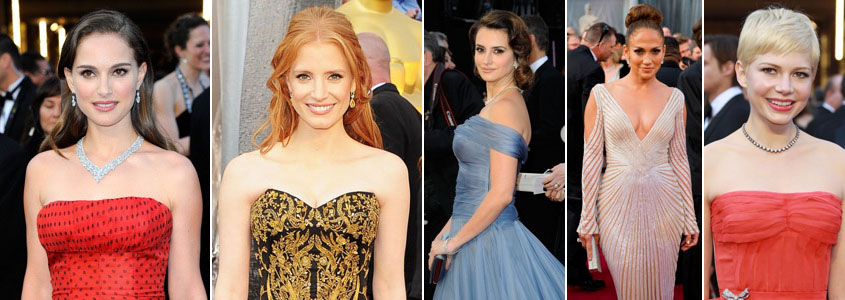
 Alright, we’re two days from the big night and it’s time to lay the cards on the table. As usual, the outcome of some categories seems set in stone, while others still have some suspense going for them. Other Oscar pundits are saying that all but two or three categories are completely sewn up, yet it’s never as cut and dry as they’d like to claim it is. There are always more races that could fall in different ways than anybody ever seems willing to admit. Which are which this year? Let us see…
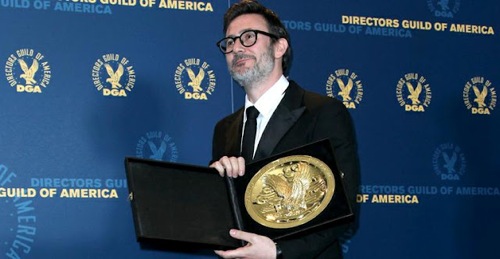
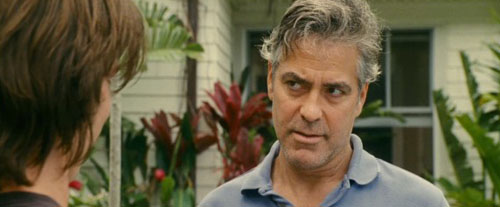
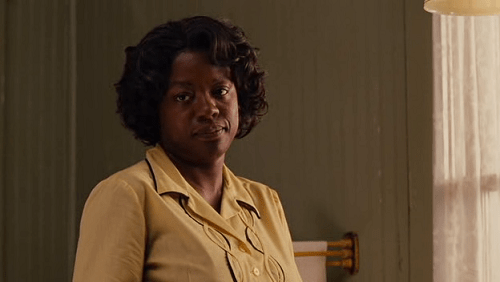
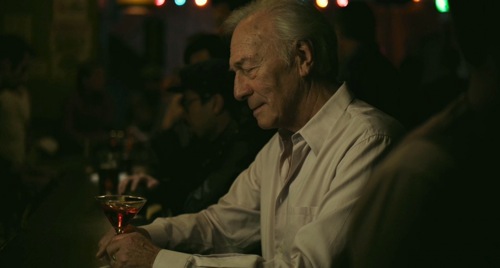


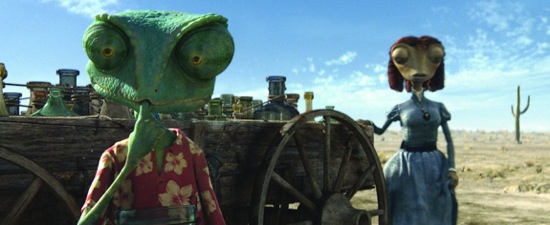

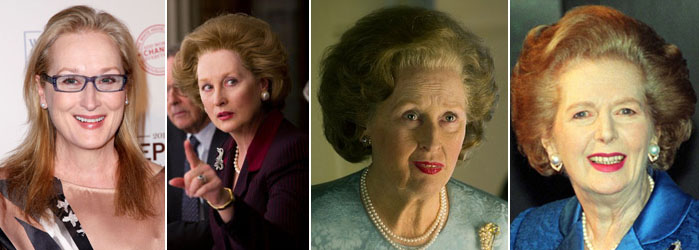
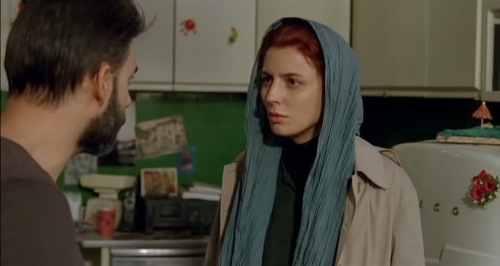

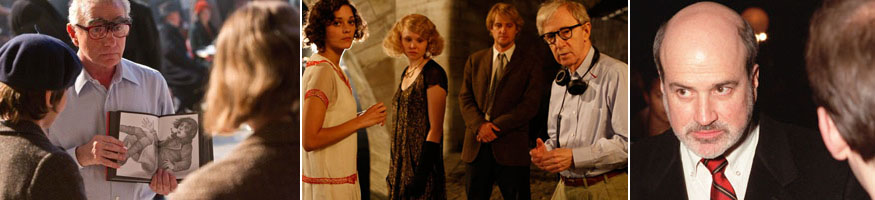


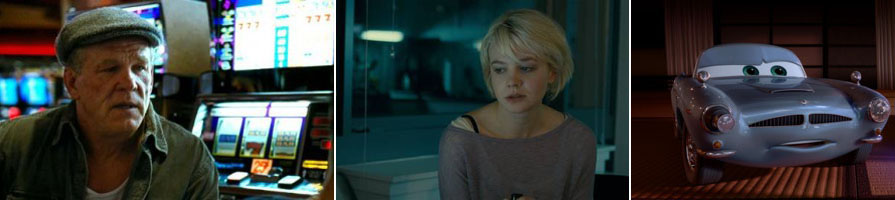


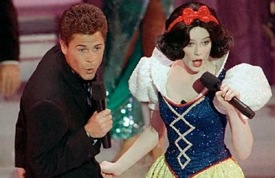 My commentary on this subject comes late as usual, allowing me the necessary time to re-watch, reflect and comment on every little thing that crossed my mind, but the gist of it won’t be much different than what has already been said in all corners of the Oscar-watching world (though I’ll try saying it more nicely than others may have):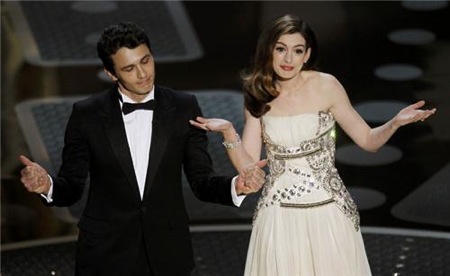
 -The first big prize of the night was Best Supporting Actress, and in the curious absence of last year’s Best Supporting Actor Christoph Waltz, the Academy brought out screen legend Kirk Douglas to present the award. It wasn’t pretty. At 94 years old, Douglas still seems pretty sharp, but he kept making jokes that made no sense (Hugh Jackman is laughing at him? Colin Firth isn’t laughing at him?) There was a total non sequiter that found him pretending to fight over his cane with the random young guy who was standing with him onstage. Then, after opening the envelope, he kept delaying the announcement of the winner. Did he think he was being funny? I mean, it was funny…but in a painful, awkward way that makes you want to cover your eyes. Why even have him there to present this particular award? It’s not like there was a theme of Hollywood icons presenting in other categories. That would somewhat go against the stated desire to draw a younger audience to the show, wouldn’t it? Most of today’s teens probably don’t even know who Michael Douglas is, let alone Kirk. His presence wasn’t a logical fit with the show at all. The Oscars are one of the few awards shows all season long where the presenter actually reads the nominee names themselves, rather than the task being handled by some anonymous voice, yet they didn’t have Douglas read the nominees. Why not? He barely shut up while he was there, so why couldn’t he read the names himself? Were the producers worried that people wouldn’t be able to understand him? Hearing-impaired actress Marlee Matlin did it when she presented Best Actor in 1987 (to Michael Douglas, in fact). It just stood out against the rest of the presentations, and highlighted the oddity of him being there. When he finally did announce the winner, it was Melissa Leo, and thrilled for her though I was, her “is this really happening” schtick was a little overdone, and wasn’t helped by Douglas continuing to insert himself in the moment as she accepted her award. The whole thing was just uncomfortable.
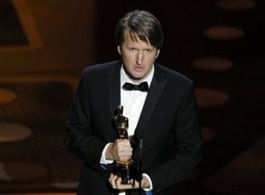 -If you’ve read my previous Oscar commentaries this season, you probably know that Tom Hooper’s Best Director win is a disappointment to me. It seems that every year, at least one Oscar needs to be given out that can go into the books as one of the all-time bad choices, and Hooper’s win is the one this year. My annoyance was heightened by the look on his face when Kathryn Bigelow said his name.
 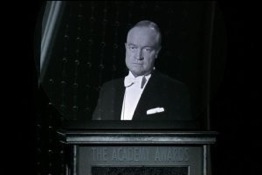 There were a few jumps back in time, but not using specific movies. Presenting the two screenwriting awards, Josh Brolin and Javier Bardem appeared as white-tuxedoed waiters in a replica of Hollywood’s Roosevelt Hotel, where the earliest Academy Award ceremonies were held. Later, a special podium was wheeled out and 18-time Oscar host Bob Hope was projected there to give the audience a glimpse of what it might have been like in the room when Hope hosted. Both segments were nice pieces of nostalgia, but the Roosevelt Hotel bit didn’t quite gel with the rest of the show, and the Bob Hope gimmick was kind of unsettling since it alternated between actual jokes as they’d been spoken by Hope and someone impersonating Hope to comment on the ceremony at hand and introduce the next presenters. It was done affectionately, and so wasn’t as offensive as Fred Astaire dancing with a vacuum cleaner or John Wayne hawking Coors Beer, but it still felt odd.
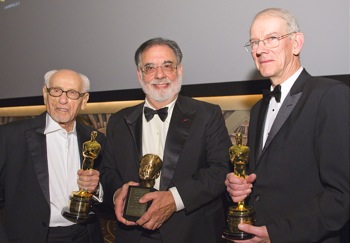

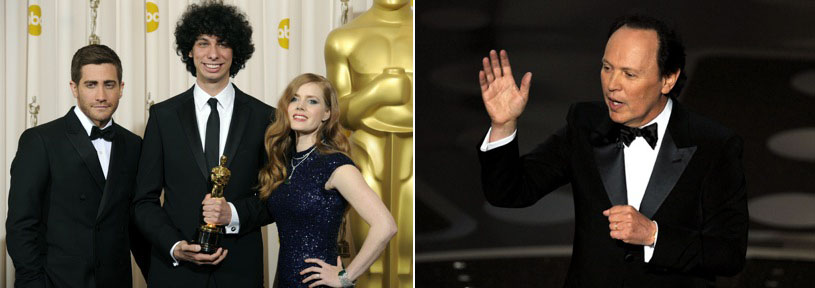


 I Am DB