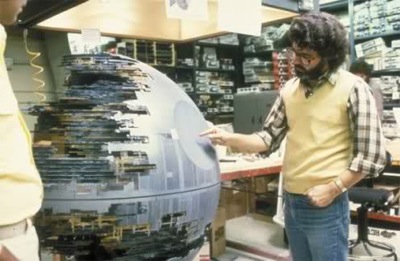
 Industrial Light & Magic, the pioneering visual effects company formed by George Lucas in 1975 to realize his vision for Star Wars, was located in southern California (Van Nuys) while making that movie. When Lucas reassembled the team for The Empire Strikes Back, he moved the company up the coast, relocating to a campus of non-descript buildings in San Rafael, about a half hour north of San Francisco. The site was on Kerner Boulevard, and all the outdoor signage indicated the buildings as Kerner Optical, Kerner Optical Company or Kerner Company. ILM occupied that location until 2005, when Lucas moved it into a newly constructed facility in San Francisco’s historic Presidio. But certain departments within ILM did not make the move into the city. The model shop had to remain behind, as did the production stages where the physical effects work was shot. The model shop and stage crews usually worked hand-in-hand. The model shop built it, and the stage crew would drown it, blow it up or set it on fire. And then there were the camera engineers and technicians who in many cases designed and constructed the equipment that would allow it all to be captured properly on film.
I’ve heard different reasons as to why these departments remained in San Rafael. It may have been that zoning regulations in the Presidio made it impossible to build a model shop and stages that would meet their respective spatial requirements. Or it may have been that ILM’s management wanted to focus solely on digital effects. Whatever the case, physical production would remain on Kerner.
 Before ILM’s move took place, I got to spend four and half years as an employee there. And prior to my hiring in June 2000, I had another experience on Kerner. In 1989, when I was 12 years old, my family came out from the east coast to visit relatives in the Bay Area. Like so many kids of that age and era, I was a huge George Lucas/Steven Spielberg fan. My aunt had a former colleague who worked at Lucasfilm, so she reached out to her and the woman arranged for us to have a private tour at ILM and lunch at Skywalker Ranch.
I remember walking around ILM in awe, carrying my Industrial Light & Magic: The Art of Special Effects coffee table book by my side. The model shop was easily one of the coolest things I’d ever seen. There was Mr. Igo’s pod from Innerspace, and Slimer’s head from Ghostbusters II. The big painting of Vigo the Carpathian from the latter movie hung on one of the walls. There were ships from Star Wars, and I’m pretty sure I remember a clay Eddie Valiant from Who Framed Roger Rabbit, squashed flat from the scene in Droopy’s Toontown elevator. It was just sitting on a small piece of wood on a table.
No one was around as we made our way through, but then a tall man walked by us and I recognized him immediately from his bio picture in my book. “That’s Steve Gawley!” I said. Gawley, I’d learned from the book, was one of the model shop’s foreman and had been with ILM from its inception. We turned around and chased him down the hall, catching up so I could get his autograph. Was I a massive geek? Yes. But this was the guy who built the model DeLorean for Back to the Future!
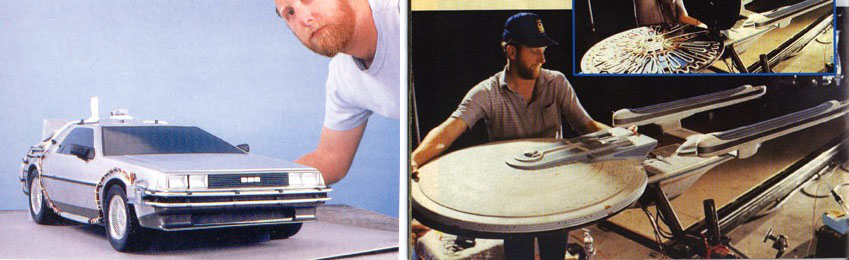
Now back to the future for real. At some point after the decision was made to leave the model shop and stage behind when ILM moved into San Francisco, the model shop’s supervisor gathered money from investors and put together a plan to spin the physical production departments off into a separate company. The plan went through, and Kerner Optical was born. The new entity would continue to produce models and physical effects for ILM, but would be available for hire to others as well. And while it seemed a loss to ILM in sentimental terms, the fact that the incredibly talented crew would be able to continue practicing their art and craft was welcome news to all.
Unfortunately, the visual effects business has long faced daunting financial challenges that have resulted in the closing of numerous smaller FX houses, and last week it was announced that Kerner Optical has become the latest casualty. Even sadder is that the end of the company seems to be the result of poor management and behind-the-scenes battles, not lack of interest in their services.
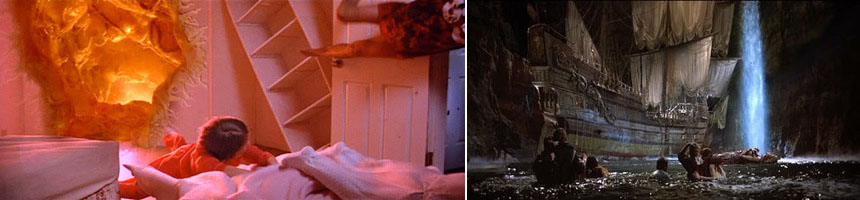
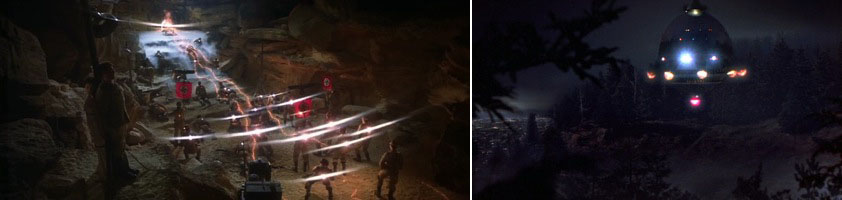
When I was employed at ILM, I never ventured into the model shop. My job had nothing to do with the work being done there, and I felt like I would be intruding. But there were occasional opportunities to see their efforts nonetheless. The stage crew often did outdoor shoots that would attract hordes of employees out to a concrete area known as The Slab. We might watch the filming of a burning windmill for Van Helsing, or the flooding of a pirate ship for Pirates of the Caribbean: The Curse of the Black Pearl. I remember an array of models for the underwater theme park in A.I. Artificial Intelligence lined up for at least a few weeks in the courtyard between two of our buildings. I would walk through them and feel appreciative that models were even being used anymore. And there was Steve Gawley, touching them up.
That may have been as close to the model shop as I ever got during my employment there, but I still recall my 1989 tour and how excited I’d been to meet one of ILM’s original staffers. The book with Gawley’s autograph (among others) remains on my shelf. It made me sad to think of ILM moving into San Francisco without the model shop and the stages, and I’m sad to hear that the shop doors are closed now. These people created so many years worth of amazing work. I regret that I never got to know any of the crew over there, but I wish them all the best and thank them for their part in a childhood full of movie memories.

 I Am DB