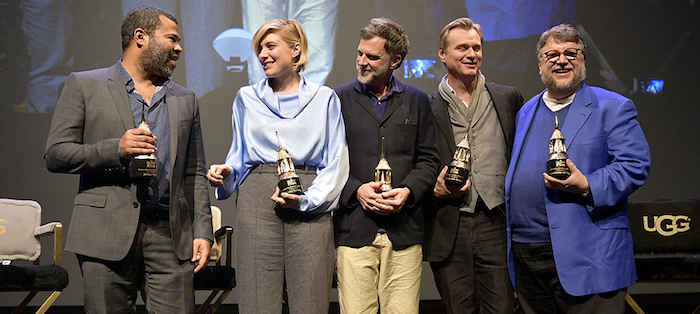
 (Class of 2017 photo from Annual Nominee Luncheon. Click image for larger version to play Spot the Celebrity.)
For an Oscars geek, the morning of the nominations might be even more exciting than the night of the show. By the time Oscar night comes around, dozens of precursor awards have been handed out, each category has been narrowed down and while there are always surprises, there are only a few ways things could go. But nomination morning offers up so many more possibilities, as the field is still wide open and anything can happen. Well…maybe not anything. The Book of Henry wasn’t about to show up on the Best Picture list, nor was Dwayne Johnson’s performance in Baywatch going to score him that long elusive Best Actor recognition. But within the realm of reason fortified by 90 years of Academy Awards history, anything can happen on the morning of the nominations.
Beginning as always in the dreaded 5 a.m. hour, this year’s nominations once again tried something a little different. After last year’s abandonment of the traditional live announcement in favor of a video intercutting comments and memories from past Oscar winners with a bland reading of all the nominees by an anonymous fembot, this year’s presentation combined the two approaches. Before a crowd of gathered press, Academy President John Bailey made some brief introductory remarks, then turned the program over to Andy Serkis and Tiffany Hadish, who announced the nominees. The video component came in the form of some stylish introductions for the below-the-line categories, each starring a female actress/Academy member. Priyanka Chopra, Rosario Dawson, Gal Gadot, Salma Hayek, Michelle Rodriguez, Zoe Saldana, Molly Shannon, Rebel Wilson and Michelle Yeoh appeared in the intros, which added some fun to what can be a dry event while also shining a small but notable spotlight on a diverse group of women. The structure was still a bit awkward, as Serkis and Haddish would read each category’s nominees and then introduce another video. It might have felt less disjointed if each participating actress could also have read their category’s nominees, but of course the videos would have been produced long before the nominees were known, and the logistics of having each actress present to read the nominees live would be complicated. Academy headquarters essentially go on lockdown the night before the announcement, and the presenters spend the night there. That operation is easier to accommodate with two people than with a dozen. Still, this was definitely an improvement over last year, and Haddish added some inadvertent entertainment value as she struggled reading many of the nominee names but maintained her sense of humor throughout.
If for some inexplicable reason you don’t want to watch the entire 30 minute announcement, you can at least check out the intro videos here. I wish I could have learned more about how these came to be, who directed them, etc., but I couldn’t find any details. Missed story opportunity, EW.com.
I had a pretty good morning as far as predictions go. I was only 100% in four categories (Actress, Supporting Actor, Production Design and Sound Mixing), but in 12 others I missed by just one. I don’t have too many thoughts to share on how things shook out, but here are a few.
BEST PICTURE
My typical go-to decision to predict nine nominees worked out this year, and I only faltered by including The Florida Project, which was the one I was least sure about as I finalized my picks. I took it off the list, put it back on the list, took it off the list…and finally put it back on, thinking the voting contingent that had supported child-centric movies like Room and Beasts of the Southern Wild in recent years might propel this indie gem onto the final list. I’m sure it had support, but not enough to land it a spot. The nominee I failed to predict – which came as a surprise to just about everyone; I didn’t see any lists that had it – was Phantom Thread. The re-teaming of Paul Thomas Anderson and Daniel Day-Lewis did extremely well, with a few other unexpected nominations on its way to a tally of six. There’s no question that PTA is widely admired in the Academy, but you never know from film to film how much they’re going to show it.
By the way, reviewing past editions of this annual post, I realize it’s been a few years since I railed against the constant use of the word “snub.” Every media outlet covering the nominations loves to point out all the movies that were snubbed and the actors that were snubbed. I feel I’d be remiss not to get back atop my soapbox and briefly decry this yearly exercise in stupidity. EW.com‘s list of snubs and surprises pointed out six Best Picture snubs. That amounts to two-thirds of the entire list of nominees. And if any of the nominated films had been passed over, those would have been called out as snubs. Of the movies that did get nominated, only one was really a surprise, with maybe two more thought to be on the bubble. None of these so-called snubbed movies pointed out were any better positioned or more widely expected to be nominated than most of the movies that actually were. These aren’t snubs, idiots. They’re just movies that missed out. Please stop being lazy and talking about these movies that came up short as if there was anything more to their omission than falling victim to an overcrowded field and the whims of several thousand voters.
BEST DIRECTOR
Thank God. Jordan Peele and Greta Gerwig both made the cut, for Get Out and Lady Bird respectively, sparing us the litany of opinion pieces we’d have been subjected to if either or both had failed to be recognized. Don’t misunderstand me; the historical scarcity of women and people of color in this category (and many others) is not unworthy of attention. Peele is only the fifth black director ever nominated (John Singleton, Lee Daniels, Steve McQueen and Barry Jenkins precede him) and Gerwig only the fifth woman (after Lina Wertmüller, Jane Campion, Sofia Coppola and the sole winner, Kathryn Bigelow). Those stats are sufficiently shocking. But as they relate to the recent #OscarsSoWhite outcry, or #OscarsSoMale – which isn’t a thing, but could be (the acting categories notwithstanding) – they are far more the result of a chronic lack of opportunity for filmmakers in those demographics to tell their stories to mainstream audiences than they are of an ingrained bias on the part of Academy voters. So above any other reason, the presence of Peele and Gerwig pleases me because it means we don’t have to hear about an imaginary aversion within the Academy to directors who aren’t white males.
Now…about the white males. While it wasn’t a big surprise by this point in the season, the nomination for Christopher Nolan was cause for his fans to celebrate after he had been left out of this category two or three times too many over the years. Hopefully this is only the first of many more to come. The category’s big surprises were the absence of Three Billboards Outside Ebbing, Missouri‘s Martin McDonagh and the inclusion of Phantom Thread‘s Paul Thomas Anderson. I thought this might be one of those rare years where the Directors Guild of America (DGA) and Academy were in complete agreement, but McDonagh was the point of diversion. Given Three Billboards‘ momentum in the Best Picture race – top honors at the Golden Globes and Screen Actors Guild Awards make it a strong contender – he seemed a likely nominee, but not a lock. I suspect he came close, but in the end he was kept at bay by an unexpected swell of support for Anderson. No complaints from me about the turn of events that delivered PTA into the final five. He’s one of my favorites, and Phantom Thread finds him in peak form.
X
BEST ACTOR
One of my instincts paid off here, and one didn’t. The one that did: James Franco missing out. Of course, nearly every outlet commenting on his “snub” (grrrr) wrote about it as if the accusations against him during the Oscar voting period – first via a series of tweets and then elaborated upon in a Los Angeles Times story – were the reason he wasn’t nominated, definitively. I’m less certain. Although Franco got a lot of recognition throughout the season, including Screen Actors Guild (SAG) and Broadcast Film Critics Association (BFCA) nominations and a Golden Globe win, I had my doubts all along that an Oscar nomination would follow. Yes, it’s important to weigh all the precursor awards to gauge who and what has momentum, but you also need to do some thinking for yourself about what does or doesn’t feel like it will resonate with Academy members. You won’t always be right, but these things are impossible to ever fully know, so sometimes you need to apply reason and instinct. Anyone doing so should have questioned Franco’s chances. That performance was never a sure thing…as much as anything can be a sure thing. Franco is funny in The Disaster Artist, no doubt, but at the end of the day the performance is an impersonation of someone whose natural state feels like a vibrant exaggeration to begin with. Franco may do an uncanny Tommy Wiseau, but was he going to get an Oscar nomination for that? Possibly. Yet there was always reason to doubt, even before he got swept up in the #MeToo movement. I’m sure the accusations cost him some votes, but I’m not convinced they made the difference. We’ll never know, but my gut tells me Franco would have been omitted regardless.
The instinct that failed to pay off was Get Out‘s Daniel Kaluuya. I didn’t, and still don’t, understand the elevation of his performance to any list of the year’s very best. He does good work and serves the movie perfectly well; I’ve got nothing negative to say about him. I’m just confounded by the level of acclaim he’s garnered. Yes, he was armed with a Golden Globe nomination and additional nods from SAG, BFCA and the British Academy of Film and Television Arts (BAFTA), and yes, that precursor quartet usually leads to an Oscar nomination…but not always. I let the occasional exceptions to that rule, along with my own opinion – which would surely be shared by the majority of voters – convince me that Kaluuya might not make it. It was possible. But it wasn’t likely, and I probably should have known better. If I thought he deserved the nomination, would I have predicted him? I probably would have.
Thinking that Franco and Kaluuya would miss, I predicted Tom Hanks and Denzel Washington. There was room for Washington, but Hanks was once again left out. Although I wasn’t able to make room for Denzel on my personal list, he was definitely right on the edge. I hope the nomination brings some attention to Roman J. Israel, Esq. The movie is decent, but Denzel is the reason to see it. He’s never played a character like this before, and it was fun to see him do something so different.
BEST SUPPORTING ACTRESS
I was off by two in this category. I didn’t think Mary J. Blige would make it despite having reasonable momentum. The part seemed too small and too lacking in the kind of showcase moments that would catch the attention of enough voters to gather her the necessary support. But here she is, and her nomination marks the first major-category recognition for a Netflix release. Mudbound picked up three additional nominations, including recognition in another top-category: Best Adapted Screenplay, where director and co-writer Dee Rees became the first black woman ever nominated. Netflix would have liked Mudbound to crack the Best Picture race, but the nominations it did get – some of which made Oscar history – help disprove the idea of a bias against the company and its releases.
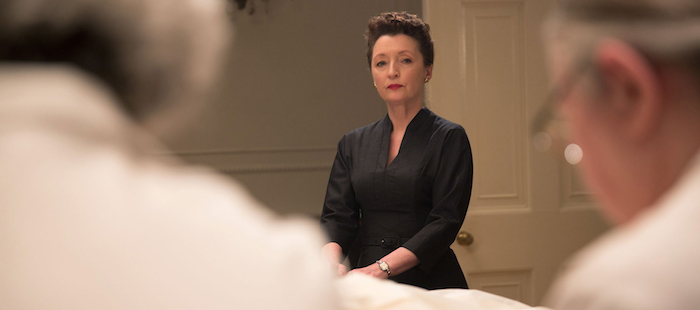
My other miss was Lesley Manville. Many hoped but few expected that the Phantom Thread co-star would find a spot, but voters’ undetected appreciation for the movie carried her along, much to my delight. Manville is excellent as Daniel Day-Lewis’ steely sister and business partner. She doesn’t necessarily say much verbally, but speaks volumes with her posture and facial expressions. And when she does talk, she can cut right to the bone. Well done, Academy!
Alas, pleasant surprises usually come at another contender’s expense, and in this case Holly Hunter and Hong Chau were the two most notable omissions. Hunter was widely expected to be included, and although I enjoyed her greatly in The Big Sick, I don’t know that the role merited a nomination. I’m more disappointed by the absence of Chau. I understand Downsizing didn’t catch on, but Chau was something special, and her multilayered performance was deserving. Hopefully the attention she did garner for the movie will at least lead to more prominent roles in high profile projects.
X
BEST ORIGINAL SCREENPLAY AND BEST ADAPTED SCREENPLAY
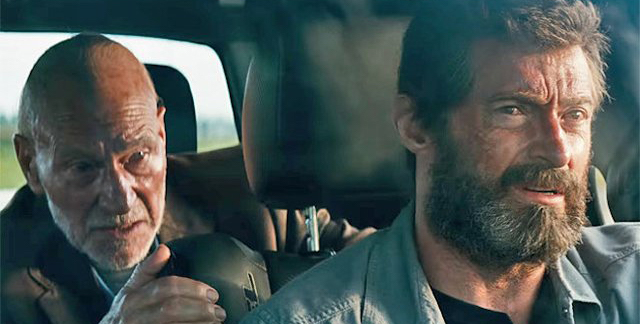
I missed by one in each screenwriting category, but in both cases I was happy to be wrong. I mean…I would rather have been right…but I’m glad about the picks the Academy made that I didn’t. For Original Screenplay, that was The Big Sick. It had unwavering momentum going in, and most pundits expected it to be there, but I thought it might be taken down (with an attack to the kneecaps, maybe?) by I, Tonya. In the Adapted Screenplay race, the Writers Guild of America’s (WGA) choices were mirrored, which meant a nomination for Logan. Maybe still stinging 10 years later from the omission of The Dark Knight, I didn’t think the Academy would go for a comic book adaptation, even one as grounded and somber as Wolverine’s swan song. But how great to see it here, the first writing nomination for a movie based on a “superhero” comic. Expecting it to be passed over, I instead predicted The Beguiled. I didn’t really think that would be included, but it seemed more probable than Logan.
One other comment about Best Original Screenplay. Given the robust support for Phantom Thread, it’s surprising that it did not land writing recognition. Paul Thomas Anderson is a four-time screenwriting nominee (Boogie Nights, Magnolia, There Will Be Blood, Inherent Vice), and this could have been an obvious place to honor a typically unique Anderson vision. But voters stuck to the script – no pun intended – and nominated the five favored choices. I can’t argue with that, even if it would have been nice to see Phantom Thread. This category has felt mostly locked for some time now, with Get Out, Lady Bird, The Shape of Water and Three Billboards Outside Ebbing, Missouri all but assured and all supremely deserving. As discussed above, I thought there was some wiggle room with The Big Sick, but that I, Tonya would have been the beneficiary. This was always going to be a tough race to penetrate, and Phantom Thread probably came up just a bit short.
X
BEST MAKEUP AND HAIRSTYLING
Seriously? Victoria & Abdul? Over Guardians of the Galaxy, Vol. 2? If I were one of the Academy’s top officials, I would be deeply concerned about whatever ailment befell the members of the Makeup and Hairstyling branch causing them to all go blind over the past year. For clearly that’s what must have happened. There can be no other logical explanation for Victoria & Abdul beating out Guardians of the Galaxy, Vol. 2. If there’s one place this year where I might consider calling out a snub, this would be it. I don’t know what bias the branch members might have against the crew from Guardians, but maybe there’s some bad blood somewhere in there, because this is such a comically incomprehensible outcome that there must be an agenda at work.
Okay okay…I didn’t see Victoria & Abdul. But I’ve seen the trailer and I’ve seen pictures and I’m confidant I’ve seen enough to know that there’s no way anyone can make a legitimate case for Victoria & Abdul over Guardians of the Galaxy, Vol. 2 in a category recognizing achievements in makeup. Are you kidding me with this?
BEST VISUAL EFFECTS
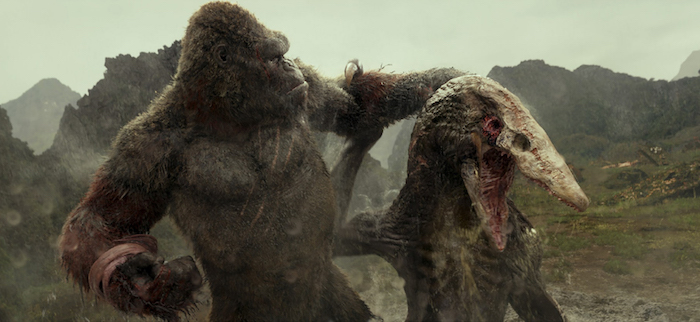
The big shock here was the absence of Dunkirk. Although CGI tends to dominate the landscape, practical effects often find a place among the nominees, and Dunkirk was heavily favored, given the overall admiration for Christopher Nolan’s film and its impressive staging, particularly the aerial sequences. Less of a shock but still a surprise was the omission of The Shape of Water, another widely appealing contender and Best Picture prospect with VFX work that’s beautiful if not necessarily groundbreaking. Instead, the visual effects branch members eschewed their tendency to recognize at least one “prestige” film, and kept the focus on the effects themselves. Dunkirk and The Shape of Water would have been deserving, but so are the two films seen as taking their spots: Guardians of the Galaxy, Vol. 2 and Kong: Skull Island. The former showcased a wide variety of superb work, from CG characters and creatures to environments to the impressive de-aging of Kurt Russell for his flashback scene. Kong, meanwhile, boasted outstanding creature effects, not just in the form of the towering simian, but in the titular locale’s many other denizens, most of them as creepy as they are gigantic. The 10 semi-finalists were all impressive this year, so some tough choices had to be made.
See, that wasn’t so bad. Just a little light reading between the behemoth prediction posts. Until the next one of those comes along, here are my wishful thinking Oscar categories and nominees, not necessarily concerned with five per category. Because I’m a rebel and I like to break the rules.
BEST POSTER


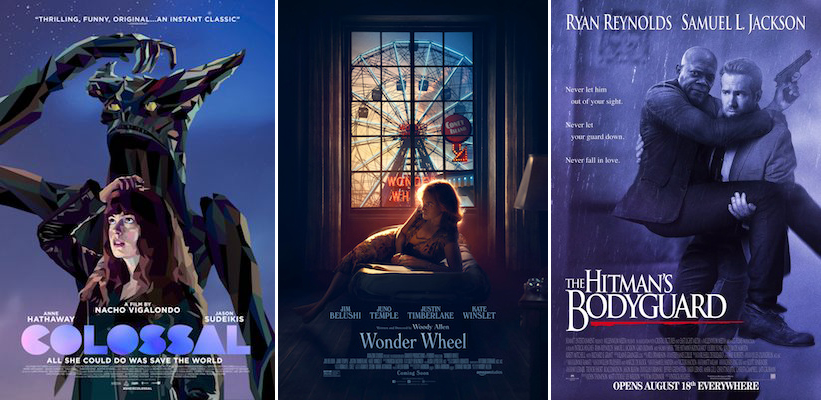
[Larger Versions: mother! (Lawrence); mother! (Bardem); The Shape of Water; Three Billboards Outside Ebbing, Missouri; All the Money in the World; Murder on the Orient Express; Guardians of the Galaxy, Vol. 2 (IMAX); Guardians of the Galaxy, Vol. 2 (Teaser); Wilson; Kong: Skull Island (IMAX); Kong: Skull Island; Baby Driver; Colossal; Wonder Wheel; The Hitman’s Bodyguard]
BEST TRAILER
Dunkirk (Final); It (Teaser); The Lego Batman Movie (Batcave Teaser); Logan (Teaser); mother!; Thor: Ragnarok (Teaser); Three Billboards Outside Ebbing, Missouri (Red Band);
BEST CASTING
Baby Driver – Francine Maisler
Battle of the Sexes – Kim Davis, Justine Baddeley
The Big Sick – Gayle Keller
The Florida Project – Carmen Cuba
Guardians of the Galaxy, Vol. 2 – Sarah Halley Finn
It – Rich Delia
Lady Bird – Allison Jones, Ben Harris
Phantom Thread – Cassandra Kulukundis
The Post – Ellen Lewis
Spider-Man: Homecoming – Sarah Halley Finn
Three Billboards Outside Ebbing, Missouri – Sarah Halley Finn
Thor: Ragnarok – Sarah Halley Finn
BEST ENSEMBLE
Baby Driver; It; Lady Bird; Logan; Mudbound; The Shape of Water; Three Billboards Outside Ebbing, Missouri
BEST BREAKTHROUGH PERFORMANCE
Tiffany Hadish – Girls Trip
Sylvia Hoeks – Blade Runner 2049
Daniel Kaluuya – Get Out
Dafne Keen – Logan
Vicky Krieps – Phantom Thread
Brooklynn Prince – The Florida Project
Algee Smith – Detroit
Bria Vinaite – The Florida Project
Fionn Whitehead – Dunkirk
BEST BODY OF WORK
Colin Farrell (The Beguiled/The Killing of a Sacred Deer/Roman J. Israel, Esq.)
Woody Harrelson (The Glass Castle/LBJ/Three Billboards Outside Ebbing, Missouri/War for the Planet of the Apes/Wilson)
Caleb Landry Jones (American Made/The Florida Project/Get Out/Three Billboards Outside Ebbing, Missouri)
Michael Stuhlbarg (Call Me By Your Name/The Post/The Shape of Water)
BEST SONG SOUNDTRACK
Baby Driver; The Disaster Artist; The Greatest Showman; Guardians of the Galaxy, Vol. 2; I, Tonya
BEST OPENING CREDITS
Baby Driver; Call Me By Your Name
BEST CLOSING CREDITS
Beauty and the Beast; Call Me By Your Name; The Greatest Showman; Guardians of the Galaxy, Vol. 2
Lastly, here’s a brief montage of all of this year’s Oscar nominated films. May it inspire you to check a few out between now and Oscar night, March 4.

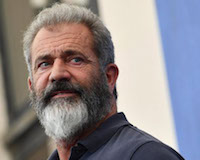 Then again, Gibson was never quite the pariah during these past years that everyone seems to think he was. He’s always had A-list friends in his corner — like Jodie Foster and Robert Downey, Jr. — who stood by him and expressed their firm belief that the person who did and said those things is not the person Gibson is at heart. Beyond that, he continued to find employment. Foster directed him in the The Beaver; he starred in the Warner Bros. revenge thriller Edge of Darkness, which was a modest hit in 2010; and he took on the antagonist roles in the popcorn action flicks Machete Kills and The Expendables 3. They aren’t exactly
 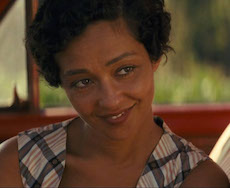 The question of who took Adams’ perceived spot has a different answer depending on how you saw the nominations going. Some might say it was Elle‘s Isabelle Huppert. By this point in the season, however, I felt Huppert was a good bet. So to me, the surprise is Ruth Negga. She didn’t came out-of-nowhere, having remained consistently in the mix since Loving‘s early November release (in fact the buzz for her and the movie really started last May at the Cannes Film Festival). But given the number of compelling performances that could have been nominated this year, Negga had become a longer shot, and she represents the only nomination received by Loving. I was thrilled to see her recognized, as she was one of my personal picks, but it was a fiercely competitive field, and any number of actresses deserved a spot only to miss out. Chief among them in my eyes are Rebecca Hall and Annette Bening. It was never expected to happen for Hall, unfortunately, but Bening was firmly in the running, so her omission is tough to take. She’s wonderful in 20th Century Women — dry, relaxed, introspective…I’ve never seen her play anyone quite like the character she plays here, and I’m sad she wasn’t honored for it.





 The most surprising omission from this year’s nominees came in this category, with The Martian director Ridley Scott being left out. He was supposed to be one of the day’s absolute sure things, with many at that point already dubbing him the sentimental favorite to win. Whether his omission was a matter of too many voters deliberately choosing elsewhere, or a matter of them thinking he was a lock and therefore giving their vote to someone else — something I suspect happened to Ben Affleck and Kathryn Bigelow in 2012 — we’ll never know. I didn’t think Scott deserved a nomination for The Martian, so I’m okay with his absence. I loved the movie and he did a great job with it, but it didn’t strike me as such a strong directorial achievement as to be singled out among the year’s five best.
 After Ridley Scott, the second most shocking omission this year came in this category, with Aaron Sorkin’s Steve Jobs script failing to make the cut. This one astounds me. It should be the winner here, as far as I’m concerned. I haven’t read the source material for any of these contenders, but who are we kidding: neither have the voters. No one is ever really evaluating this category by how successfully the source material is translated to the screen. They’re going off the movie itself. Even without reading the source material, I doubt that any of the nominees — all of whom did excellent work — crafted anything as creative, unique, or just plain smart as what Sorkin did with Steve Jobs. Very disappointing.
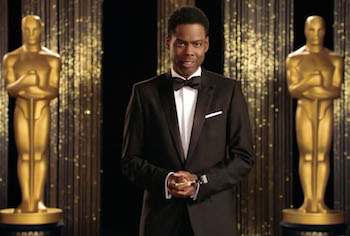 That’s really all I have to say about the nominees at this stage. The big show is two weeks away, so we’ll see each other before then. Chris Rock is hosting, and in this year of racial controversy, who better to comment on the drama? I have a great idea for the opening of the show. The announcer says, “Ladies and gentlemen, please welcome your host for the evening, Chris Rock!” And out walks Louis C.K., nodding and doing his understated, I’m-kind-of-uncomfortable-right-now Louis C.K. thing. “I…I know you were expecting Chris. You were probably expecting Idris Elba or Will Smith too, but you know…anyway the Academy quietly decided that in keeping with the theme this year…” and then he’d just kinda point to his face with a telling look. And it would go on for a minute until they figured a way to get Rock out there. I imagine maybe Louis calling Chris and tracking him down to Jerry Seinfeld’s house. They put Jerry on screen, Chris is over his place just hanging out in a tux, Louis and Jerry convince Chris that the show needs him, he agrees to come, and then Jerry drives him over, the ride becoming a riff on Seinfeld’s web series, this time called Comedians in Cars Getting Oscars. I dunno — it’s a work in progress. I’ve got two weeks to figure out the second part, but the opener is gold.
 After all of my skepticism and fretting, the Academy finally embraced Wes Anderson, with The Grand Budapest Hotel scoring nine nominations, tying with Birdman for the most of the year. But the big story out of the nominations was the disappointingly weak showing for Selma, which did score one of the year’s coveted Best Picture nominations, but only managed one other, for Best Original Song. It was absent from key races in which many, including myself, thought — or at least hoped — it would be recognized. Ava DuVernay missed out on a Best Director nomination, David Oyelowo didn’t make the Best Actor list, and the screenplay was overlooked as well. Cinematography and Editing might also have been possibilities had the film been embraced. Selma‘s underwhelming presence, combined with the blinding whiteness of the 20 acting nominees, led some impetuous voices (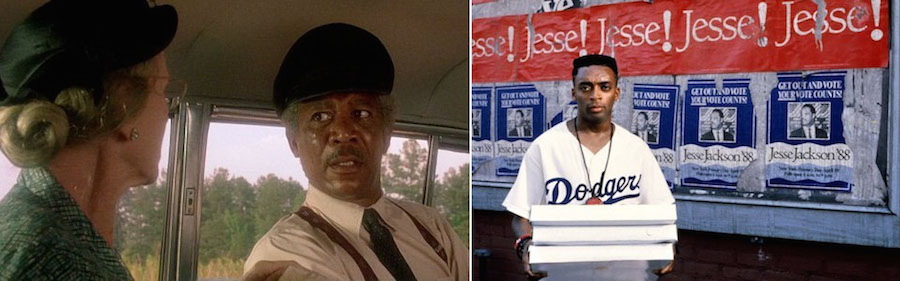
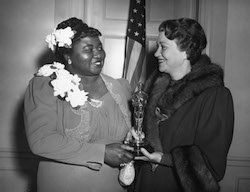 At the end of the day though, I just don’t buy the racism thing. In the industry, yes, but not in the Academy. This is an organization that awarded Gone With the Wind‘s Hattie McDaniel an Oscar in 1939 (and don’t start in with the fact that she was playing a servant). If the number of black performers who have won since then is low compared to white performers, well again, the Academy can only reflect the industry. Have there been performances by black actors and actresses that should have been nominated and weren’t? Absolutely. Just like there have been performances by non-black actors that should have been nominated and weren’t. Bottom line, only five people get nominated per category, and outstanding work finds itself sidelined every year. But if the Academy were comprised of a bunch of racists, they wouldn’t nominate actors of color at all. Racism isn’t selective. It doesn’t come and go from year to year. If an institution and its members are racist, they’re consistently racist, at least until enough new people who embrace acceptance arrive in large enough numbers to change the institution’s actions. Selma and most of its filmmakers were not nominated this year, and no performers of color were nominated this year, and that’s unfortunate. But it’s not because one year after the success of 12 Years a Slave, Academy members’ latent racism suddenly flared up. In the last 10 years, Jamie Foxx, Morgan Freeman, Forest Whitaker, Jennifer Hudson, Mo’Nique, Octavia Spencer and Lupita Nyong’o have all won Oscars. In the same period, nominations have gone to Don Cheadle, Jamie Foxx (in addition to his win), Sophie Okenedo, Terrence Howard, Will Smith, Djimon Hounsou, Eddie Murphy, Ruby Dee, Taraji P. Henson, Viola Davis (twice), Morgan Freeman (in addition to his win), Gabourey Sidibe, Denzel Washington, Quvenzhané Wallis, Chiwetel Ejiofor and Barkhad Abdi. Other non-whites who have won in the same period? Well, only Javier Bardem and Penélope Cruz. But nominations went to Catalina Sandino Moreno, Penélope Cruz (twice in addition to her win), Adriana Barraza, Rinko Kikuchi, Javier Bardem (in addition to his win) and Demián Bichir. All totaled, yes, these numbers are far fewer than they are for white nominees. But if the industry makes fewer movies in which actors of various ethnicities have the opportunity to play great roles, the Academy is not to blame. Even if those movies and roles exist, they have to earn enough acclaim and attention to become part of the Academy conversation in the first place. And even then they have to be lucky enough to break into the list of five nominees. There are always politics at play when it comes to Oscar nominees and winners, but they’re seldom the politics of race. Ejiofor, Abdi and Nyong’o were all nominated last year, but Fruitvale Station‘s Michael B. Jordan and Octavia Spencer were not, nor were Forest Whitaker or Oprah Winfrey for Lee Daniels’ The Butler. Were those four actors the victims of a racist agenda? Or were they the victims of only five nominations available per category and a surplus of deserving contenders, just like Tom Hanks, Robert Redford, Oscar Isaac, Emma Thompson, Julie Delpy, Adèle Exarchopoulos and Daniel Brühl, among even more? If the Academy had a race problem, it wouldn’t have nominated or awarded all those people named above. If the Academy were not interested in non-white stories, its members wouldn’t have voted Best Picture nominations to Babel, Letters from Iwo Jima, Slumdog Millionaire, Precious, The Help, Beasts of the Southern Wild, Django Unchained, 12 Years a Slave and yes, Selma.
 Whew. I said I wouldn’t get get too deep into this, and look what happened. Okay, just a couple more observations about these two categories. Of the people who did get nominated for Best Director, four of them were widely expected. The fifth slot, which some thought would go to DuVernay and others thought might go to Director’s Guild of America (DGA) nominee Clint Eastwood, instead went to Foxcatcher‘s Bennett Miller. It wasn’t a total shock — he was considered a possibility — but few had him in their final five. Interestingly, Foxcatcher was not one of the eight Best Picture nominees, making Miller the first person to be nominated for Best Director without a Best Picture nomination since 2009’s expansion of Best Picture beyond five nominees. I do wonder — and I’m probably not alone — if Miller benefitted from a boost in support after Mark Schultz, played by Channing Tatum in Foxcatcher, went on a
  BEST ACTOR
 BEST ACTRESS
 Starting with some of the songs from Muppets Most Wanted, all of which were incorporated directly into the movie. I mention that because voters in the music branch are presented with clips of all the eligible songs exactly as they appear in their respective movies, the idea apparently being that songs should be judged as much for context as for musicality. If this is the goal, maybe the category needs to be clearly redefined — and renamed — as “Best Use of an Original Song.” And if that’s the thinking, then voters would have done well to include “Sing Along” from Rudderless, an intimate song performed in the movie’s final scene by Billy Crudup as a father grieving for his deceased son. Yet there lies one of the problems with this method of voting. A song like “Sing Along” really needs to be seen (or heard) in light of everything that’s come before it in order to be understood and appreciated, and with 79 eligible songs, there’s no way voters can watch each full movie to understand every song’s place within that movie. So really, the voters should just receive a CD with each eligible song and judge the song on its own merits. Maybe that ends up benefitting something like “Grateful” even more than the current system. I don’t know. What I do know is that a) the system as it exists contradicts itself at every turn, and b)
 One nice stat for this category is that with Her and American Hustle in the running, Megan Ellison becomes the first woman to be nominated for Best Picture twice in the same year. She also joins the illustrious company of Francis Ford Coppola, Fred Roos and Scott Rudin as only the fourth producer to hit that mark at all (Coppola and Roos in 1974 for The Conversation and The Godfather Part II, Rudin in 2010 for True Grit and The Social Network). Ellison and her production company Annapurna Pictures have only been on the scene for a few years, but she has established herself as an essential figure, funding the work and supporting the visions of some of the most prestigious filmmakers working today. In addition to Her and American Hustle, she produced Paul Thomas Anderson’s The Master, Kathryn Bigelow’s Zero Dark Thirty, and also had a hand in Spring Breakers, The Grandmaster and Killing Them Softly. If early buzz is any indication, she could be back here next year as a producer of Foxcatcher, the highly anticipated new film from Moneyball and Capote director Bennett Miller.
 Whatever happens, we hope the players handle it with grace, but that’s not always the case. The day that began with the nominations announcement concluded with the Broadcast Film Critics Association’s Critics Choice Awards, where Captain Phillips‘ nominated screenwriter
  The morning of the nominations coincided with the first day of the Sundance Film Festival, which always begins with a press conference attended by Redford. Naturally
 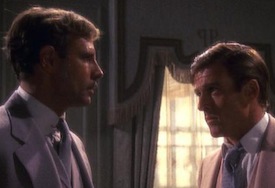 There are any number of reasons why Redford (and Hanks) may have been passed over, and as the nominations loomed, they were the most vulnerable of the perceived frontrunners. One person who campaigned with vigor was Bruce Dern, and it paid off for him. Perhaps the Academy only had room for one 77 year-old Hollywood veteran who starred in the 1974 version of The Great Gatsby and was seeking the second acting Oscar nomination of his career. The newest Great Gatsby, Leonardo DiCaprio, did make the cut for The Wolf of Wall Street. It’s still not the best work of his career, but it’s damn good, so congrats to you Leo. With Dern, Chiwetel Ejiofor and Matthew McConaughey getting the nominations they were expected to, the last slot went to Christian Bale, which makes me happy. Even though the category’s abundance of options forced me to exclude him from my list of personal picks, his performance is my favorite thing about American Hustle, and I’ve grown even more fond of it as the weeks have passed.
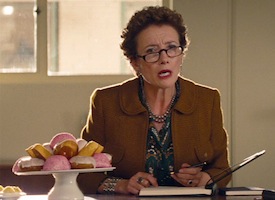 So that one Saving Mr. Banks nomination that felt pretty safe was for Emma Thompson, but it wasn’t to be. I thought Meryl Streep might be the one to get squeezed out if Amy Adams were to make it in, but instead it was Thompson who fell off the list of expected nominees. She took the news with her typical brand of practical humor,
 At least “The Moon Song,” from Her, got nominated. It’s first heard
  Even more surprising than the inclusion of Her was the exclusion of 12 Years a Slave, easily one the year’s best scores and one that was widely considered a sure thing. I’m not sure what happened there. The only thing I can think of is that voters found it repetitive. The score is driven by


 I Am DB