
[IN SCOTTY VOICE: “Captain, there be huge spoilers ahead!”]
Seriously, read no further until you have seen Star Trek Into Darkness. Which, if you missed in theaters at the beginning of the summer, was recently released on DVD and Blu-Ray. (Damn, that theatrical-to-home viewing window is getting smaller all the time.) A lot of people seem to be catching up with it now, so here are some thoughts I didn’t get around to posting a few months ago. You know you want it.
When director J.J. Abrams and writers Alex Kurtzman and Roberto Orci took the reins of Star Trek in 2009, they found a clever way to establish their own take on a well-known set of characters while still honoring the canon and acknowledging what had come before. For the most part, fans seemed to embrace their approach. Now with that groundwork laid, the rebooted Star Trek could begin the whole boldly going where no one has gone before thing. Yet, as those who’ve seen Star Trek Into Darkness know, assuming they are familiar with the original series of Trek films, Abrams, Kurtzman, Orci and Damon Lindelof (a producer on the first film but new to the writing team for the follow-up) instead took the film very much where the series has gone before, choosing to evoke Star Trek II: The Wrath of Kahn in substantial ways. You don’t have to be a Vulcan to question the logic.
I enjoyed Star Trek Into Darkness in and of itself. I found it exciting, well-paced, emotionally effective and fun. As with the previous film, the actors were all entertaining and the visual effects were superb. But if examined in the greater context of the entire Star Trek film series, I can’t help but be puzzled and a little disappointed that the creative team chose to so blatantly tread on ground already covered in Wrath of Khan…not just in using that film’s titular villain (originated so brilliantly by Ricardo Montalban and played here by Benedict Cumberbatch), but in mirroring its famous climax.

For as long as Star Trek Into Darkness was in the works, fans aggressively speculated that the villain would be Khan. (In April, Vulture put together a timeline of sorts detailing how long this has been going on; its mere existence amuses me.) All along, the filmmakers refused to play ball. When it finally came out that Cumberbatch’s character was a terrorist named John Harrison, a traitor within Starfleet, many of those fans still insisted this was just a ruse, and that Abrams and company had Khan up their sleeves. Now we know it’s true. My question is, why? Why did so many fans want to see a villain they had already seen in a film which so many of them consider the finest big screen installment of the series? And more importantly, why would the filmmakers concede to give it to them instead of offering an entirely new antagonist? And why the hell does Carol Marcus have a British accent? (That’s totally off-topic, actually, but a valid question posed by my hardcore Trekker friend, May.)
The choice of villain is not the only way that Into Darkness hearkens back to Wrath of Khan; the new movie also recycles the climax of the earlier film, in which Spock sacrifices his life in order to save the crew of the Enterprise. Here, it’s Kirk who gives up his life…but other than the role reversal and the specific details of why the ship and its crew are in danger, the situation plays out exactly the same. It’s one thing to layer a movie like this with easter eggs and references to the previous films; it’s another thing to take an entire pivotal sequence and, with only minor alterations, completely reuse it. Some might call it creatively bankrupt, and while I wouldn’t be able to argue, I won’t go that far; to me, it just seems so miscalculated and pointless. This is a science-fiction film. The writers have the entire universe as their playground; they can do anything they want, and certainly Star Trek has provided enough alien races and planets to draw from if they want to revisit something familiar for the fans to appreciate. Yet with only their imaginations to limit them, this is what they came up with. It made no sense to me, so I looked for some explanations. They were not hard to find.
Early on in this interview with Grantland, co-writer Lindelof explains exactly why they chose to embrace Khan as the villain. After explaining that many potential viewers of this movie are not even familiar with the original TV series or films, Lindelof says:
The other conversation, which is the conversation that we find ourselves having 100 times for every one time that the other conversation takes place, because they don’t care, is: “Is it Khan? Are you doing Khan? Don’t do Khan! You guys shouldn’t do Khan! You have to do Khan.” Like, it’s just all different iterations of that conversation, and that started during the first movie, [which] was: “Are you going to do it? Don’t do it! Do it!” Just all that.
And that’s the worst thing you can say to someone. I mean, I’m not — I like watching sports, but I’m not good at them, but I consider myself to be highly competitive, and J.J. and [Into Darkness co-screenwriters] Bob [Orci] and Alex [Kurtzman] and [producer] Bryan [Burk] are all like-minded like that, and it was just — we were getting briar-patched, you know? It was a good old-fashioned Brer Rabbit–ing, when people were saying to us, “Don’t do it.” It was like: We either do it now, and we do it as much of a touchstone back to that original movie as possible, so that no one will ever ask us after this movie comes out again, “What are you doing from the original series?” Because it’s like, that’s all they were really asking us, is “When are you going to do Khan and how are you going to do Khan, and how reminiscent of The Wrath of Khan is it going to be? Are you doing “Space Seed” or are you doing Wrath of Khan or are you doing both or whatever?
(“Space Seed” is of course the episode of the TV show that first introduced Montalban’s Khan.) Lindelof goes on a bit more about the decision process and the question of calling back to the original series, but what the above answer boils down to is, “We decided to do Khan because if we didn’t, people were going to keep asking us if we were doing Khan, and telling us we should do Khan or telling us we shouldn’t do Khan and that was going to be really annoying, so we did Khan to shut everybody up.”
Doesn’t sound like a good reason to me (although I can appreciate the desire to get annoying fanboys off their back).
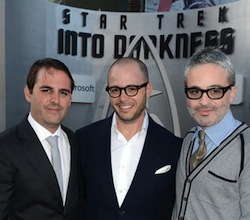 This interview with the film’s other two writers, Kurtzman and Orci, suggests that they developed the story and the villain, then debated whether Khan and his backstory could be grafted onto that villain. They felt it could, and that doing so would work whether viewers were familiar with Khan’s history or not. So they went ahead with it. But they probably wouldn’t have considered the Khan question had the fans not been going on and on about it, which brings up another important point. The internet has forever changed the face of fandom, allowing the creators of art and entertainment to collide directly with the consumers of that art and entertainment. Fans have become part of the dialogue, and creators can and often do respond directly to their comments and concerns. This is certainly an area in which Lindelof is practiced, having engaged with avid Lost fans over the course of that show’s six years on the air. While he has always maintained that he and co-producer Carlton Cuse told the Lost story that they want to tell, the duo also often said they were monitoring the fan reactions, listening to what the chatter was and occasionally making minor course corrections based on that feedback. A lot of TV showrunners say the same. Today, it’s not enough for opinionated fans of movies and TV to passively watch what’s on the screen. They’ve morphed into entitled brats who not only want, but somehow expect, to be part of the conversation. As such, the creators run the risk of being held hostage by the desires of the fans. So we get a new Trek movie with an old Trek villain because the fans wouldn’t shut up about it.
Okay, fine…I don’t even have a big issue with Khan as the bad guy here. What he does in this movie and what he does in “Space Seed” and Star Trek II are completely different. I’m more confused and let down that the writers didn’t stop at repurposing Khan, but unnecessarily took things further by reusing something as major as Spock sacrificing his life for the ship. Sure, here it’s Kirk instead, but as I mentioned, nearly everything about it plays out the same way, down to Kirk and Spock separated by glass as they say a tearful goodbye. In Wrath of Khan, that goodbye was built on the established, long-time friendship the two shared, imbuing their final moments together with a deep well of emotion. That’s something the new film’s corresponding scene can’t possibly match, even if it does a decent job of tailoring the exchange to the relationship as it exists at this point in the reboot. Perhaps more importantly, the death carries less weight in the new film because we know there’s no way Kirk is going to stay dead. Indeed, he is swiftly revived and on his feet again as though he had just taken a power nap. At least Wrath of Khan ended with Spock dead, the crew in mourning and the possibility (even if unlikely; this is science-fiction) that he was gone for good. When moviegoers walked out of Wrath of Khan, Spock was dead, and would remain so for two years of real-time. When the crew reassembled for Star Trek III: The Search for Spock, the entire movie was about that search. Leonard Nimoy only appeared in the final scenes, and the effect of Spock having been dead didn’t just go away immediately. The mental and emotional repercussions continued to play out in Star Trek IV: The Voyage Home. In contrast, Kirk is dead for about ten minutes, if that, in Star Trek Into Darkness, then he’s up and about and back to his normal self. So not only is the death scene devoid of any real sense of loss, and its aftermath further trivialized by the lack of lingering effects, it doesn’t even carry any surprise, since we recognize what’s happening from having already seen it in a previous movie. Maybe the filmmakers would argue, as Lindelof does say in the Grantland interview, that plenty of the new film’s audience members have never seen Wrath of Khan. Fair enough. But does that make it okay? What they might consider to be homage feels more to me like theft, whether or not every viewer realizes it.
X
In the end though, the heavy references didn’t seem to hurt the movie. It did well at the box office, it’s doing well on home video and the reviews were more positive than not, with some even appreciating what Lindelof refers to in the Grantland interview as “the Khan of it all”. Vulture‘s David Edelstein wrote:
Is the movie good? It’s hard to be objective. The plotting is clunky and nonsensical, but Abrams and crew bombarded me into happiness. More than that, they made me feel so special for getting the in-jokes. Star Trek Into Darkness is a feature-length dialogue with Star Trek II: The Wrath of Khan: Abrams and screenwriters Alex Kurtzman, Robert Orci, and Damon Lindelof set the 1982 film’s best-known lines (and best-known scream) in peculiar new contexts.
I agree that it’s fun to pick up on all the in-jokes, but I would have preferred such sly references to be the limit of the new movie’s reliance on the older one, as when Spock invokes Star Trek II‘s “needs of the many” line in the opening sequence. Still, like I said at the beginning, I enjoyed Star Trek Into Darkness within its own bubble. Not only was it fun, but it tossed around a few interesting ideas, like the debate over whether or not Starfleet – founded with peaceful intentions of space exploration – should be militarized in the wake of the events depicted in the first movie. There was also the further development of the characters. In an interview with Playboy, J.J. Abrams said, “We’re testing these characters in ways they deserve to be tested: Kirk being cocky to a fault, Spock being so Vulcan that it raises the question of how he can possibly be a friend or lover when he’s that unemotional.” I also liked Khan’s M.O., which was not motivated by simple definitions of good and evil. Unlike his 1982 counterpart, this Khan is not driven by a desire for power or revenge, but rather devotion to those he loves. My friend likened him to Ed Harris’ character in The Rock…then immediately chastised himself for making a positive reference to a Michael Bay movie. But I agreed with the comparison before reassuring him that The Rock is the one Bay film that can be referenced free of embarrassment. Harris’ character in that movie is a more three-dimensional villain than action movies usually offer, and so is Into Darkness‘ Khan. That said, the same motivations could have been applied to an all-new character. I hope that whenever Star Trek Out of Darkness or Star Trek Toward the Light or whatever they decide to call it comes out in a few years, the creative team will show a little more originality and a little less attention to the hum of the fanboys by introducing an original threat into an otherwise familiar world.

 I Am DB