I Am DB

August 31, 2014

Movie Mixtape #2

Filed under: Movies — DB @ 11:00 am
Tags: ,

Well, it’s taken us long enough, but the wait is over. 14 months after the first release, and nearly 13 months after this compilation was started, we’ve finally got something to show for it. Without further ado, Burnce and Frants Present Movie Mixtape #2.


BA: Alright kid. Our first Movie Mixtape was clearly a huge success. Picked up on several blogs, shared by thousands of film lovers all over the world. Let’s not leave them wanting for too long. Also, let’s make clear that, honestly, maybe ten people total read our first Movie Mixtape, and most of the preceding claims here are lies. But hey, films are lies too, right?

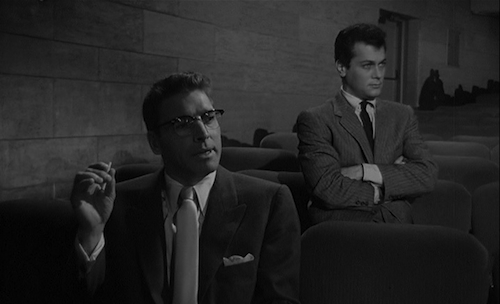
As you may know, I went on a bit of a film noir kick a few years back. Rewatched some that I already loved, like Double Indemnity. Discovered some new ones to love, like Out of the Past. Needless to say, I have developed quite an affinity for the genre, so I’m going to start Movie Mixtape #2 with one of my favorites. One of the many reasons I love this one is that it feels like the first Post-Noir film (not neo-noir). Most people tend to date the film noir movement from around ’41 to the late 50s. This film is from 1957, so it’s just under the wire there. And it has all the qualities you’d expect: the dirty city, corrupt and powerful men, duplicity, depravity, personal destruction. But it’s not about gangsters or detectives or police. It’s about a press agent and a gossip columnist. The noir elements are there, but the film’s been ‘miscast.’ That’s why it feels post-noir: someone said, “Hey, let’s make a noir, but let’s change up the characters.” It feels like the first major film that tipped its cap to the genre instead of being implicitly part of it.
X
The script is just wonderful, so many wonderful one-liners and rapid-fire back and forth (eat your heart out, Aaron Sorkin). The performances by Tony Curtis and Burt Lancaster are dripping with sleaze. I tell ya, it’s just tops.
X
Sweet Smell of Success
Dir. Alexander Mackendrick
Wrt. Clifford Odets, Ernest Lehman
1957
XXXXX
DB: In one of this movie’s many great lines, Lancaster’s J.J. Hunsecker describes Curtis’ Sidney Falco (GREAT names, by the way) as “a cookie full of arsenic.” The same could be said of the movie itself. If only all poison went down so easily. I think studio executives often worry that a movie has to have a main character that the audience can relate to, and/or sympathize with. I’ve never agreed with that. I don’t have to like, admire or identify with the protagonists. I simply have to be interested in them. This movie could stand as Exhibit A in defending that position. Hunsecker and Falco are despicable through and through, but what fun it is to watch them play their games of power and manipulation. By making them so enjoyable to watch, the movie makes us complicit in their shady dealings at the same time that we’re rooting for the victims of their plotting to win the day. It’s a nifty trick of dramatic orchestration. You aren’t kidding about the performances, either. The physically imposing Lancaster keeps cool while personifying menace and malice, and Curtis shuffles between private anxiety and public confidence with artful ease, maintaining an underlying moral vacancy all along.
X
Our last mixtape touched on movies that captured the thrill of New York City on film, and this one really achieved that for me. Half of this movie feels like it’s happening at 1:00 in the morning, which seems fitting since Hunsecker and Falco are vampires of a sort. But no matter what time of day the events are happening, Mackendrick portrays a city that is pulsing with activity and energy. He gets some help in that department from Elmer Bernstein’s jazzy score and the cinematography from the great James Wong Howe.
X
Sweet Smell of Success hovers on the edge of the journalism world. For the follow-up, I give you a movie that brings us directly into that scene. This one spends a lot more time in the newsroom (while still plenty outside of it), as our lead characters – another two man team – exemplify a more virtuous side of the field than J.J. Hunsecker. They are sometimes forced to play games and manipulate too, but they do so toward more noble ends than their own power or personal glory. I’ve always enjoyed stories about the newspaper industry, and as it continues to fight for survival, this movie is the ultimate reminder of the important role that print journalism has played in American history.
X
All the President’s Men
Dir. Alan J. Pakula
Wrt. William Goldman
1976
X
BA: There’s not much new insight I can bring to such an iconic film. As far as a ‘procedural’ goes, this one doesn’t let up. Peeling back layer after layer, starting to realize you’re poking a tiger, then that you’re poking a thousand tigers. It almost begins to play like a horror movie. But maybe because I recently rewatched Sydney Pollack’s Three Days of the Condor (’75), I do have something that feels worthy of pointing out. The Cold War gave something to film history that filmmakers have struggled to replace since the fall of the Soviet Union: a high stakes bad guy that everyone understood straight off. There was a constant bipolar tension in the world then. Damon Lindelof recently talked about the stakes in event films these days: once your budget passes $100 million, you have to save the world. That’s given us a crazy tent-pole season that I called The Summer of Peak Fist. But during the Cold War, the stakes were always that high, such that one man (like Redford’s Condor) could be running around the city, also trying to save the world. One mistake, one misunderstanding, could result in a simple button press and POOF, it’s all over. We don’t have that situation anymore. Die Hard gave us the “rogue terrorist” formula that worked well for years, and of course now we have the post-9/11 terrorism films, but terrorism plots, no matter how heinous, are almost always local. During the Cold War, the world needed saving every second of every day.
X
The spy film genre flourished under this situation, profiling the clandestine methods in which we kept the world from exploding. Criterion just released a fine example in The Spy Who Came In From The Cold (’65). What I want to point out here, though, is what the subject of All The President’s Men – the Watergate scandal and resulting cover-up – seemed to do to the genre. Before Watergate, there was always a double agent, a communist threat, a Russian spy. But then Watergate happened. And so look at Three Days of the Condor (spoiler ahead!!!): a hit on a CIA office, led by German Max Von Sydow, leads the audience to naturally assume, “It’s the commies!” But it turns out to be American spy agencies protecting their own operations.  Three Days of the Condor is a spy film that chooses as its bad guy not the Soviets but ourselves. And the movie doesn’t have any closure, but rather ends with the suggestion that the government can even tell the media what to print. Without closure, without “And that’s that,” the audience leaves the theater with a new mistrust of everything around them. That All The President’s Men was released the following year, also with Redford, almost feels like kismet: “See what we did in Condor? This is why it’s the new normal.”
X
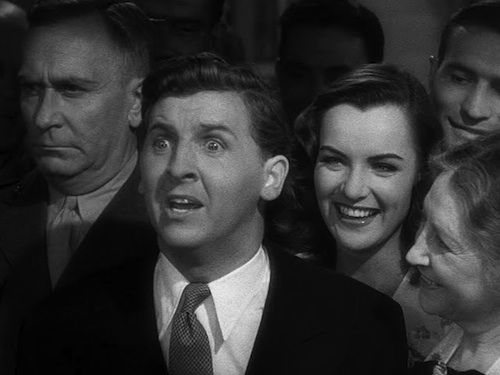
This is all speculation, of course, heightened by the coincidence of me watching both films within a week of each other. But it feels right, no? Regardless, in looking for my next suggestion, I strove to find another historical event that changed the way filmmakers approached their storytelling. I arrived at World War II. Things were going well, and then BAM, war again. It gave us the gung-ho, USA!-USA! war hero films. It gave us more and more escapist musicals. It gave us the dark, dirty noir genre. And by the end of the war, it even gave us introspective looks at ourselves, in William Wyler’s The Best Years of Our Lives (’46). I almost recommended that one, but I thought I’d spice it up with a comedy. And so here’s an unexpected film made during the war, that deals with the over-patriotic hero worship in a surprisingly frank way. A man comes back to his hometown, having lied about going to war, and is honored as a hero. As with any comedy, the momentum of it all results in our ‘hero’ going along with it as best he can, as it snowballs out of control. With a kooky performance by Eddie Bracken, I give you wartime political satire that’s just as relevant today, even if the jokes feel a bit dated.
X
Wrt & Dir: Preston Sturges
1944
X
DB: Excellent insights into two movies that clearly demonstrated Robert Redford’s disillusionment with the American government in the 1970’s…a sensibility that was shared by much of the country and which was reflected by so many of the great films of that decade (a decade bursting with great films). Interesting thoughts as well on the changing face of the movies’ big baddie over the last several decades.
X
There’s no bad guy to overthrow in Hail the Conquering Hero. Instead it’s the protagonist’s own shame that must be overcome, along with the tidal wave of adulation that prevents him from doing just that despite his repeated efforts. That was one element that prevented me from fully embracing the movie. I tend to lose patience with stories in which people won’t just shut up for a minute and listen to what someone is trying to tell them, which happens over and over again here as Eddie Bracken’s Woodrow Lafayette Pershing Truesmith tries to come clean with his hometown worshippers, only to be steamrolled each time by their frenetic enthusiasm and insistence on celebrating him. I also found the tone distractingly inconsistent. Was it a satire of what you called “overly-patriotic hero worship,” or was it the kind of broad, goofy comedy in which the band keeps playing at the wrong moment and the mayor is a buffoon? It couldn’t quite decide. Bracken’s performance seemed to belong in the latter, while much of the activity crowding around him seemed more of the former. This made it harder for me to buy into the relationship between Woodrow and Libby (played by the lovely Ella Raines). Her devotion to him never quite made sense to me, since they seemed like such an unlikely pair. Unlikely because while her performance was grounded, his was comically exaggerated. Only in the early scenes, prior to his newfound Marine buddies inventing the lie about his military service, and the climactic scene where he makes his confessional speech, did he seem like he was in the satire rather than the screwball comedy of errors. Still, I enjoyed Bracken’s performance on its own. I only knew him from his small role years later as Walley World founder Roy Walley in Vacation, so it was neat to see him in his heyday. There were a lot of colorful supporting performances as well, but I’m afraid the movie didn’t quite jell for me.
X
As it pertains to our mix tape endeavor, I did notice something interesting. Even at this early stage, we seem to be repeating a characteristic among our choices: movies about people who get caught up in a lie or misunderstanding, whether or not they themselves are responsible for it. Looking at the previous tape, we had Meet John Doe, The 39 Steps, and Doc Hollywood (and maybe you could argue Brewster’s Millions). I’m not sure whether my next pick perpetuates this coincidence or uses it as a jumping off point, but whereas the main characters of all those movies are aware of their circumstances and consciously dealing with them in one way or another, here the character in question is completely oblivious to the effect he has on those around him. In my mind, that separates it from the other selections.
X
He’s a simpleton who stumbles into the corridors of power and finds himself influencing policy at the highest level. Kind of like most of today’s Republican party…if the protagonist here was sinister, manipulative, and willfully ignorant and childlike as opposed to naturally so. (Sorry to get political, but as I write this, we’re nearly two weeks into the federal government shutdown, so idiots behaving like children while occupying positions of power are top of mind.) In cinematic terms, the character is like a forerunner to Forrest Gump, and he’s brought to life through a delightful performance by Peter Sellers that is every bit the equal of the classic character work he delivered in Dr. Strangelove and The Pink Panther films, but without makeup or funny accents to conceal him.
X
I look forward to hearing what strikes you about this movie, both because there are so many things in it that ring true nearly 35 years later, and because its final scene has the potential to reframe everything that’s come before it.
X
Being There
Dir. Hal Ashby
Wrt. Jerzy Kosinski
1979

BA: Let me go grad student on you here: for me, so much of this film is about the power of filmmaking itself. If you were to turn this film on somewhere near the end, you’d find a charmingly quiet man standing at the bedside of a dying man. And when that dying man gives up his last breath, the quiet man reaches out and puts his hand across the dead man’s forehead. It’s a touching gesture, a moment of final human connection. But it’s none of that, because the quiet man – Peter Sellers’ brilliant portrayal of simpleton “Chauncey Gardner” – is just aping something meaningless from earlier: in the opening scenes, when his caretaker dies, the maid informs him that she felt his forehead, and he was cold as a fish. So he went upstairs to the dead body and felt the forehead. That’s what you do when there’s a dead body, he must think.

In a weird, infinity-mirror type of way, that’s the magic of a film. It shows you what it thinks you need to see, and the overall experience delivers a certain emotional journey. Here, that journey is of an ‘idiot’ being mistaken for a profound genius, because the people he’s interacting with haven’t seen the rest of his story and don’t bother to try. We as the audience are privy to it, and so the comedy comes from something we know that they don’t. On top of that, Gardner himself can only come across as competent – however accidentally – because he himself has spent a lifetime clicking around the television stations. He never stays on one show for very long, so what he’s seen of other people interacting with each other are to him out of context. So we have this crazy snowball effect, where a simple man who’s only seen snippets of filmed stories walks around repeating those snippets when a similar context arrives, and the people he repeats them to, themselves having only seen this snippet of his life, think they understand it just as he believes to understand a soap opera or exercise show. It’s only the audience that knows the whole story……
X
….. or do we? That last shot, for all its Christ-like allusions and state-of-mind easiness, delivers something else: there’s a magic in a film, unlimited possibilities. Even the audience, who have been in the know this whole time, is surprised by it. A common reaction may be to say, “How did that happen? Is there a sandbar or hidden floor? Is it literal or a metaphor?” But that’s beside the point, because the entire film is filled with people who simply accept what they’ve seen as what they think it is, no questions asked. They’re ‘experiencing’ life, not analyzing it. This is driven home when director Ashby includes end credit outtakes of Sellers and crew giggling through a particularly silly moment that didn’t appear in the film. Ashby gets the last word, pointing out, “And even YOU didn’t see everything. You only saw what I wanted you to see.” Sure, there are cynical lessons here about politics and media that are relevant today (and, I may add, continue the trend discussed earlier: Watergate changed the enemy, and from then on the natural artistic response is analysis [….President’s Men], a new reality […Condor], and finally, satire), but I think the real magic here is in the details themselves, and how they combine to form a complete and deliberate vision.
X
So, let’s stick with that. The telling of a story, the completeness of a life, and the limitations of two hours of screen time. This next film is crazy, in the best way. Your mind starts to reel at it all, but it kind of makes sense despite itself, because its progression is our progression. From the loony mind of a gifted writer, in his directorial debut.
X
Dir./Wrt. Charlie Kaufman
2008
X
DB: Ooof. When I saw you had selected this movie, I was both excited and…I’m not sure what word to use. Overwhelmed? Excited because ever since I saw it when it first came out, I’ve wanted to see it again. Overwhelmed because the main reason I wanted to see it again is that it’s so dense and so heady and there’s so much going on that I had no idea what to make of it on first viewing, beyond being once again enraptured by the dizzying imagination of Charlie Kaufman. There could be an entire, semester-long course dedicated to this movie. My brother took a class in college on the James Joyce novel Finnegan’s Wake, which is so complex and challenging that there are actually companion books the class read in conjunction with the novel itself in order to help understand it. I feel like this movie would benefit from similar assistance.
X
If you and our reader(s) will indulge me a personal side note, you said something in your Being There commentary that struck me. Describing the characters in the movie, you said, “they’re experiencing life, not analyzing it.” I think that’s true of the different ways that you and I watch movies. I wrote at the top of my post about my favorite movies of 2012 that I experience movies emotionally, not intellectually. Maybe every now and then I have a more analytical take on something, but more often my response is a simple gut reaction. I’m all about the surface pleasures. So although I’m an avid movie watcher, I’m also a shallow one.  With this mixtape project of ours, that leaves me a bit outmatched as you continually extrapolate the most interesting, inside-out takes on these movies. Your thoughts on Being There are so far removed from anything that would ever occur to me. And then as if to highlight this contrast, you offer up fucking Synecdoche, New York. You magnificent bastard.
X
Still, when it comes to this movie, I can’t beat myself up. I don’t think anyone can watch it just once and walk away with more than a small amount of comprehension. And though this was my second time, it may as well have been my first given the passage of years since I initially saw it. There is so much happening both visually and thematically – and all at once – that it demands repeat viewings. One interesting thing I learned through the DVD’s special features is that Cotard, the last name of Philip Seymour Hoffman’s central character, is taken from a mental health condition called Cotard Delusion, or Cotard’s Syndrome, which finds the afflicted believing that they are dead or do not exist, or are slowly dying, or losing their blood and internal organs. Hoffman’s Caden Cotard is introduced as a death-obsessed hypochondriac, and his ongoing debilitation bears out the meaning of the name. The title itself is also loaded. “Synecdoche” is a term for part of something that is used to represent the whole, or vice versa. (Wikipedia offers the examples of a congregation being called “the church” or workers being referred to as “hired hands.”) See, before we even get into the actual movie itself, the work begins.
I don’t want to suggest that I’m uninterested in movies that make you think or make you work, but in the case of a movie as packed as this one, I rarely feel like I have the time to spend on thoughtful consideration. There’s just too damn much to do. Rumination at the level required by Synecdoche is a luxury I can’t afford. I know…poor me. So because I don’t possess the hours or the intellectual capacity to unpack this movie even superficially, let me hone in on one small aspect of it to finally lead us into our next track. (The flow of these posts don’t convey the time between movies, but it’s been nearly two months since you sent me this selection.)
X
Caden is a theatre director, married to an artist named Adele, and they have an adorable young daughter named Olive, upon whom both selfishly and ignorantly dump their neuroses. Adele soon takes Olive to Berlin for a work related trip, and never returns, even keeping her from Caden when he travels there to see her some years later. While Caden’s life goes on, and he sinks deeper and deeper into the quagmire of his massively staged, hopelessly layered, eternally unfinished creation, the loss of Olive is a throughline that haunts him. Not that he was ever fit to be a father, and he probably had no idea the damage he was doing to her when they were together, but his love for her was always sincere. There’s not much in this movie we can trust as real; in fact, I’m not even confident saying that Olive was ever real. But she’s certainly real to Caden, and so is the effect of losing her.
X
This is something we’ve seen before in art, and sadly in life. Children become pawns in the manipulations of their fucked-up parents. Maybe the parents really love their child, or maybe they’re incapable of loving anything beyond themselves. It’s a tragedy that was played out quite beautifully in a movie from just this past year. So with nothing but respect and admiration for Charlie Kaufman, I’m nevertheless unabashedly happy to pass the “Now Leaving Synecdoche, New York” sign and move on to this adaptation of an 1897 novel by Henry James, updated to the present day and starring Julianne Moore and Steve Coogan as the self-involved parents of a little girl who can’t even comprehend that she’s fighting to retain her innocence as she gets tossed around from guardian to guardian. The young actress at the center, Onata Aprile, will both warm and break your heart.
X
What Maisie Knew
Dir. Scott McGehee, David Siegel
Wrt. Nancy Doyne, Carroll Cartwright
2013
X
BA: This touching and heartbreaking little film highlights two important parts of filmmaking. And with this particular subject matter, the two parts bump up against each other. The first is an established perspective. The entire film is from Maisie’s point of view, often with the camera literally at her level, the adults cut off at the top of frame. If the parents are arguing and Maisie wanders back to her room, we can no longer hear the argument. We’re just with Maisie as she avoids whatever it is the adults are yelling about and focuses on a book, or a drawing, or looking out the window. Having even a single scene without Maisie present would have broken the whole film apart. It’s not just that she has to be in the scene; the audience can only know what she knows. Only then can we really try to connect with her innocence emotionally, because we’re denied the full adult story if she tunes out or walks away.
X
Which brings up the second point: knowing your audience. What works against a film like this, where you’re trying to experience life as a young girl does (Onata Aprile’s quiet performance is lovely). The audience is very likely comprised wholly of adults, and adults will bring with them an understanding of what’s really going on. What the judge says, the petty underhanded fighting, one parent fishing for info on the other through seemingly innocent questioning of the daughter. WE know what they’re really up to, and we get protective of Maisie. Because we know she doesn’t hear that stuff and know what it really is. Thus, the film has to live in this in-between space: trying to portray the innocence of a child’s perspective to an audience that has already lost it. You can’t put the rabbit back in the hat, but you can remind us there was a time when the hat surprisingly produced a rabbit. It’s just that now, we’ve seen the hidden compartment.
X
That disconnect prevented me from all-out loving the film, though I did enjoy it completely. Maybe that disconnect is the filmmakers’ intention, too (there is a running theme about a moat, the barrier between a castle and the dangerous animals outside). But I’ve seen that story before. I wonder if you can even make a film that gives you a true experience of childhood to anyone other than a child. This isn’t the first time I’ve thought of it, either. I’ve been taking notes for at least 8 years on a film I’d like to find a way to write someday that completely captures, visually as well as emotionally, what it was like to be a kid. So far, it’s a bizarre mash-up of Willy Wonka Technicolor meets Gondry-like visual devices. Who knows? It’s hard to have an adult experience a story about childhood without the nostalgia element. Beasts of the Southern Wild got the closest, I’d say. And it required magical animals and a flooded landscape.
X
I knew pretty quickly what the next film on our mixtape should be. It also tells a story through a child’s perspective, an incomplete understanding of the realities of the adult world influencing conclusions about what’s what. Only here, we add the DNA of a spy film. An Embassy on foreign soil, an accidental death, and ever so many lies. Before Carol Reed and Graham Greene gave us the classic The Third Man, they gave us this unique thriller.
X
Dir. Carol Reed
Wrt. Graham Greene
1948
X
DB: Our running theme of characters caught up in lies continues with this nifty little thriller. One of the key differences here, however, is that some of the falsehoods are of a much more innocent nature. Phillipe is told many lies during the course of the movie, and they are the same lies children are told everyday because the truth is too complicated, or beyond their comprehension. And as the film goes on, it becomes painful to watch this poor little boy try to work through the confusion that these lies have wrought. Every time he thinks he’s trying to do the right thing to help his friend Baines, his actions instead threaten to seal the man’s fate. It starts to feel like you’re watching a rag doll get kicked around. By the end, I just wanted the adults to listen to what he was so desperately trying to tell them…even though if they did, it would just mean another strike against Baines.

There’s also the fact that Phillipe himself is lying to protect Baines, even though he mistakenly thinks Baines has just killed someone. It struck me immediately that the obvious follow-up to this movie would be Atonement, another story in which a bright but naive child sees something – or rather, doesn’t see what they think they’ve seen – and reacts in a dangerously misguided fashion because they don’t understand the truth. Those two movies would make for a nice double-feature. But I’m not picking that, since it’s a bit too much of the same. Children, misunderstandings, harmful lies…I think we need to go in another direction, which also rules out some other good follow-ups that I considered and which further involve the consequences of lies. Instead, I’m taking the concept down a different but related road. In The Fallen Idol, Baines has regaled Phillipe with tales of his adventures in Africa. We soon learn that these are lies as well, since none of the events ever took place. We don’t consider them to be lies though, do we? They’re stories, told for the boy’s amusement. But really, what are stories if not lies that we tell for the purpose of entertainment? And aren’t movies and TV shows the biggest lies of all? You brought up the same idea in the very first paragraph of this post. Acting, editing, sets, special effects….all tools to construct an illusion. This is an idea that plays directly into a project you’re working on right now, so I know you know what I mean.

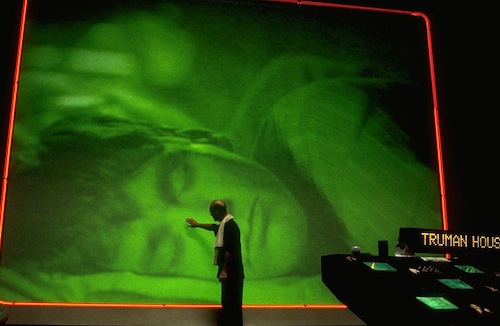
For the last 15 years or so, reality television has blurred the lines even further. Sure, the situations may not be fictional exactly, but they are very much constructed; shaped to create a narrative, with real people jammed into roles of good guys and bad. These shows are not reality. They’re fiction, blatantly manipulated, yet audiences welcome these “lies.” They view the programs obsessively, and thus become active, willing partners in their own deceit. This next movie concerns one gigantic lie, designed to entertain the masses. And that it does. With the exception of the person at its center, everybody’s in on it, everybody’s caught up in it, and nobody has ever stopped to consider the cost because they’re all enjoying it too much.

The Truman Show
Dir. Peter Weir
Wrt. Andrew Niccol
1998

BA: So the story goes that Andrew Niccol’s first draft of this script was a dark sci-fi thriller, set in NYC, and that Brian de Palma was going to direct. Makes sense coming from the guy who wrote (and directed) Gattaca, but what a different movie that would have been! Probably closer in tone to that same year’s Alex Proyas thriller Dark City. Once Peter Weir came on board, he began to craft it into the timeless setting of Seahaven.

I’ve seen this more than a few times, but it’s been a while. So this time around, two things really jumped out at me. First, it’s a lot quicker than I remembered. I think that’s a testament to the depth and detail of the film. The way we’re introduced to the world as if we’re watching the TV show, the way 99% of the camera shots are of the ‘hidden’ variety (almost a precursor to ‘found footage,’ in a way?). The structure of the film gives us Truman’s life, interrupted almost immediately by the light that falls from the sky. And then we get flashbacks, and then when we finally meet Christof (a little on-the-nose with that name), we do so via an interview during which we get to experience the entire life of Truman from birth to now. All of this in a lean hour-plus, which then takes us into Truman’s falling apart and eventual awakening. By the time he opens that door at the end and steps through, we’re hit hard with it, because we feel like we’ve been watching the show for decades as well.
X
Much of that, too, comes from the art direction. And that’s the second thing that jumped out at me. The music the characters listen to, the clothes they wear, their furniture and appliances feel like the 1950s. And yet there’s modern cars, computers, phones. It’s this odd mixture of past and present, which is really interesting when you step back and think about it. Part of it was no doubt to draw a solid line between Truman’s world and the modern world looking in at him (Christof’s production has all the tech he could ever need, even a Weathermaker!). Truman’s almost 30 in the film, which means that the show started in 1968. So even then, the 50s thing would’ve been somewhat dated. And yet it didn’t change. Maybe that’s the appeal of a familiar TV show: your favorite characters will always be in their familiar spots. The Cosby Show‘s living room, ER‘s hospital, 21 Jump Street‘s 21 Jump Street. It’s yet another trove of detail that shows you how deeply everyone involved with this film really thought it all out.
X
It’s off this latter point that I pivot to the penultimate film on our mixtape. The choice to film in the cookie-cutter town of Seaside, Florida really drove home the homogeny of the environment created around Truman. Rightfully so, too, because Christof wants complete control over what affects his main character. Seahaven is a blank slate, everything so alike and innocent that you don’t even notice it. Then all Christof has to do is start a fire, or make it snow, or throw in a love interest, and he’s guaranteed that the drama will come from that action, not something unexpected. But, like the false elevator wall Truman discovers during his ‘breakdown,’ things are never so cut and dry. Even in the picture perfect, let’s-move-to-the-suburbs, nuclear family/Donna Reed 50s that the art direction is modelled after, shit gets real.
X
Even during the 1950s themselves, filmmakers were pulling back the curtain and showing America that behind the ambrosia salad and rotary mowers, life really was ugly and imperfect. One director in particular made his name doing just that, and I give to you my favorite of his soapy, soapy films.
X
Dir. Douglas Sirk
Wrt. Peg Fenwick
1955
X
DB: I’ve been wanting to see this movie for over a decade, ever since watching Todd Haynes’ 2002 film Far From Heaven, his homage to these “women’s pictures” on which Douglas Sirk made his reputation. All That Heaven Allows and Imitation of Life (which I also have yet to see) are considered the primary inspirations for that film, but I never got around to watching them after seeing it, despite my intentions. Now that this one is under my belt, its influence on Haynes is clear. And though I’d assumed his effort was just a thematic interpretation of Sirk’s work, now I see that Haynes also recreated Sirk’s stunning use of color.
X
Perhaps the colors stood out so much because the light was refracted through all of the suds in which the movie is lathered. Your description of “soapy” was apt. Melodramatic as it may be though, it was hard not to get caught up in the drama. Almost everyone in Cary’s life – from her college-age children to her so-called friends from the country club and cocktail party crowd – react so disdainfully to her romance with the younger, blue-collar Ron, and there were a few characters I found myself talking smack to out loud for their treatment of the couple. Yet at the same time that I felt defensive on behalf of their relationship, the romance felt a little rushed to me. I don’t think the movie did much to build up their attraction, which went from 0 to 10 in little more than the time it took to tour Ron’s rundown mill.

If I wanted to follow this up with another story of lovers battling outside forces that threaten to break them apart, there would be no shortage of movies to choose. But what will linger with me over time about this movie isn’t the story or the social commentary, but those vibrant, gorgeous colors. There were moments – think of those wide shots of Ron’s mill – that looked like they were animated. Cary and Ron might well have been walking around in a Disney cartoon. I mean, Jesus – there was even an adorable reindeer hanging around! A reindeer, Brantley!

So it’s color and cartoons that I’m thinking about as we wrap up this set. And while I have two movies in mind that might actually be more applicable than the one I’m going with, my ultimate selection accomplishes a couple of additional things. Yes, it elaborates on the idea of live actors in a world that sometimes seems (and at least briefly is) animated, but it also offers a nice bit of symmetry by serving as another riff – albeit a much lighter one – on the film noir origins that inspired your pick for our opener, Sweet Smell of Success. Lastly, it allows me to pay tribute to a terrific actor who recently left us. So enjoy revisiting this classic from our childhood, and raise a drink to Bob Hoskins as you do.

Who Framed Roger Rabbit
Dir. Robert Zemeckis
Wrt. Jeffrey Price & Peter S. Seaman
1988

BA: What can you say about Roger Rabbit that any movie lover in our generation doesn’t already know? That they got the rights to cartoon characters from every conceivable studio. That Hoskins was asked to do the near-impossible, acting alongside greenscreens and practical gadgets that would later be drawn over. Watching it again, from start to finish, you can see all the noir tropes it’s supposed to have: a private detective, his trusty gal, a femme fatale, a musical number, a gin joint, a mystery in Los Angeles that (like Chinatown) is basically just a land grab. And as you said, a solid way to wrap up Movie Mixtape #2. Not just because we’ve bookended this thing with noir, but because in just two months, I’ll be getting married in the very movie theater in which I first saw Roger Rabbit. An old school Art Deco theater that would fit in quite nicely in Eddie Valiant’s world.

Coming Eventually: Movie Mixtape #3

X
X

June 28, 2013

Movie Mixtape #1

Filed under: Movies — DB @ 12:25 pm
Tags: ,

image

The making of a great compilation tape, like breaking up, is hard to do and takes ages longer than it might seem. You gotta kick it off with a killer to grab attention. Then you gotta take it up a notch, but you don’t want to blow your wad, so then you gotta cool it off a notch. There are a lot of rules.

– Rob Gordon (John Cusack), High Fidelity (2000)

What about a movie mixtape? A playlist of ten films that aren’t directly related, but have a certain thematic flow when viewed in order? The web is filled with audio mixes, a carry-over of the cassette, but we at I Am DB (David Burnce) and I See Frants (Brantley Aufill) thought it was high time to introduce the world to the first Movie Mixtape. Brantley came to me with the idea, and I got us started…

DB: Okay, so how to kick off this intriguing project? Making the first choice, I have the entire breadth of existing movies at my disposal. Where to start? What genre? Mainstream or obscure? Do I need to make a statement? Does it need to be deep, thought-provoking? Or can it just be good fun? How to begin? Movies started popping into my head, and who knows how or why those that came to mind did. But when this one came up, it seemed right.

On a superficial level, I like the choice because it takes place in your hometown of Dallas, Texas, while the star and co-writer is from my hometown of Woburn, Massachusetts. Furthermore, it’s based on a play and therefore represents a collision of theater and film, which also seemed appropriate given our histories. And having studied both mediums, perhaps you’ll have some thoughts about how successfully or not it’s brought to life cinematically.

Although it’s the work of a famous, Oscar-winning director, it is one of his lesser-known movies, and probably one of his best. I first saw it on the young end of my teenage years, late on a Friday night with my brother, who had rented it. I remember being really freaked out by it, in the way that The Shining freaked me out, even though it isn’t a horror movie. But it really got to me, especially the ending, which I found utterly chilling.

If I had any reservations about kicking things off with this, they were erased when I turned on the TV last night just before putting in a DVD, and while curiously scanning the cable channels to see what was on, saw that this very movie would be playing in a half hour. It must have been a sign. So here we go.

Talk Radio
Dir. Oliver Stone
1988
image

BA: Oliver Stone’s films always have this fever dream freneticism, the pace of a boulder dangerously bounding down a cliff face, picking up speed, its awkward shape making its path unpredictable (a term I only recently learned is called ‘trundling’, illegal in many mountain areas). I remember literally feeling high as a kite after seeing his 1991 biopic The Doors. Bogosian’s Talk Radio was one of the first non-Shakespeare stage plays I’d ever seen (at the Arts Magnet High School in Dallas, mere blocks from where this film takes place), and there’s a lot of it that’s still relevant today. Shock jocks aren’t nearly as shocking, but the topics are still out there: racism, homophobia, gun control. I remember the play had certain moments where you could breathe, extended scenes with callers that focused more on what they were saying. But in Stone’s version, it’s all one big cynical blitz, as gasbag Barry Champlain just keeps mining the worst that the public had to offer. The callers and what they have to say are merely a springboard for Barry to laugh at them, mock them, and cut them off to the delight of other listeners who probably all think they’d be smart and quick enough to react the same way. Bill O’Reilly probably loves this movie.

Rewatching it today, for the first time in about 20 years, it’s definitely an 80s Oliver Stone film. Feels very dated (complete with Alec Baldwin mullet!), but then again, the 80s were Stone’s prime era. Even his more recent films (like the Wall Street sequel in 2010) still employ the familiar tricks that were innovative in 1988… but feel tired today. Bogosian’s energy carries well when he’s ‘in character’ and on mike, and likely played very well on stage at the Public Theater in 1987. But the constant in-your-face camera shows some holes in the facade; it’s a tough final monologue here, and he doesn’t carry it completely. Then again, it may be enough that he’s yelling and has clearly had enough. It achieves the same fever dream finale that Stone was no doubt aiming for (note: the music over the final credits is “Telephone & Rubber Band” by the Penguin Cafe Orchestra, and it may sound familiar because it was sampled in Spacehog’s 1995 song “In The Meantime“).

Two films immediately came to mind as an obvious follow-up to this one: Billy Wilder’s Ace in the Hole (’51) and Elia Kazan’s A Face in the Crowd (’57). Both have an outgoing and persuasive lead character manipulating the mass media of the day to their own ends. But it occurred to me that’s just more of the same, and I found myself landing on a lesser-known (or at least lesser-talked about) Capra film from 1941. Starring Gary Cooper and my Old Hollywood girlfriend Barbara Stanwyck, this film also features a central figure riding a media wave to dizzying heights, but here the participant is somewhat unwilling, ignorant of what’s going on. He’s the one being used by the machine, not the other way around. Barry Champlain would never stand for this.

And so, I give you Movie #2 in our mixtape, a film that strikes a surprisingly relevant political note in these Tea Party Patriot days.

Meet John Doe
Dir. Frank Capra
1941
image

DB: Like many stars of yesteryear, Gary Cooper is an actor who I’m more familiar with by name than by having explored much of his filmography, so it was a pleasure to watch him, and your Hollywood girlfriend – for whom the same holds true – in this Depression-era drama.

Like Talk Radio, and the other two follow-up films that you mentioned having considered, there is plenty in Meet John Doe that still applies today. Not just in the idea of powerful figures attempting to manipulate, control and dominate the world around them, but in the lack of civility that we express toward our fellow man. Have times ever been more divisive than they are now? It seems to me that over the last 10 or 15 years, we’ve come to define ourselves with increasing rigidity along political lines, and are less and less capable of sympathizing, empathizing or relating in any way to someone who holds different views than we do. The current debate over gun control is a perfect example. Feelings on the subject are naturally strong, but too many people aren’t even the slightest bit open to hearing what the other side has to say. So this movie’s idea of overcoming prejudices we might hold about our neighbor and extending the hand of friendship is one that today’s society could surely benefit from.

It’s also interesting to look at the Barbara Stanwyck character and consider how often we do things because we have to look out for ourselves and our own interests, without realizing the greater consequences our actions have. This is applicable in all kinds of ways. I think of someone who might work for a corporation that engages in corrupt practices and is doing great harm, even though the people actually driving the company in that direction are a few executives at the highest level. The majority of employees are just average people trying to make ends meet, support their families, etc. They’re just cogs in a greater machine that is inflicting injuries they might not even be aware of. Or maybe in some sense they are aware, but they’re just doing their job and trying to protect their own modest interests. We rage against banks and insurance companies, but most bank and insurance company employees are regular middle class people doing the 9 to 5 grind.

Maybe I’m trying to extrapolate too much from the movie. In any case, there were more than a half dozen options that popped into my head as potential follow-ups to this, picking up on one strand of the story or another. I wanted to choose one that’s relevant, but not just another exploration of the same main theme, as well as something that would shift gears a bit after the first two “tracks” being relatively serious. What I settled on shares a couple of things with Meet John Doe. It features a protagonist who goes from having a relatively meager lifestyle to suddenly having more wealth and influence than he’s ever known or even wanted. And like John Doe, there is a secret behind his newfound status that he must protect at all costs. (The outcome of that secret is a little different, in that here it would shed light on his mysterious behavior, whereas John Doe’s fear is that the secret would be a letdown to his admirers and followers.) And as an added bonus, this pick carries forward the baseball connection from Meet John Doe.

I’ve always had a soft spot for this comedy, even if it’s not loaded with huge laughs.

Brewster’s Millions
Dir. Walter Hill
1985
image

BA: What is the deal with Jerry Orbach? Monty Brewster spends his own money putting on a 3-inning exhibition game against the NY Yankees – a game with absolutely nothing on the line – and Orbach still pulls Brewster after 2+ innings?!?! Harsh (and of course, he put Baby in a corner).

I, too, enjoyed this movie many times over back in my youth. Excellent connection to Meet John Doe with an almost identical pitch-and-catch-in-hotel-room scene. The story is incredibly accessible to just about every audience you could imagine. How would YOU attempt to spend $30 million in a month? It’s so accessible, it’s no surprise it’s been made into 10 different films (including a lost silent version starring Fatty Arbuckle). The original 1902 novel required Monty to spend $1 million in a year to inherit $7 million. The 1945 Brewster has to spend $1 million in 60 days to earn the $7 million (and that Monty does it the way I would: he rents a yacht and travels). And of course, here we have the shocking $30 million in a month to earn $300 million. INFLATION!!!!

You’re right, it’s never been heavy on laughs. At most, it’s simply enjoyable to see how one particular man would navigate this unlikely scenario, and wonder how we might do the same. It’s Powerball dreaming. Fun little cameos here and there (Rick Moranis, Hume Cronyn). Two things always stood out to me with this film. First, I’ve always enjoyed the through-line the screenwriters employ with the ever-present Chuck Fleming of Action News. He divides up the story’s different plot points quite well, with on-camera reporting and on-screen quotations. Smart to use him in multiple formats. Fleming’s familiar face gives the hullaballoo around Brewster an excitement and immediacy that you can’t just get with a bunch of extras screaming. This thing is news, important and sensational; Brewster’s character and integrity are being judged by an entire city, not just his buddies. The other thing was that this is one of the films that shaped my then-limited understanding of the great New York City. I grew up in Dallas, and had never even visited NYC until 1995 when I entered college (I went on to live in that fantastic place for 12 years), but I was highly aware of it from movies. Unlike so many other locations, NYC always seemed like its own character when a movie was set there. The stakes were instantly upped just by the location. Wall Street, Splash, The Secret of My Success (special connection to that one, as the lead character’s name is Brantley!), and Brewster’s Millions filled in the blanks of this magical city for this young film nerd.  SIDENOTE: Notice I didn’t mention Ghostbusters! Weird, but it doesn’t feel as NYC to me.

So I choose to segue along that line, to a movie that really makes me love the greatest city in the world. At first, I was going to recommend Jules Dassin’s The Naked City (1948), one of the first docu-style police procedurals with no lack of glorious late-40s New York locations. But let’s not jump back to the 40s quite so quickly. Instead, I’ll keep it light, and give you a film that I was surprised to adore. It captures the fun and crazy nature of a single night in New York, combined with a fun cast, a tight script that doesn’t condescend (also based on a novel), and a quirky soundtrack. And every time I watch it (even back when I still lived in NYC), it made me love – and now miss – that lovely, lovely town. Enjoy it, you hipster.

Nick & Norah’s Infinite Playlist
Dir. Peter Sollett
2008
image

DB: I hear people gripe that Michael Cera is the same in everything he does. I’ll concede that he usually plays the same general type, but I think the characters are different enough to allow him to bring a variety of shadings to each portrayal. And even if I’m wrong, I dig his shtick, so I’m okay with it. He’s nicely paired here with Kat Dennings, who I knew from her small part in The 40 Year-Old Virgin and an arc on ER before she showed up in this. Kudos to Peter Sollett for casting her in the lead role. She wasn’t as big a star as Cera, and her looks are unconventional, so she might not have been an obvious choice, but the two have great chemistry.

The movie is a charmer, and I can see why it appeals to you as a love letter to New York, though it doesn’t conjure the city as vividly for me as some of those 80’s movies you mentioned, Ghostbusters included. (For what it’s worth, The Devil Wears Prada is an example from around the same time as this movie that, for me, captured New York City as a character the way you described.)

I especially like the way that music brings the two characters together, and that Norah already has a crush on Nick sight unseen, just based on his mix tapes (a powerful art form, responsible for this very project). When Norah brings Nick to Electric Ladyland Studios, that felt special, like a glimpse into a place we haven’t seen a dozen times before. In fact, it was that aspect of the movie that triggered what I wanted my next pick to be. I thought it would be interesting to look at a documentary that went inside a recording studio with a major artist/band, and there was only movie I was interested in choosing: Let It Be.

Unfortunately, I discovered that Let It Be is not readily available; it’s never been out on DVD and doesn’t seem easy to come by online either. Maybe it can be found out there somewhere, but rather than dealing with the hassle of digging for it and maybe finding only a copy of subpar quality, I moved on. But I’ve had a really hard time coming up with a satisfying alternative, which is why it’s taken me so long to lob the ball back to you. Honestly, I’m not all that enthused about my pick, but continuing to think about it has become annoying, so I’m just choosing something so we can move on. I’m sticking with the idea of music creating a connection between people, though in this case it’s a musical instrument, and it connects people across time and continents. I saw it once, a long time ago, and don’t remember it well; I can’t even recall if I liked it. But other than Let It Be, it’s the one movie that keeps coming back to mind even as I try to think of something else. So let the music play…

The Red Violin
Dir. Francois Girard
1998
image

BA: Maybe it was my teenaged perception, but were most foreign films that found US distribution in the 90s filled with stuffy pretention? Tous Le Matins Du Monde, Indochine, and this Canadian bore? This one suffers on another level, a self-inflicted wound that I now refer to as the War Horse Syndrome (the film, not the play). “Let’s link together a bunch of unrelated people across time and space with a single object!” Unless that single object is undeniably awesome (like the horse in the War Horse PLAY was), you’re kinda stuck trying to find some theme with a bunch of characters you don’t have time enough to know or care about. Even more working against it here, as the object is inanimate. The idea of a red violin – that elusive perfect instrument marked with the blood of its creator’s true love – is a good one. But what’s the unifying theme here? It’s cursed? Does it symbolize our desire for beauty? For art? Each of the stories linked to this violin seem to exist in their own world, but a world I didn’t care much about. The only truly interesting story was the present day one, wherein Samuel L. Jackson plays a restorer who does the CSI work on this found violin: can this be the famed “red violin”? I enjoyed the forensics on it, discovering why people treasure such instruments. It was only then that I truly understood what made it unique. Up to that point, it was only unique because people said it was, and why am I to believe people I don’t know or care about?

These War Horse Syndrome tales have always been around. Remember 1993’s Twenty Bucks? Or the short-lived ABC drama Gun? That show was exec-produced by Robert Altman, which is telling, because these types of stories feel like a poor man’s Altman. He was always good at spinning many characters’ stories around, and seemingly effortlessly (not at all effortlessly in reality) linking them all together in an organic way that tells an overall single tale. Maybe it’s that the 90s were simply filled with these intertwining storyline films. 1995’s Smoke and its sequel Blue In The Face come to mind. Are they not just a poor man’s Altman, but a poor man’s Pulp Fiction? That film changed movies, no doubt, and not always for the better. These stories are still tried today (witness Cloud Atlas).

How to follow this up? I first latched on to another film that attempts to capture the story of life’s great span, and does so beautifully, literally without a single word: Frammartino’s Le Quattro Volte (2010). However, since The Red Violin was such a pretentious downer, I think we need a pick-me-up. So I’m choosing yet another foreign film that involves music, but it’s so delightfully eccentric it smacks of a smart Wes Anderson homage. I’ll note, too, that it’s fitting that we’ve found ourselves in the middle of Movie Mixtape (the format itself inspired by music) with films that revolve around music. Those who know you know you LOVE film scores; you know composers and movie leitmotifs better than anyone I know. Even silent films had live musical accompaniment. Films may be moving pictures, but music has always been part of the viewing experience.

So then, I hope you enjoy this quirky Israeli comedy. I sure did.

The Band’s Visit
Dir. Eran Kolirin
2007
image

DB: War Horse Syndrome, I like that. I tend to enjoy films with large ensembles that crosscut between different characters, though what you’ve described – the ensemble that is built around an object – is maybe a sub-genre of that. I’m thinking more of the Altman films, which you of course mentioned, like Short Cuts or Nashville, as well as things like Magnolia, Traffic, and even Love Actually…conceptually, at least. (At least I know enough to stay away from things like Valentine’s Day, New Year’s Day and He’s Just Not That Into You.) But you’re right, there’s also that Pulp Fiction influence as well, which definitely permeated the late 90’s cinemascape. (I don’t know that I’d lump Smoke or Blue in the Face into a bucket of poor man’s Altman, but I know what you’re getting at.)

The Band’s Visit was definitely a charmer. I liked that it focused on just a few of the band members. I expected it to be more of a story about them as individuals and a group, but instead it hones in on the uptight bandleader, the brash young romantic and the patient “second-in-command”, two of whom are, like most people, more than what they initially appear to be.

What I really enjoyed about it was the “kindness of strangers” aspect. I always find myself moved by characters who demonstrate decency and openhearted kindness, and that certainly applies here, mainly in the character of Dina, but also the other Israeli hosts.

That was the aspect that I seized on when trying to think of a follow-up. At this point, I’ve abandoned the hope of finding more obscure movies that you might not have seen; my exposure to the classics is just too narrow. So I’m selecting an 80’s Hollywood hit that also involves a character who finds herself in the wrong part of a foreign country and must rely on the kindness of a stranger – or at least the assistance of one, since kindness may be too tall an order initially – to get where she needs to go.

Romancing the Stone
Dir. Robert Zemeckis
1984
image

BA: First off, I can’t remember the last time I’ve watched this film straight through, unedited and commercial-free. It’s one of those that you catch on TBS during the mudslide scene and watch for a while until it’s time to switch over to the game.

Secondly, how did I not know that Zemeckis directed this?!?! And get this: the studio thought it was gonna be such a flop that they preemptively fired him from Cocoon, and the surprise success of it allowed him to make his personal project known as Back to the Future. So thank goodness for that. Front to back, it’s definitely aged a bit, but it’s still interesting in that while it’s a typical mid-80s rom-com on either end (complete with cheesy saxophone score), the middle becomes an action/adventure movie. One might think they were riding on the coattails of Raiders‘ success, but this feels more like a rom-com that went off on an adventure, rather than a straight-up Raiders rip-off (for an authentic Raiders rip-off, see the Richard Chamberlin/Sharon Stone disastrous Allan Quatermain films; admittedly a guilty pleasure for this film kid when he was young, because they were so obviously bad). Kathleen Turner sure was a looker (which so much hair, man it’s out of control in some scenes), Michael Douglas grins and charms up there with the best of them. And Danny DeVito is almost an after-thought, such a small part for him that allows him to do next to nothing. I guess it was my hazy memory of this film’s sequel The Jewel of the Nile, which showcases him much more prominently.

Don’t put yourself down, dear Burnce, for a lack of the classics. Your embrace of the defining films/filmmakers of our formative years is unparalleled. You’re steeped in nostalgia, and talking movies with you always makes me feel like a kid again, like we just saw Poltergeist for the first time and we’re raving over it. I admit I’ve become very much a film history nerd: I just want to keep walking backwards to see what influenced this/that influenced that/that influences blah blah blah. There is room for both, and this Movie Mixtape is all the stronger because of it.

Allow me, then, to take us way way back again. I’m zeroing in on Romancing the Stone‘s unique mix of romance, comedy, and action. But here the structure is flipped: a thriller on either end, with a surprising bit of screwball situational comedy in the middle. It even inspired a rather hilarious piece of satirical theatre, which I saw in NYC and laughed my arse off. And note, too, that it’s an early work of a true master (one you wouldn’t first think of for comedy), and this has all the hallmarks that this filmmaker would make a phenomenal career on. Based on a 1915 novel, it is widely considered to be one of the best British films of all time.

The 39 Steps
Dir. Alfred Hitchcock
1935
image

DB: This was a well-timed choice, as I had just finished re-reading a book called The Genius of the System, which I first read for one of my film classes during our year as roommates at Ithaca. It’s all about the rise and fall of the Hollywood studio system, and a significant portion of the book is dedicated to David O. Selznick, who brought Hitchcock to Hollywood on the strength of his British movies like The 39 Steps. Their fruitful but tension-fraught relationship is given considerable attention in the book, and even though this film predates Hitch in Hollywood, it felt appropriate to visit a film from that era.

As you suggested, The 39 Steps offers a nice example of both the playfulness and the suspense that Hitchcock loved to toil in, a combination that’s still in rough form here, but that he would perfect over the next few decades. The tonal shifts are a bit abrupt, but Robert Donat’s performance helps to smooth the transitions, since he maintains a consistent air of determination to clear his name and exasperation that no one believes his story. Even in the more dramatic scenes, his looseness and bemusement keeps things light.

The idea of no one believing what you’re trying to tell them, especially when it pertains to your well-being, is another theme Hitchcock would play with in the years to come, and it was a twist on that idea that led to my next pick. In this case, it’s not that no one believes the protagonist, but rather that people make assumptions and/or think they understand something about him that, in fact, they don’t. Their view of the central character – even their nicknames for him – are derived from this mistake, which he stops trying to correct.

There’s another reason behind this pick. To me, it represents the idea that while many movies follow a predictable formula, they can still be highly satisfying if they are done with care. This contemporary comedy re-writes no rules and doesn’t have any lofty ambitions. But it’s written with warm humor and cast with strong performers all the way down the line to create a colorful and memorable gallery of characters. A good mixtape should offer up surprises, but also the familiar. Not just familiar selections, but comforting ones. I’ve always found this to be a comforting movie.

Doc Hollywood
Dir. Michael Caton-Jones
1991
image

BA: This comedy resonated with 15-year old me on a few levels, the main one being my extensive experience as an “outsider” in a small town. I grew up in Dallas, Texas (the BIG CITY!), but my father was born and raised in Hillsboro, a tiny town about an hour south. When I was four years old, he bought some land down there, and just about every single weekend (and full weeks during the summer), we’d go to the farm to mow the pastures and feed the cows. It was that stereotypical small town: courthouse in the town square, raised sidewalks guiding you to storefronts with large front windows. When you wanted to call someone up, you just needed to dial the last four digits (as everyone had the same prefix). There was a weather line where some nice recording read you the forecast. And everyone knew everyone. (NOTE: This film also resonated because it’s a PG-13 film with full-on boobs and two instances of the word ‘fuck’.)

I still love this movie. It’s one of my favorite portrayals of ‘small town America’ on film, despite the fact that it glosses over quite a bit of negativity and isolation. Two main reasons this film works so well. One, the cast, specifically the supporting players. David Ogden Stiers’ mayor is delightful, Frances Sternhagen’s cynical widow (she has my favorite line: “Doc Hogue does the complete Walt Whitman if you don’t monitor his drinkin’.”), Barnard Hughes as the grumpy town doctor, Woody, Bridget. They all take what reads on paper as a fairly average comedy and inject each of their characters with personality. Take those personalities into the second reason it works: ………………………. timing. Director Caton-Jones finds the town of Grady’s pulse from the very beginning. There’s a rhythm to the way the townsfolk speak not just to Ben Stone but to each other, a shorthand that exists only because they’ve all been together in this machine for decades. Back and forth, knowing what the other one’s going to say before they say it.

That rhythm is what really sells a small town for me. The way that each person plays a role in the bigger picture; it’s the world boiled down to its simplest form. Here’s the doctor, the mayor, the butcher, the mechanic. They support each other, bartering and trading. And they all get by together. The Last Picture Show gets it, though that’s not as positive a portrayal (not that it’s negative, really, either. That film stands out for its almost complete lack of judgment either way; in this way it feels the most authentic, if not the most ‘feel good’). Doc Hollywood does it simply, and leaves a lovely taste in your mouth.

With the 10th and final film in our inaugural Movie Mixtape, I want to leave the participants with the same charming satisfaction that I get from Doc Hollywood, but with a tad more ‘pedigree’, let’s call it. This film also finds the pulse of a small town, deals with issues of people ‘stuck’ in their place, happily or unhappily, of everyone playing their part. It, too, has a stellar supporting cast: Bruce Willis, Philip Seymour Hoffman, Pruitt Taylor Vince, and the late Jessica Tandy (in her final film role). It, too, has an infectiously simple score that just nails it (by Howard Shore; Doc Hollywood‘s six-note theme by Carter Burwell does lovely work). And it gave Paul Newman his final Best Actor nomination. Here is the other film I cite as a favorite portrayal of ‘small town America’.

Nobody’s Fool
Dir. Robert Benton
1994
image

DB: We’re clearly in agreement about how much the casting contributes to the success of Doc Hollywood. I have to single out Eyde Byrde, who played the humorless, no-nonsense Nurse Packer. Near the end of the movie, Julie Warner’s character says she’s going out for coffee, and asks Nurse Packer if she wants anything. Without looking up from her reading, Nurse Packer replies, “Mmmmhmmmm, how ’bout Bob Barker?”

I write that down and it’s like, “Ooookay, so what?” But the way she delivers the line….the tone, the inflection…it kills me. The actress’ name means nothing to me (and you know I’m good with names of actors), and I don’t recall ever seeing her in anything else. But for that one line alone, she will forever be in my head. Such is the power of movies.

Your follow-up could not be more pleasing. Nobody’s Fool is a personal favorite of mine. We’ve talked before about that beautiful, simple score by Howard Shore (glad you brought that up, and Doc Hollywood‘s too; another great bit of film music), and of course I have boundless affection for Paul Newman’s performance as Sully, which I included in my blog post of 100 greats last summer.

And yes, like Doc Hollywood, much of pleasure the movie offers is derived from its supporting cast, some of whom you rightly mentioned. Let me add Melanie Griffith, who gives one of her best performances; the great Margo Martindale, who I first took note of in this movie; and Gene Saks as Sully’s one-legged lawyer. He has what might be my favorite line in the movie, when he tells Sully’s son Peter, “Right: you run into problems, drop your old man’s name, watch the doors fly open.”

But as wonderful as the cast is, Nobody’s Fool is all about Newman. It’s the ultimate “slice of life” movie, and so it relies almost completely on the character whose life we’re watching. And Newman is such a joy here. So comfortable. So funny. So easy he hardly appears to be doing anything. And you can’t help but feel that it’s largely because he’s so good that everyone around him is too.

It felt refreshing to me when I first saw it in the theater that there’s no plot to speak of; we just follow Sully from one little episode to the next. When the movie ends, perfect as it is, it could just as easily have transitioned to the next scene, the next encounter, the next joyful moment. It’s a great case study in a movie not having to beat the drums in order to stand out. Strong writing, great acting, colorful characters, an authentic sense of place and emotion…these things can be accomplished on a small scale, and any movie that hits those notes has done its job.

An excellent note to end on.

Create a free website or blog at WordPress.com.