I Am DB

February 23, 2010

LOST S6E4: The Substitute

Filed under: Lost — DB @ 2:32 pm

SUBURBAN COMMANDO
As the episode began, I thought for a moment that I had mistakenly tuned into Desperate Housewives, as a minivan rode down a rather Wisteria looking lane. Turned out this suburban paradise was home to Locke, and in this opening sequence I got answers to some questions I had asked about him after watching the season premiere. Yes, he is still with Helen in this timeline, and no he did not wind up in the wheelchair as a result of an altercation with his father (which we know because Helen suggests they ditch the big to-do and instead have a shotgun wedding with her parents and his father). Helen finds Jack’s business card in Locke’s pocket and says he should take the doctor up on his offer for a free consult.

Locke still works at the box company under the supervision of Randy Nations (who will later be described by Hurley – accurately, I might add – as “a huge douche”). Although this time around, I have to side with Randy. He’s totally within his rights to fire Locke for going to a conference in Australia on the company’s dime and then not attending the conference. The bigger questions here, of course, are A) what the hell kind of conference does someone from a box company need to attend, and B) what the hell kind of conference does someone from a box company need to attend that would be worth the company paying for a trip to Australia? Two of Lost’s questions that I suspect will remain mysteries forever…

After his firing, Locke goes to the parking lot and finds the wheelchair accessible door of his van blocked by a yellow Hummer, which we soon find out is Hurley’s. After venting his frustration, Locke calms down and Hurley introduces himself as the owner of the company. This too is consistent with earlier events. Back in the Season One episode Numbers, Hurley learned from the accountant who was managing his lottery winnings that his growing collection of assets included a box company in Tustin. Also consistent is the yellow Hummer; we saw it when Hurley drove his mother to the house he had bought for her – which was on fire when they arrived.

To make up for the blocked parking space and the firing, Hurley tells Locke to go to a temp agency which he also owns and have them hook him up with a new job. His initial interview there is with some freaky lady who asks him questions about what kind of animal he would describe himself as and whether or not he sees himself as a people person.
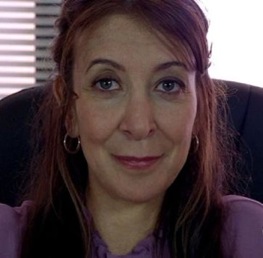
There was something odd about this scene, not just because the lady was creepy but because there seemed to be an extended bit of time devoted to her. When Locke asks to see her supervisor, the camera holds on her close-up for an inordinately long time before she says yes and gets up. Unless her appearance is significant and foreshadows something (and I can’t imagine what that would be) then why are we lingering on her?

Wait…I think maybe I just found my answer. Turns out we’ve seen this woman before. In Season Three’s Tricia Tanaka Is Dead, Hurley’s dad takes him to see a psychic who claims she can rid him of his curse. Turns out his dad had paid her off. But guess who the psychic is?

Now that that pointless side trip is over…

I felt better when Rose showed up and announced herself as the office manager. When she hesitates to place Locke in a position at a construction site, calling it “unrealistic,” he asks her what she knows about realistic. She frankly reveals that she has terminal cancer, and that her initial reaction to the news was a refusal to accept it. Eventually she decided to stop the denial and live whatever life she had left. I bring this up because it is yet another plot point that ties to an earlier episode: Season Two’s S.O.S., in which Rose’s cancer is revealed. There is a scene where she and Locke briefly meet at the airport in Sydney, him in his wheelchair. Later on the island, she alludes to him that they’ve both been healed (she explains to Bernard still later that she knows the cancer is gone; she can feel that it’s not in her body).

On a side note, it’s kinda weird that Rose works for Hurley and just happened to be on the same flight from Sydney to Los Angeles with him. Maybe everyone from the temp agency had been to a conference. For temp agency employees. In Australia.

Back at home, just as an Oceanic rep arrives with his suitcase of knives, Locke tells Helen about being fired because he ditched the conference to go on a walkabout. He says they wouldn’t let him go (another of my questions from two weeks ago answered) and that he yelled at them not to tell him what he can’t do. But this time, he acknowledges that they were right – showing an insight that the other Locke didn’t posses (and which the Man in Locke mocked him for when he spoke to Ben in Jacob’s cave). He pulls out Jack’s business card and tells Helen that he doesn’t want her to spend her life waiting for a miracle because there’s no such thing. She assures him that he was the only thing she was ever waiting for was him, but also says, “There are miracles, John.”

Soon we see John is his new temp position: middle school substitute teacher. He seems to like it, and when he heads into the teacher’s lounge for lunch, he exchanges a friendly introduction with the European History teacher: Ben Linus. So it appears that Ben, like his younger colleague Ethan, has a whole other life in this timeline that suggests he was never on the island.

Huh.

THE FUNERAL PARTY
Ben enters Jacob’s chamber and finds Ilana alone crying – probably more over the death of Jacob than the death of her team members (sorry Bram). She asks how they died, and Ben tells her that Locke turned into a pillar of black smoke and killed them all. He lies when he says that this was how Jacob died as well. Whether this is significant or not I don’t know, but Ilana is now under the impression that the Man in Black killed Jacob while in the form of the Smoke Monster. I wondered previously if the Man in Black can harm Jacob when he’s in smoke form. If the answer is no – which it probably isn’t, but if –  Ben’s lie might be a signal to Ilana that something is amiss.

When Ben says that Locke kicked Jacob’s body into the fire and it burned away, Ilana walks to the now-flameless pit, pulls out a sack and fills it with ash. Will these ashes provide the same protection that the ash around Jacob’s cabin provided? That the ash Bram poured around himself or that The Temple inhabitants used around the perimeter provided? The ashes Ilana takes can’t just be Jacob’s, can they? Wasn’t there wood burning in the fire? How exactly do the ashes we’ve seen provide protection against the Man in Black? That’s starting to emerge in importance to me as far as our many, many mysteries go. Is the fire pit the key to the protection? Does anything burned in this location take on a protective quality?

Ben asks llana if she knows why Locke carried Richard out into the jungle. With no tone of doubt, she says it’s because he’s recruiting.

The real Locke is still lying on the beach. I felt a pang of sadness at seeing him lying there with a crab on his head. It scurries away as Frank covers him up and says, “He’s gettin’ pretty ripe.”

When Ilana and Ben emerge, only Sun and Frank are left on the beach. Sun says the others all went to The Temple. “Right now it’s the safest place on the island,” Ilana says. “We should go there too. Come on, let’s get out of here.”

S: What makes you think that I’m going with you?
I:  Because you want to find Jin.
S: What do you know about my husband?!
I:  I know that if he’s on the island and he’s alive, then he’ll be at The Temple.

Why does she think that? It’s a big island, lots of people, lots of places. Why would she assume Jin would have found his way there?

Sun says they have to bury Locke – an especially generous gesture given how anxious she must be to arrive at the place where Jin supposedly is. As they carry Locke’s body across the beach, Ben asks Ilana why she had to bring Locke’s body to the statue.

I:  Because the people there needed to see the face of what they’re up against.
B: And what’s to stop what they’re up against from changing his face?
I:  He can’t, not anymore. He’s stuck this way.

So how much does Ilana know and understand about what’s happening? She seemed unphased upon hearing that a man turned into a giant puff of smoke and killed her comrades. Presumably she knows that the Man in Black and the Smoke Monster are one and the same, and she knows that he can’t change his form again now that he’s picked Locke. Although there must be some way of taking on a new form, however difficult it may be, seeing as he’s done it once (that we know of). We still don’t understand exactly how the Man in Black took over Locke’s body. I’ve speculated that he used Christian Shephard to get Locke off the island so that Locke might be killed and brought back, enabling him to take over the body (though he didn’t really “take over” Locke’s body; he just took on his form). I don’t know how he would have guaranteed Locke being killed off the island, but maybe there was some way he would have been able to arrange it had Ben not stepped in and taken care of it for him. When the Man in Locke first entered Jacob’s chamber and confronted his old nemesis, he said that he had found his loophole and that Jacob had no idea what he – the Man in Black – had to do to get there. At this point, we don’t have any idea either. So why is he stuck in the form of Locke?

Getting back to Ilana, she also knows that The Temple is the one safe haven left on the island. And she knows about Jin, which means she probably has information about some of the others too. Sayid, for example, who she “escorted” onto Ajira 316…

The group comes back upon the old 815 camp, and they bury Locke where some of the other island bodies are buried (I think the makeshift cemetery is home to Libby, Ana Lucia, Boone and Shannon). The skeleton of Eko’s unfinished church is nearby. When Ilana asks if anybody wants to say something about Locke, Ben finally steps forward. “I knew him. John Locke was a…a believer. He was a man of faith, he was…a much better man than I will ever be. And I’m very sorry I murdered him.” This is one of the few things Ben has ever said on the show where I actually believed him. I think his growing understanding and remorse, as well as being thrown into the position of not knowing what the hell is going on – a position to which he is unaccustomed – will continue to fuel him toward a sacrifice he will ultimately make.
Ben’s brief eulogy is touching, and as much as I love all things Frank Lapidus (seriously, how much does that guy rule?), I sort of wish the scene hadn’t ended with a joke. (Frank’s line, a runner-up for the episode’s best: “This is the weirdest damn funeral I’ve ever been to.”)

RECRUITMENT
With the arrival of Season Six and the revelation of the Man in Locke as the Smoke Monster comes a brilliant new device I hope we’ll get more of: SmokeyCam! I loved watching the Smoke Monster’s POV as he barreled around the island, stopping right outside Sawyer’s house (his billowing reflection visible in the window) and then retreating…the crazy sound effects – something mechanical as well as what sounds like an animal’s cry – on full audio display. That’s such a cool sound effect. What the hell is it?

After locating Sawyer, Smokey retreats back to the jungle and unties a sack from a tree which contains Richard. (That cracked me up. He had poor Richard strung up in a sack in a tree.) The Man in Locke tells him it’s time to talk.

R: What do you want?
L: What I’ve always wanted. For you to come with me.
R: Why do you look like John Locke?
L: I knew he’d get me access to Jacob. Because John’s a candidate. Or at least he was a candidate.
R: What do you mean? What do you mean a candidate?
L: Didn’t Jacob tell you any of this?
R: Any of what?
L: Oh Richard…I’m sorry. You mean you’ve been doing everything he told you all this time and he never said why? I would never have done that to you, I would never have kept you in the dark.
R: And what would you have done?
L: I would have treated you with respect. Come with me and I promise I’ll tell you everything.
R: No.
L: Are you sure about that, Richard? Because people seldom get a second chance.
R: I’m not going anywhere with you.

Man in Locke stops short when he looks past Richard and sees a boy standing there, looking all Children of the Corn. Dressed in Others garb, he is standing Christ-like with bloody arms and palms facing outward. Richard turns to see what Man in Locke is looking at, but the boy is either gone or invisible to Richard. This creepy moppet’s appearance is among the biggest WTF moments of the new season, and the fact that it seems to scare the Man in Locke fascinates me.

But he’s not the only one who’s frightened. Richard is still completely unnerved by the Man in Black’s presence (and especially in this new form). He also looks genuinely bewildered by the talk of candidates. Is it true that he has had no idea what Jacob was up to for all these many years? I also wondered if there’s any particular reason that the Man in Black has always wanted Richard to come with him, or if his desire for Richard’s allegiance is just part of an attempt to win followers.

Of course, the Man in Locke’s line that “people seldom get a second chance” carries a nice irony since he himself seems to be enjoying exactly that. And most of the 815ers seem to be as well, thanks to the alternate timeline (although since we don’t understand the nature of that yet, we can’t really say if it’s a second chance).

Man in Locke leaves Richard, promising to see him sooner than he thinks, and returns to Sawyer’s, this time in human form. Sawyer is just beginning a new stage of mourning: severe intoxication. The house is a mess, music is blaring and he’s sitting in the bedroom in boxers and a wifebeater, drinking whiskey from the bottle (sounds like my typical Wednesday night). Locke walks into the room, and Sawyer slowly takes in his visitor. Luckily he’s not too drunk yet, though he must think he is. “I thought you were dead,” he says.

“I am,” Locke answers.

When Sawyer tells him to get out of his house and Locke counters that it’s not his house but just the place where he lived for a while, Sawyer seems to take him in more fully.

S: Who are you? Cause you sure as hell ain’t John Locke.
L: What makes you say that?
S: Cause Locke was scared. Even when he was pretending he wasn’t. But you? You ain’t scared.
L: What if I told you I was the person who could answer the most important question in the world?
S: And what question is that?
L: Why are you on this island?
S: I’m on this island because my plane crashed. Cause my raft blew up. Cause the helicopter I was on was ridin’ one
too heavy.
L: That’s not why you’re here. And if you come with me, I can prove it.

WHEN YOU GOT NOTHING YOU GOT NOTHING TO LOSE
So they head off into the jungle, and while making their way, Sawyer sees the boy from earlier standing beyond the Man in Locke. This time the boy’s arms are by his side and don’t appear to be bleeding. Man in Locke is surprised that Sawyer can see him. He runs after him and trips on the way (why doesn’t he just turn into Smokey?). When he looks up, the barefoot, blonde boy is standing right above him, staring down at him with contempt.

“You know the rules,” the boy says. “You can’t kill him.”

The Man in Locke gets to his knees and borrows his physical predecessor’s common refrain: “Don’t tell me what I can’t do.”

The boy shakes his head dismissively and walks away. Locke repeats himself, yelling this time.

So who’s the kid? Well I had no idea upon watching the show, but a number of friends have suggested with confidence that it’s young Jacob…though they all admit they don’t know why or how that makes sense. I confess that this possibility didn’t even enter my mind, but it certainly seems to make sense. Well…okay, it makes sense in Lost-world. He does look sort of like Jacob (actually I’d say he looks more like a young David Marcus, who you Trekkies know as the son of one James T. Kirk. But I digress…).
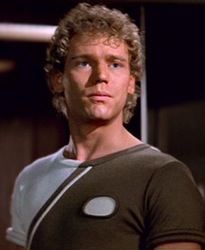
More importantly, he and the Man in Locke recognize each other and speak to each other with common understanding. But if this is Jacob, who is the “him” he refers to? Is he saying that he himself can’t be killed by the Man in Black? If so, why does he say “him” instead of “me?” When Man in Locke and Ben first entered Jacob’s chamber, even Jacob acknowledged that the Man in Black had found his loophole. So could the boy be referring to someone else that the Man in Locke intends to kill? Again with these rules and who can and can’t be killed. According to Ben, Charles Widmore broke the rules when he repeatedly left the island and had a daughter with an outsider, and when Keamy killed Alex. Upon visiting Widmore on the mainland, Ben says they both know he can’t kill Widmore. So many unexplained rules…

Is the boy even real? If he is Jacob, will he re-grow at an accelerated rate? Reader Nic A. pointed to (if I might make another Star Trek reference) Spock’s resurrection and rapid growth from boy to man in Star Trek III: The Search for Spock. What does the boy’s presence mean for the Man in Locke’s plans? Whatever it means, Man in Locke doesn’t seem too concerned about it when he returns to Sawyer, even playing dumb when Sawyer asks if he caught up with the kid. “What kid?” he asks.

But before that happens, while Sawyer is alone, Richard runs out of the jungle in a panic.

Richard runs off as the Man in Locke returns. He and Sawyer continue their trek through the jungle, but now Sawyer is thrown off by Richard’s warning. He soon pulls a gun on Locke and asks what would happen if he pulled the trigger. Cool as can be, Locke asks, “Why don’t we find out?”

S: What are you?
L: What I am is trapped. And I’ve been trapped for so long that I don’t even remember what it feels like to be free. Maybe you can understand that. But before I was trapped I was a man, James, just like you.
S: I have a hard time believin’ that.
L: You can believe whatever you want, that’s the truth. I know what it’s like to feel joy, to feel pain, anger, fear, to experience betrayal. I know what it’s like to lose someone you love. You wanna shoot me, shoot me…but you are so close James, it would be such a shame to turn back now.

Sawyer relents and they press on.

CAVE OF WONDERS
They arrive at a cliff face overlooking the ocean. A number of ladders descend to a cave opening. Man in Locke goes first, and as Sawyer follows, his ladder snaps and falls. The Man in Locke saves him and they make their way down to the cave. A scale sits on a table, holding fist-sized rocks – one dark, one light. The dark one seems to be slightly heavier. Locke picks up the light one and throws it into the ocean, telling Sawyer it’s an “inside joke.”

He leads Sawyer further into the cave and makes his revelation: names, scrawled in white all over the cave walls and ceiling, each preceded by a number and almost all of them crossed out. “That’s why you’re here,” he tells Sawyer. “That’s why you’re all here.”

Of all the names I could discern which were crossed out, the only one I recognized was Littleton (Claire). I didn’t see Cortez (Ana Lucia), Carlyle (Boone), Rutherford (Shannon), Dawson (Michael), Pace (Charlie) or Smith (Libby). I think I saw Goodspeed (Horace?), but didn’t notice any other names of people from the Dharma Initiative, the freighter or the Others. The only other names I could make out – and I didn’t recognize any of them – were Mattingley, Troupe, O’Toole and Sullivan.

But of course there were those names which were not yet crossed out, as Sawyer and Man in Locke discuss:

The absence of Kate’s name among the un-crossed out strikes me as quite conspicuous, as I assumed that the list hidden in Jacob’s ankh – which Dogen found when Jack and Co. arrived at The Temple with a dying Sayid – would correspond to the names remaining on the wall. So has she been crossed out? She must have been on there to begin with, right?

And the questions keep coming. Why did Jacob choose these people as potential candidates? What happens when someone’s name is crossed off? Claire’s name is struck out, but we don’t know how long ago that happened. She appears to be alive, but we also don’t know yet what her story is, so we can not be sure how long one can survive on the island after being crossed off. We don’t even know if being crossed off means that person is going to die (though Man in Locke refers to the names in the cave as “people whose lives he [Jacob] wasted.” And then there’s the fact that Locke had not yet been crossed off; his surrogate does that now.

Why did Jacob decide these people weren’t candidates? Is this list related to the lists that I assume have been handed down from Jacob to Richard to Ben? What about the list that Michael was given, instructing him to bring Hurley, Sawyer, Jack and Kate to the Others? Is everybody from Flight 815, or at least all those who survived the crash, on the island because of Jacob? What about the Ajira passengers?

What does it mean, if anything, that Hurley and Sayid were selected by Jacob after coming back from the island? Did they just happen to be on the plane and survive, only being identified as candidates later and prompting Jacob to lure them back to the island? Does the Man in Black have a place like this, where he has been scoring names, perhaps with a dark rock?

A QUESTION…AND THIS ONE’S NOT RHETORICAL
Okay, enough of me talking at you. It’s time to let the people speak, and I have a question to pose. I think we all assume that in this great duel of the fates for the island, Jacob is the good guy and the Man in Black is the bad guy. But what if we’re wrong?

What if Jacob is the selfish manipulator and the Man in Black is the one trying to save everyone? What if everybody who’s been doing Jacob’s bidding – Richard, Dogen, Ilana, Ben, etc. – have all been misled and misguided? I know some fans out there on the internets have mentioned this possibility. Considering that Jacob has been represented as “white” and the Man in Black, well, there it is, it would be a bold move to subvert a lifetime of cultural conditioning as to what those two colors represent. Or at the very least, it would muddy that viewpoint enough to show that we all have the capacity for both sides – something Lost‘s producers have always aimed to explore.

The show has provided clues that could suggest either outcome. In this episode, Richard told Sawyer that the Man in Locke is “not gonna tell you anything. He’s gonna kill you.” But the Man in Locke shows Sawyer exactly what he promises. And not only does he not kill him, he saves his life. He then talks about Jacob’s belief that that the island needs protecting and refers to all the names in the cave as lives Jacob has wasted. On the other hand, the way Man in Locke talked to Ben after Jacob’s death showed him to regard the castaways’ pre-island lives as pathetic and miserable. He seems to have a healthy contempt for them.

So in the spirit of interactivity, and of me finding out if more than three people are reading these things, let me know what you think. Is Jacob the good guy in all of this, with the Man in Black as his murderous enemy? Or are we headed for a flip?

LOOSE ENDS/FOOD FOR THOUGHT
-I’ve noticed that Henry Ian Cusick’s name is still listed among the main cast members. I had read that Desmond would not be a series regular this year, though this suggests otherwise. I wonder why he wasn’t in any of the Lost Supper photos. And speaking of regulars, I’m wondering how Ilana and Frank will factor into the story as we move through the final season. I would think that if they’ve been bumped to regulars this year, there must be some pretty big stuff coming down the pike for them. I can’t wait to find out what.

-You gotta love that Helen was wearing a shirt that says “Peace & Karma.”

-I wanted to circle back to Locke’s conversation with Helen about miracles. While many elements of Locke’s flash-sideways connected to Locke’s original backstory, there were some notable differences (like acknowledging that the walkabout organizers were right to tell him he couldn’t go). Sideways-Locke’s opinions of miracles is another stark contrast to the Locke we’re familiar with. His belief in miracles comes up directly in the Season Four finale, There’s No Place Like Home (Part II). Locke tells Jack he’ll have to lie about everything that happened since they got to the island. He says it’s the only way to protect it. “It’s an island, John. No one needs to protect it!” Jack shoots back.

L: It’s not an island. It’s a place where miracles happen.
J: There’s no such thing as miracles.
L: Well…we’ll just have to see which one of us is right.

Not only does Locke feel differently in the sideways world, but apparently Jack “Nothing is Irreversible” Shephard does too.

-Seeing Locke’s body laying in the ground as Lapidus and Ben threw dirt over him was a final, sad reminder that Locke as we’ve known and loved him for years is no more. We have the sideways Locke and the Man in Locke, but we’d be remiss not to say goodbye to the original Man of Faith. RIP, John.

-Obviously one the Lost’s big themes is destiny vs. free will. Do we control our own fate, or has our course been predetermined? Eloise Hawking believes in destiny, as she told Desmond when they first met, using the example of a man on the street who gets killed in an accident. She says it wouldn’t matter if she had intervened to save him. If it wasn’t one thing today, it would be something else tomorrow. She also sets her own son, our friend Daniel Faraday, on a course that she knows will result in his death.

Faraday, on the other hand, winds up at the opposite end of the spectrum. His whole argument for detonating Jughead is that the past can be changed because people are variables. “We think, we reason, we make choices, we have free will. We can change our destiny,” he tells Jack and Kate. And until we know the meaning of the alternate timeline, we won’t know if he’s right.

But the question raised its head again in this episode, and I was obviously intrigued by the Man in Locke’s assertion that ever since Sawyer’s contact with Jacob, his choices have not been his own. Jacob met Hurley a day before Ajira 316 departed, so his influence in that case is a lot easier to consider than Sawyer’s, or Kate’s, both of whom met Jacob in their childhood. There are a lot of decisions to be made between the age of 10 and…whatever age they are now. I’m left wondering if this is the kind of issue the show would even attempt to resolve, or if in the end we’ll see that neither fate nor destiny control our lives in full, leaving Jacob and the Man in Black – or perhaps their replacements – to play out their game for all eternity. If that mysterious boy on the island is indeed Jacob, maybe that’s why he’s there and that’s what he means about the rules and not being able to kill the unknown “him.” If one is light and the other is dark, then both must exist, always. Like The Joker says to Batman in The Dark Knight, “I think you and I are destined to do this forever.”

There you go: destiny.

LINE OF THE NIGHT
“Well I guess I’d better put some pants on.” – Sawyer

Tonight’s Episode: Lighthouse

February 20, 2010

Favorite Movies of 2009

Filed under: Movies — DB @ 1:24 pm
Tags: , ,

A traditional Top Ten list doesn’t make much sense to me. I can pick out my absolute favorite few movies in a given year, but beyond those, I’m not really sure what distinguishes my seventh favorite movie of the year from my eighth. By the same token, cutting the list off at ten seems equally pointless if the idea is to highlight the movies from the year that meant the most to me. Again, I’m not sure how to differentiate number ten on my list from number twelve. So what follows is a look at my favorite movies from the year, period…starting with the top of the top and working my way through the rest alphabetically rather than assigning arbitrary rankings.

And away we go…

#1:
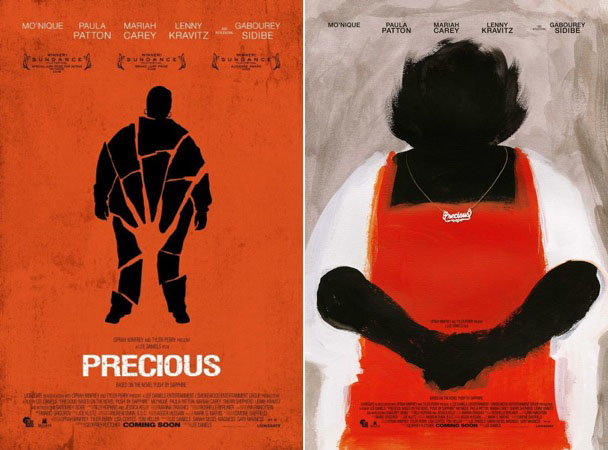
PRECIOUS

If you’ve been afraid to see this movie, get over it. Yeah, it’s not exactly the feel-good movie of the year….but for my money, it was easily the best, so no excuses. You may think that the story of Claireece “Precious” Jones – an obese, illiterate 16 year-old, abused every which way by her monstrous mother and pregnant with her second child by her father – will be unbearably dark and depressing, but you couldn’t be more wrong. Remember last year’s crowd-pleasing indie (and winner of eight Academy Awards) Slumdog Millionaire? Precious is satisfying in much the same way. It doesn’t have the same stand-up-and-cheer momentum going for it, but like Slumdog‘s protagonist Jamal,  Precious refuses to be defined by her environment or background and will not allow others to set her limitations. From an audience’s perspective, the more important similarity between the two films is the emotional response they earn. As unforgiving as Precious’ circumstances are, she has the courage to fight against the forces that threaten to keep her down, and in her struggle is beauty and hope. She may still face a bleak future, but she’ll face it on her own terms, and not without a fight. Precious is not depressing; it’s inspired and inspirational.

As the producer of films like Monster’s Ball and The Woodsman, Lee Daniels has shone a light on dark, complex stories that ask more of us than another empty Mummy sequel or Katherine Heigl romantic comedy…and which give us more in return. Now he reveals himself as a director just as willing to tackle challenging material and find a way to make it accessible to a mainstream audience. With a script by Geoffrey Fletcher, adapted from the novel Push by Sapphire (the film’s full title cites its source material), Daniels strikes a delicate balance between the harsh realities of Precious’ life and the fantasies that provide her an escape, and he employs carefully measured cinematic flourishes to keep the gritty elements from becoming too overbearing. He is aided in this effort by the terrific, undersung cinematography of Andrew Dunn, who keeps dark the stifling apartment Precious shares with her cruel mother, but also bathes it in an orange glow as if the fires of hell are burning just offscreen. He contrasts this with brighter, more natural lighting for the classroom where Precious begins to come into her own.

In the title role, newcomer Gabourey Sidibe does more than just fulfill the highly specific physical requirements of the character. She nails the girl’s soul, and her performance is only more impressive once you see an interview with her and realize what a transformation she makes, holding every part of her physical self differently in order to become Precious. Lenny Kravitz and Mariah Carey shine in smaller roles as a nurse and social worker, respectively. Carey, especially is a wonderful surprise. Shedding her known persona entirely, she plays an average woman working a difficult job that takes its toll, and the strength of her performance is that in just a few scenes she shows us more about this woman than the movie has time to tell. She’s really excellent. At the alternative school where Precious begins her new journey, she finds a friend and supporter in the lovely Miss Rain, played by Paula Patton with an open heart and a tough edge lurking below the surface. The girls who play Precious’ classmates are also essential to the film’s success. Each brings a unique charm to the table and gives the sense that they could be the subject of their own compelling story.

Then of course, as Precious’ mother Mary Jones, there is Mo’Nique. Where did this woman come from? I don’t think I had seen her in anything prior to this, and only had marginal awareness of her as a comedic actress. Well there’s nothing comedic about her work here. Mo’Nique strikes with the fury of a hurricane, delivering a performance so powerful, so searing, so scary and riveting that for all of the character’s savagery, you just want more of her. You can’t take your eyes off her, and every single one of her scenes packs an unforgettable punch to the gut. The movie, and Mo’Nique’s performance, challenge the audience to understand that even a monster has its motivations. We aren’t asked to excuse or forgive anything Mary does, but in seeing what drives her, we are made to see that evil has roots. It doesn’t simply spring from nothing, and Mo’Nique drives that point home in the year’s best performance.

Don’t be afraid of Precious. You know it was showered with awards and accolades, you know you’re supposed to like it, but maybe it just sounds like so much work. Well listen to the words being typed by my fingers: this is a great, great film that will, in the best way possible, knock you on your ass. Vibrant characters, wonderful acting, humor, heart, drama…do not miss it.

The Rest:
(500) DAYS OF SUMMER

Writers Scott Neustadter and Michael H. Weber and director Marc Webb have pulled off one of the hardest types of films to do: a refreshing, original romantic comedy. Forgoing the gloss of such by-the-numbers studio efforts that have kept the likes of Kate Hudson and Matthew McConaughey busy over the last several years, (500) Days of Summer enjoys a breezy indie feel in its structure (jumping around through days in the relationship), its look (there’s a nice earthtone palette employed by cinematographer Eric Steelberg, and it actually makes Los Angeles look like a pleasant place to live) and certainly in its casting of Joseph Gordon-Levitt and Zooey Deschanel as the couple. As the romantic Tom and the cynical Summer, Gordon-Levitt and Deschanel embody a relationship that is sweet, sad and authentic in all its ups and downs. I’m not even sure it’s fair to label it a romantic comedy; that might be limiting. The more dramatic elements feel real, rather than tacked on in order to hit story beats. It reminded me of Eternal Sunshine of the Spotless Mind in its capturing of a moving, believable relationship that evokes the yearning, excitement, joy, confusion, frustration and heartache that will be recognizable to anyone who’s ever been young and in love.

x

ADVENTURELAND
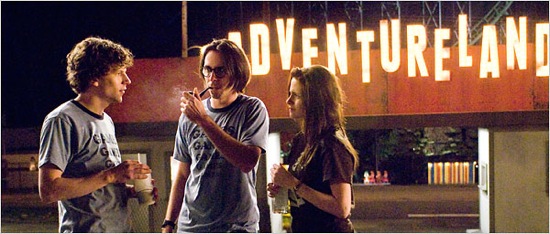
I’ve never worked at an amusement park; there wasn’t a lot of sex or drugs in my youth; and I was only 10 years old in 1987, the year in which this film is set. So I’m not quite sure what it was that I so personally connected with in the story of a college grad forced to take a summer job at a local, old-school fun park. Perhaps it was just the pleasure of watching a winsome story in an interesting setting with a colorful, appealing group of characters. Or maybe I’m just a sucker for movies where kinda nerdy guys get to hook up with hot girls. Whatever it was, the film slowly, warmly snuck up on me, just as the experience does on the protagonist James, played by Jesse Eisenberg. It’s evident that writer-director Greg Mottola (The Daytrippers, Superbad) has a lot of affection for this story and these people, and the cast – including Kristen Stewart, Martin Starr, Ryan Reynolds and Bill Hader – couldn’t be better. A few lesser-known actors also stand out: watch for Margarita Levieva as the park’s resident fantasy girl Lisa P. and Matt Bush as its resident bonehead, Frigo. Great movie for a warm summer night.

x

AVATAR
Despite its less-than-original story and simplistic characters, Avatar succeeded for me as a thrilling and transportive cinematic experience, introducing the beautiful but dangerous world of Pandora. Sure, I wish that James Cameron’s vivid imagination could have extended far enough to, say, create a less obvious name than Unobtanium for the planet’s elusive mineral sought by the humans as an energy source. (Seriously….Unobtanium?) It doesn’t hold up to Cameron’s past films, and its allure will probably fade over time, but right now in its recent wake I can say that the technical and creative achievements won me over. Plus, Sigourney Weaver makes everything better.

x

DISTRICT 9
The mysterious marketing campaign peaked people’s curiosity, and Peter Jackson’s name as producer didn’t hurt, but once we showed up it was co-writer and director Neill Blomkamp’s vision that carried the day. The film thrusts viewers immediately into the action, offering the minimal amount of history needed to set-up the story of an alien population in Johannesburg being forced out of the slum they’ve occupied for 20 years in favor of new, government-sponsored housing further outside the city, all while their massive, immobile mothership hovers overhead. How did the aliens and the humans learn to relate? How did they learn each others’ language? The answers may be interesting, but we don’t get them and we don’t need them. We accept the world as it is and dive into the story.

Using a combination of documentary-style footage with traditional narrative structure, Blomkamp and co-writer Terri Tatchell introduce us to Wikus Van De Merwe (impressive newcomer Sharlto Copley), a mid-level bureaucrat at Multi-National United, a global corporation which has been placed in charge of the massive alien evacuation operation. A seemingly minor incident in the field winds up having life-altering consequences for Wikus and puts him at odds with MNU, forcing him to seek help from the creatures he’s trying to displace.

It’s interesting to me that in this strong year for science-fiction, when genre god James Cameron returned to the game with a film huge in scope and budget, young filmmakers like Blomkamp and Duncan Jones (see Moon further down) are still carrying the torch of  ingenuity that Cameron displayed 25 years ago with The Terminator. With its simple but imaginative premise, low-tech style and adrenalizing tension, District 9 reminded me of Cameron’s 1984 breakthrough. If we’re lucky, this is the first step in a similarly awesome career.

x

FANTASTIC MR. FOX
Wes Anderson’s foray into stop-motion animation manages to be a completely original film even while sharing the now-familiar DNA that runs through all of the director’s work (including 1960’s rock and roll from artists like The Rolling Stones and The Beach Boys, appearances – vocally only, in this case – by Bill Murray, Jason Schwartzman and Owen Wilson, and camerawork that slides and glides over immaculately designed sets). The fact that the film fits so snugly into Anderson’s oeuvre reinforces what a singular talent he is. His charming take on Roald Dahl’s classic story perfectly casts George Clooney as the voice of the title character who, despite his effort for a normal, domestic life, can’t turn away from his natural hunting instincts. His brazen thievery from the local farmers Boggis, Bunce and Bean endanger the entire animal community as well as his marriage. Among the pleasures of the adaptation by Anderson and Noah Baumbach is one of my favorite characters of the year, and one not featured in Dahl’s source material: Mr. and Mrs. Fox’s outcast son Ash, voiced by Schwartzman. Ash is frustrated that he lacks his father’s suave style and athleticism, and it upsets him all the more when his seemingly perfect cousin Kristofferson comes to stay. Ash gives the film much of its humor, and much of its heart as well.

x

THE HANGOVER
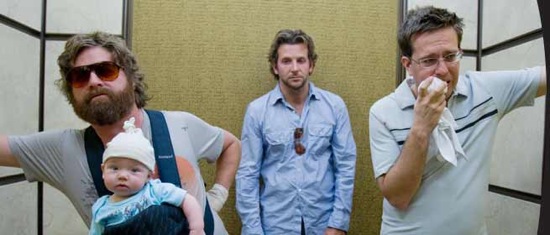
The high-concept premise of this hilarious comedy is sort of brilliant in its cleverness and simplicity: three men wake up in their wrecked Vegas hotel suite the morning after a bachelor party, unable to find the groom or recall anything about the previous night’s activities. Going off what few clues they have – including a tiger in the bathroom and a baby in the closet – they try to piece together what happened in time to find their friend and get back to L.A. for the wedding. The journey is full of belly laughs, but the trio itself is the key to the movie’s magic. Bradley Cooper is the cool party boy, Ed Helms is the uptight straight-arrow and Zach Galifianakis is…well, words really can’t do justice to Galifianakis’ oddball man-child, but he’s nearly worth the price of admission alone. If you don’t have the taste for a little raunch in your comedy, this probably isn’t for you. But if movies like Old School and Wedding Crashers are up your alley, The Hangover will have you rolling.

x

HARRY POTTER AND THE HALF-BLOOD PRINCE
As a die-hard fan of the Potter books, I have (like many such fans, I suspect) a complicated relationship with their movie adaptations. This one was no exception, and my list of “why did they change that” and “it makes no sense to keep this if they didn’t include that” was long. Still, there’s a lot to enjoy about Half-Blood Prince. Director David Yates and screenwriter Steve Kloves manage some magic of their own in the balance they strike between the darkness encroaching on all the characters and the humor that comes as a result of the students’ raging hormones. To the latter point, two standout additions to the cast are Jessie Cave and Freddie Stroma as Ron’s girlfriend Lavender Brown and Hermione’s suitor Cormac McClaggen, respectively. Both are welcome and, at times, hilarious additions to an already amazing cast. Jim Broadbent, the latest British stalwart to join the series, shines in the key role of a professor from Hogwarts’ past. And as a teenage Voldemort in some too-brief flashbacks, Frank Dillane is frighteningly good, ever-so-subtly capturing the malice and menace that lurks just below the respectable prefect’s surface. Cinematographer Bruno Delbonnel casts a spell as well, with striking camerawork that moves furtively in and out of the shadows and helps conjure the feeling of dread that hangs over the story. Unfortunately the film oddly and frustratingly deflates in its last few scenes, when it should be hitting its emotional heights. But up until then it’s the moodiest, funniest and most beautiful film in the series so far.

x

THE HURT LOCKER
Director Kathryn Bigelow’s best film since Near Dark is an unrelentingly intense experience that places viewers alongside a three-man bomb squad in Iraq. Jeremy Renner plays the daredevil leader Will James, whose apparent lack of fear and casual discarding of protocol troubles his fellow soldiers, the cautious J.T. Sanborn (Anthony Mackie) and the nervous, struggling Owen Eldredge (Brian Geraghty). Even amidst the heart-pounding set-pieces, the film manages to be an intimate character study, drawing the audience close to the three men through simple glimpses into their days and nights, on duty and off. Working from a solid script by Mark Boal, a journalist who spent time with bomb squads in the field, Bigelow directs with restraint and a documentary-like unobtrusiveness, letting the natural tension of each situation do the work. She’s also not afraid to exercise the patience required to convey the men’s quieter challenges, demonstrated by a sequence in which they fall under attack in the middle of the desert by a sniper and must wait their enemy out for hours. This is a tight, compelling drama offering an unflinching look both at the broad experience of contemporary warfare and the personal experiences of the soldiers who fight it.

x

INGLOURIOUS BASTERDS
“Once upon a time in Nazi Occupied France…” is the kickoff to Quentin Tarantino’s long-gestating World War II tale. Over the course of five chapters, the writer-director tells two stories: one about a squad of Allied soldiers hunting and scalping Nazis across the French countryside; the other about a young Jewish woman, the sole survivor of her family’s murder at the hands of the SS. The two threads meet in a bravura, 40-minute final act that finds Tarantino audaciously and thrillingly re-writing world history. Along the way, he plays with tension like he never has before. He’s described his efforts as equivalent to stretching a rubber band as far as it can go before snapping. Scenes are often lengthy, and he wrings the maximum amount of suspense he can before delivering the payoff. The film’s ensemble – winner of the Screen Actor’s Guild award for Best Performance By a Cast – features Brad Pitt, hamming it up amusingly as the U.S. lieutenant in charge of the Basterds; Melanie Laurent as the Jewish girl; Michael Fassbender as an undercover British officer; Daniel Bruhl as a Nazi war hero; and Diane Kruger as a German movie star. But the standout performance belongs to Christoph Waltz as the cunning Nazi colonel Hans Landa, a simultaneously genial and sinister detective. It’s a great role, and in his American film debut, the veteran Austrian actor makes an unforgettable impression. He’s won nearly every acting prize available to him since the film premiered at last May’s Cannes Film Festival. All the hallmarks we expect from Tarantino are here: brilliant dialogue, shocking violence, great performances and an obvious love of films and filmmaking.

x

IN THE LOOP
This hilarious satire of diplomatic relations between the U.S. and the U.K. in the days leading up to a Middle East war flew under the radar last summer, but demands to be seen by anyone who likes their comedy whip-smart and their language extra-salty. The Oscar-nominated screenplay combines the rapid-fire wordplay of Aaron Sorkin with the precise and artful profanity of David Mamet. Few of the players are household names (James Gandolfini and Steve Coogan are the biggest stars on hand), but they are a sensational group of new and familiar faces who helped make this one of the best surprises I’ve had at the movies in recent memory. See it as soon as you can. And check out the lengthy collection of deleted scenes on the DVD – they’re every bit as good as what remained in the movie.

x

THE LOVELY BONES
I know that in offering praise on this film, I’m in the minority. Adapted from the 2002 best-seller by Alice Sebold, it received mixed to savage reviews, with Roger Ebert calling it “deplorable.” (Even if you weren’t a fan of the movie, I think a look a Ebert’s review shows that he’s way off base in his interpretation). Having not read the book – in fact, having the opinion that the story of a murdered teenage girl observing her family and her killer from heaven sounded kinda stupid – I came to the film only with the expectation that Lord of the Rings director Peter Jackson would create something interesting. As far as I’m concerned, he succeeded. Saoirse Ronan plays Susie Salmon, the murdered girl caught between earth and heaven in a place whose landscapes are constructed from her own memories and from where she watches her family (Mark Wahlberg and Rachel Weisz portray her parents) deal with her loss while her neighbor and killer (Stanley Tucci in a creepy, change-of-pace performance) covers his tracks.

The movie is not without problems. The role of Susie’s grandmother, played by Susan Sarandon, seems to exist mainly for comic relief, but I expect there was more to it in the book. Similarly, a plot thread involving a classmate of Susie’s who seems able to sense the dead girl’s presence is underdeveloped and probably had more significance on the page. From what I’ve seen, most of the negative reviews come from critics who’ve read the novel and feel that Jackson buried its beauty and soul in an orgy of CGI. (The “In-Between” that Susie occupies in death is aggressively art directed, no doubt.) Still, I think that overall Jackson created an engrossing and haunting movie that finds power in the depiction of a family torn apart, a killer trying to keep himself together and young victim trying to make sense of what happened to her and where she’s headed.

x

MOON
There’s something cool about Duncan Jones, the son of David Bowie, making his feature directorial debut with a science-fiction film whose haunting quality evokes his father’s classic song “Space Oddity.” The film centers on astronaut Sam Bell, the lone occupant of a lunar space station, as he enters the final two weeks of a three-year stretch running an operation in which the moon’s surface is mined for a substance that is sent back to Earth and converted to energy. As Sam’s departure looms, he has an accident which leads to a devastating discovery.

Among the smartest things that Jones does with his movie is casting the great Sam Rockwell in the lead role. The discovery that Bell makes and the situation he finds himself in as a result provide a great showcase for the actor, who deserves every opportunity to show off his stuff. Even with a setting as expansive as the moon and the emptiness of space around it, Jones keeps the film feeling intimate and Sam’s isolation palpable. And while, like many space stories, this one may seem a bit cold and cerebral, the director and his leading man offer something strangely moving and highly satisfying. This one really stayed with me.

x

THE ROAD
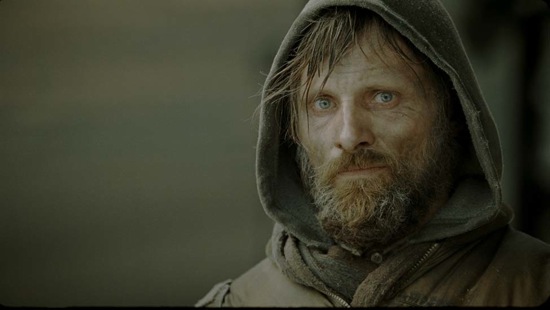
Director John Hillcoat and screenwriter Joe Penhall don’t mess with Cormac McCarthy’s Pulitzer Prize-winning source material in their adaptation. The story is so sparse, there’s not much messing that could be done. They faithfully tell the story of a father and son moving through the cold, dismal, ashen landscape that remains after an undefined natural disaster has destroyed the world. They search for food, they search for shelter, they try to avoid other survivors – many of whom have turned to cannibalism – and they try to reach the coast, where they hope to find warmer weather and perhaps hope itself. That’s it. Boring? Never. Viggo Mortensen is at his understated best as the protective father, striking a natural rapport with Kodi Smit-McPhee as his compassionate son. Watch for a brief but astounding performance by Robert Duvall, who digs deeper in five minutes of screen time than many actors can go in a whole film.

x

A SINGLE MAN
The impressive feature directorial debut of fashion designer Tom Ford looks as great as one would expect, but luckily Ford is concerned with something more than just the scenery. In the best performance of the year by a male lead, Colin Firth plays George Falconer, a college professor struggling and failing to deal with the sudden death of his partner. Taking place over the course of one day (with flashbacks illuminating the relationship between George and Jim, played by Matthew Goode), the film gives us a character perilously close to losing his way but still in possession of a desire for life, even if he doesn’t realize it. The journey of discovery that comes as George navigates his grief is one experienced by the audience as much as the character, for we get to see Firth dig into a role deeper than anything he’s done before. The scene where he receives the phone call about Jim’s death is a masterful example of restraint and internalization.

x

STAR TREK
An epic, imaginative reboot of the beloved but recently stalled-out Star Trek franchise that successfully introduces yet another new crew to follow, succeeding despite the challenge of having audiences accept this new team as younger versions of the original cast. Director J.J. Abrams pulls it off thanks to a smart script by Roberto Orci and Alex Kurtzman (how is it that these guys write so well for Abrams and so poorly for Michael Bay?) that takes the Trek continuity fans are familiar with and through that most wondrous and liberating storytelling device known as time travel, spins it into an alternate reality that paves the way for a new franchise. Some fans cried foul, accusing the filmmakers of using time travel as a cheat that would let them ignore the history of a universe already deeply established. Others heralded the bold choice as just what Star Trek needed, a creative jolt that shows respect to its roots but frees the filmmakers from the shackles that had begun to hold the series back. I agree with the latter, and the fact that Leonard Nimoy shows up to bridge the gap – just as William Shatner appeared alongside Patrick Stewart in Generations to help pass the baton to The Next Generation crew – helps smooth the transition.

Abrams and his technical crew have created a great looking film, one that revels in widescreen glory and fills the frame with icy blues and sunbright oranges. ILM’s gorgeous visual effects enhance the cinematography and art direction, and advances in technology have allowed Abrams to ramp up the intensity and speed of Trek’s space battles. (Even in the original spate of Trek movies, working with higher budgets and fewer limitations than the TV series, the battling ships didn’t move very fast or evasively. The climactic pursuit of the Enterprise by the Reliant in Wrath of Kahn was less cat and mouse than two blind mice). Credit also goes to the cast assembled to fill the shoes of the beloved original Trek crew. When Chris Pine’s casting was announced, I was skeptical. I hadn’t seen him in anything, but he looked like a dime-a-dozen pretty boy. Watching the movie, I was pleased to find he had charisma to spare and that, at moments, was able to almost capture that elusive Shatner magic. Zachary Quinto’s casting, on the other hand, seemed too good to be true from the get-go, and the story crafted by Abrams, Orci and Kurtzman allows him to add surprising new dimensions to Spock, a character we thought we knew so well. Quinto and Karl Urban, as Dr. McCoy, most successfully channel their predecessors, although Simon Pegg is full of promise as Scotty and Zoe Saldana is a smart, sexy Uhura.

Abrams does occasionally falter, most glaringly in a brief but distracting segment involving not one but two over-the-top CG creatures that serve no real purpose. He also has a tendency towards humor that goes a little too goofy, as when Kirk’s hands swell like balloons as the result of an injection he’s given by McCoy. Luckily these moments are brief and forgivable, overshadowed by a sense of fun and excitement that whets the appetite for continuing voyages.

x

UP
The Pixar formula might be getting boring if there was actually anything formulaic about what they do. But building a movie around a grumpy, 80-year old man isn’t exactly playing it safe. The fanciful adventure is set in motion when widower Carl Frederickson (voiced by the great Ed Asner) equips his house with enough helium balloons to carry him to Paradise Falls, an idyllic South American locale that he and his wife Ellie always dreamed of visiting but never managed to reach. The plan first goes awry when Carl discovers an inadvertent stowaway named Russell, a neighborhood boy trying to earn his latest Scout badge. Things continue to unravel from there, with talking dogs, an exotic bird and a mysterious figure from the past all standing between Carl and his dream. Among the movie’s many pleasures is an early montage depicting Carl and Ellie’s life together, and it is among the best and most moving scenes all year, a beautiful example of economic and emotional storytelling. It seems Pixar’s only formula is to come up with great stories and tell them superbly. If only they could share the secret, maybe all movies would be this imaginative and touching.

x

UP IN THE AIR
Avatar wasn’t the only movie released in December to feature wondrous three-dimensionality, and it wasn’t the best either. That honor belongs to this shimmering comedic drama from Jason Reitman, whose script (also credited to Sheldon Turner, who worked on earlier drafts, and based on a novel by Walter Kirn) provides three of the year’s richest roles, as well as a timely commentary on how the economic disaster affects the lives of everyday working folk. George Clooney, continuing to exhibit superb taste in material, plays Ryan, a consultant hired by companies to come in and handle layoffs. He loves the traveling-man life that goes along with the job, and has perfected the art of living simply and efficiently. Then the arrival of two women into his perfect world has unexpected effects. One is co-worker Natalie (Anna Kendrick), a recent Cornell grad with big ideas to redefine Ryan’s company; the other is Alex (Vera Farmiga), a fellow frequent flier with whom Ryan becomes romantically involved.

None of the three are quite what they appear to be, and Reitman’s generosity as a writer and understanding of great characters and relationships is beautifully displayed, particularly between Ryan and Natalie. They’re forced to go on the road together so Ryan can show her the ropes, and Reitman doesn’t just coast by throwing them into a constantly contentious relationship that finally thaws after one special moment finally brings them to a mutual understanding. Their relationship is more layered than that. There is tension, but Ryan doesn’t treat Natalie with total contempt or disrespect. He wants her to understand what he does and how her proposal would affect that. Though his goal is to stop her plans from going into practice, he’s supportive of her as she learns the job. She, in turn, is open to his guidance even as she wants to prove herself as more than the naive girl she feels he takes her for. As she watches him handle the challenge of firing someone, she knows that she has overlooked the nuance involved, and the more Natalie learns, the more Kendrick shines. None of this may sound like much, but many movies wouldn’t give its characters such shadings. Reitman doesn’t present us with archetypes; he presents us with realistic people…who admittedly, have perhaps unrealistically great dialogue to speak. There is so much to enjoy about this movie, from the Oscar-nominated performances of Clooney, Kendrick and Farmiga to the supporting players that include Danny McBride, Amy Morton and Reitman’s Juno alums Jason Bateman and J.K. Simmons; from the crisp editing and cinematography that visually convey the precision of Ryan’s lifestyle to the inspired stroke of weaving in scenes with non-actors who really were laid off from their jobs; from the blend of levity and thoughtfulness to the lack of a tidy resolution. With his third film, Jason Reitman cements his standing as one of contemporary cinema’s great storytellers.

x

WHERE THE WILD THINGS ARE
Director Spike Jonze and his co-screenwriter Dave Eggers accomplish a small miracle with their adaptation of the classic children’s book by Maurice Sendak, turning the story known as much for its brevity as its charm into a psychologically fascinating meditation on loneliness, love and family. It’s  the best, most honest and moving depiction of adolescent isolation and longing I’ve seen since E.T. Actor Max Records is a natural as the rambunctious, lonesome protagonist with whom he shares a name, but the wild things are the real stars. Beautifully realized by Jim Henson’s Creature Shop, enhanced by the visual effects team at Double Negative and voiced by James Gandolfini, Catherine O’Hara, Forest Whitaker, Lauren Ambrose, Chris Cooper and Paul Dano, they are a stunningly original group of characters. I could not get enough of them, and my only disappointment with the film is that at an hour and a half, I didn’t get to spend nearly as much time with them as I wanted. The movie got a bit lost in the crowded fall schedule, and has been disappointingly overlooked during the awards season. I hope that in time, it will be re-visited, re-evaluated and eventually appreciated far and wide for the work of art that it is.

x

ZOMBIELAND
Because a certain faction of my friends were going through a big zombie-phase – from video games like Left 4 Dead to graphic novels like The Walking Dead to regular novels like World War Z – I felt compelled to rally the troops for what looked like a fun little movie on a favorite subject. I had no idea just how much fun it would be. It was, in fact, the most fun I had at the movies all year. Opening night, a packed house – always a good way to see a comedy – and from the first moments to the last (a post-credits easter egg worth sticking around for), Zombieland delivered bigtime. The pairing of Jesse Eisenberg (who had the A to Z “land” spectrum covered in 2009) and Woody Harrelson is inspired, the former’s nervous, nebbish energy providing a great counterpoint to the latter’s cool, cavalier alpha male. Adding to the fun are Emma Stone and Abigail Breslin as too-cool-for-school (if-there-were-still-school-but-there-isn’t-because-all-the-teachers-and-classmates-are-zombies) sisters out for themselves. The movie’s aim is firmly to have fun, but it goes just deep enough to remind us what these four characters have endured and lost, which enriches the story in a small but meaningful way. It also boasts the best surprise celebrity cameo of the year; maybe the best ever. So avoid all spoilers, and remember: double-tap!

x

There we have it. I could list plenty of other movies from the year that I enjoyed a lot, but these are the ones that left the strongest initial impressions. The film lover in me feels bad leaving certain others out, but I’ll exercise some restraint and leave you with these montages posted to YouTube from other movie fans out there, honoring the year in film.

(Click here for the creator’s blog listing all the clips featured here)


February 16, 2010

LOST S6E3: What Kate Does

Filed under: Lost — DB @ 3:00 am

Yes, S6E3. Apparently last week’s episode counts as 2 even though both hours were contained within the LA X heading.

First off, I would like to begin with an apology. If you read last week’s message, you may have noted that I referred to the character Cindy as a “stewardess.” Reader Chelsey S. offered a friendly reminder that the proper term in this day and age is “flight attendant,” and that I should get with the times and stop clinging to sexist, politically incorrect terminology. So let me take this opportunity to assure all of my readers that I meant no disrespect to any of the devoted women and men who fly the friendly skies and attend to our needs and comfort at 20,000 feet.

Now then, this episode’s title references the Season Two episode What Kate Did, in which we learned that she tucked her stepfather Wayne into bed for a drunken night’s sleep and then blew up the house, sending her on the run from the most persistent on-screen U.S. Marshal since Tommy Lee Jones. This episode doesn’t offer anything so revealing – at least not as far as we can tell at this point – but we did get a number of interesting tidbits throughout the hour.

TAXI DRIVER
We pick up with L.A. Kate as she jumps into that cab occupied by Claire and demands at gunpoint that the driver take off. She looks out the rear window and sees Jack standing by the curb, talking on a cell phone. At the sight of him, Kate seems to experience a déjà vu moment similar to the ones that Jack had on the plane. I asked in my last write-up why Jack was the only one experiencing that sensation, but I guess we’ll see the others have it at different points. Seeing Jack from inside the cab isn’t the first time she’s laid eyes on him; they bumped into each other on the plane. But the look she gives definitely says that he is familiar to her in a deeper way.

As they cab driver makes his way out of the airport, he has to abruptly stop at a crosswalk for Arzt, whose bags have fallen into the road. Arzt’s presence also sends me back to last week’s rumination about why we’re seeing characters that died on the island re-appear in this new timeline. I wondered about Arzt specifically last week because unlike Charlie and Boone, he was a side character who didn’t have a big story on the island. So whereas there might be things to explore with Charlie and Boone in L.A., what purpose could Arzt serve? It’s still early in the season, but I wonder if his role is to continually pop up in all of their lives, appearing in these small ways and reinforcing that fate connects these people whether or not they ever landed on the island. He might not influence the story in a big way, but maybe he’s a poster boy for the interconnectedness of the Flight 815 family.

After they clear the airport and the cab driver abandons ship, Kate jumps into the driver’s seat and orders Claire out of the cab, leaving her stranded without her luggage and purse. Once she has a chance to breathe and get the cuffs off, she goes through Claire’s bags. Upon seeing the baby gear and a photo of Claire pregnant, her conscience kicks in. She goes back to the spot where she booted her, and finds her on a bench waiting for a bus. She returns her bags and after asking where she’s headed, offers to give her a ride. Claire is skeptical, but given her unfamiliarity with the area, Kate’s calmer demeanor and a general lack of options, she agrees.

When they arrive at the Brentwood home of the adopting couple, Claire asks Kate to go to the house with her. But the woman who answers the door says that her husband left her and she can’t take the baby. Perhaps due to the sudden onset of stress, Claire starts having contractions, so Kate takes her to the emergency room. I tried to recall Los Angeles geography to see if Brentwood was near Jack’s hospital, but realized seconds later that this was still just a short while after the plane landed and Jack wouldn’t be there anyway. Another familiar doctor is there, however: Ethan.

I FEEL THE NEED…THE NEED FOR GOODSPEED
Ethan introduces himself as Dr. Goodspeed. Makes sense, seeing as he is the son of our Dharma Initiative friends Horace and Amy, though it is a little jarring to hear him use that surname. (On the island, he was known as Ethan Rom – an anagram for Other Man).

Ethan’s appearance here got me thinking – always a bad sign since half of what I think about is 95 percent likely to be utterly irrelevant to the plot. I assume, based on his name, that Ethan is still the son of Horace and Amy. Remember though, that the first time we met Horace, it was outside Portland when he came upon Roger Linus carrying his pregnant and barely conscious wife Emily. She gave birth to Ben right there, and then died. The woman with Horace at the time was named Olivia (played by actress Samantha Mathis of Pump Up the Volume, Little Women, The American President, etc.). Some years later, when Roger and Ben arrive on the island to join the Dharma Initiative at Horace’s invitation, Olivia is still there. She was teaching Ben’s science lesson about volcanoes when there was supposedly an invasion of the Dharma compound by the Hostiles.

Now jump ahead to last season’s 1970’s storyline. Olivia is gone, and Horace is married to Amy. The show offers no explanation for this, though the behind-the-scenes story is that Mathis was either unavailable or uninterested in returning, and so Amy was created and paired with Horace. These things happen, but the fact remains that Olivia is now part of Lost‘s history. It was never officially established on the show, but visual clues and press information from ABC seemed to make it clear that Olivia was Horace’s wife. And it’s fair to guess that if Ethan is now living a respectable life off the island, he might never have been to the island at all. So was Horace ever on the island? If he wasn’t, how did he meet Amy? Is Ethan Amy’s son, or Olivia’s? Was the Dharma Initiative ever on the island in the new timeline? The sweeping camera shot across the underwater island revealed the Dharma barracks, but were those houses and swing sets actually built by the Dharma Initiative, or did they belong to another group first? Does anyone else care about this? No? I should move on?


Okay, so Ethan tells Claire that she can deliver her baby then and there – a little early but not dangerously so – or wait. You gotta laugh when he tells her that waiting will involve him administering some drugs. “It’s perfectly safe. I just don’t want to have to stick you with needles if I don’t have to.” Not a concern he had on the island…

During a brief moment of beeping-machine induced alarm, Claire shouts, “Is my baby okay? Is Aaron okay?” Kate has another moment, very brief, when Claire says the name Aaron. Like the appearance of Jack back at the airport, this jogs something inside her, but the moment quickly passes. Later, when they’re alone in the hospital room and Kate is about to leave, Claire asks why she’s wanted. “Would you believe me if I said I was innocent?” Kate asks.

“Yeah,” Claire answers. “Yeah I would.”  In fact, Claire and Kate have come so far in so short a time that Claire even gives her credit card to Kate as a thank you…and a little something to help her as she remains on the run. Kate then tells her that Aaron is a great name. “I don’t know why I said it,” Claire laughs. “It’s like…I don’t know, I knew it or something.” Kate says Claire should keep the baby, and then departs. So what is Kate’s crime in this timeline? Did she still kill her stepfather? Or is it someone else’s murder she is wanted for?  During the Lost panel at last summer’s Comic-Con, Damon and Carlton played a video containing an excerpt from an America’s Most Wanted-type show. The segment was on Kate, and said that in an attempt to blow up her stepfather at his place of business – a small office he operated out of as a plumber – she inadvertently killed his co-worker instead. Don’t know whether that will come up on the show or not…

RESURRECTION REDUX
Like John Locke before him, Sayid appears – and that’s the key word, here – to have come back to life. He is weak and confused and obviously doesn’t know what the Temple is or how he got there. His wound is almost completely healed, and he thanks Jack for saving him. Mr. Miyagi comes bursting onto the scene, having been notified of Sayid’s return by Daniel-san. (Maybe significant, maybe not, but when Miyagi hears the news, he instinctively clutches whatever it is he’s wearing around his neck. It looks like a narrow capsule.) They want to take Sayid for a private talk, but Jack says that’s not going to happen until he gets some answers. The ensuing scuffle is broken up when Sawyer fires a gun and says that Miyagi can do whatever he wants to the others, but that he’s leaving. “Please, you have to stay,” Miyagi calmly but firmly implores him, as if so much depends on it. Sawyer ain’t buying it. Before ditching the party he warns Kate, “Don’t come after me.”

But of course, that’s what Kate does. That’s “what Kate does.” She goes after people who tell her not to go after them. So when Daniel-san can’t get an answer out of Jack about where Sawyer is headed, Kate says she can track him and bring him back. Jin offers to go with her. Miyagi agrees, sending along two Others to accompany them: Aldo and Justin.

I instantly recognized Aldo from an earlier season; it’s a symptom of my unhealthy knowledge of the show, although his adult-Haley Joel Osment looks make him easy to recall. Before he even brought it up I placed him as the guard that Kate, Sawyer and Alex knocked out when they rescued Karl from that crazy Clockwork Orange room back in Season Three’s Not in Portland.


THE IRAQI PATIENT
Miyagi straps Sayid down, blows some sort of dust or ash over him (the ash?), attaches electrodes to his chest and cranks a machine which electrocutes him. It was a lot smaller and more high-tech, but I still thought about Count Rugen’s Machine from The Princess Bride, which he used to torture Westley (also known as the Man in Black!). I missed the Albino, but I guess since Sayid’s wound was already healed, he had no purpose there.

After the electrocution, Miyagi goes a bit more primitive, burning Sayid with a hot poker. Sayid keeps asking what he wants and why he’s doing this, but Miyagi says nothing. Daniel-san returns with a couple of men and offers yet another unhelpful explanation – the kind that the Others are so good at. “I’m sorry we had to put you through that,” he says. “It was a test. We had to be sure.”



“Test to be sure of what?” Sayid counters.

‘Don’t worry, you passed,” Daniel-san says reassuringly as the men lead Sayid out. When he’s gone, Daniel-san says to Miyagi, “I just lied to him, didn’t I?”

“Yes,” Miyagi answers solemnly.

When Sayid is brought back to Jack and the others and he tells them what happened, Jack storms out and finds Miyagi and Daniel-san, who…okay wait. Since we find out later in the episode what Miyagi’s real name is, let’s go ahead and start using it: Dogen. And since we’re not calling him Miyagi anymore, Daniel-san doesn’t make much sense. His real name hasn’t been spoken on the show yet, but he has been named behind the scenes as Lennon. So with that…

When Jack arrives, Lennon is looking at a book – a little casually if you ask me, given all that’s going on. “Hey Shephard,” he says. “We were hoping you’d come on your own.” Lennon tries to explain that Sayid is sick, and says there’s not really a literal translation for Dogen’s explanation, but that the closest thing is “infected.”

L: He says you have to give your friend this pill.
J: Are you serious? Why don’t you give it to him?
L: Because it won’t work unless he takes it willingly, and he won’t take it willingly from us.
J: Well then maybe you should have asked him to take it before you tortured him.
L: We didn’t torture him. We were…diagnosing him.
J: To see if he was infected?
L: Yes.
J: I’m not going to give anything to Sayid unless I know what’s in it.

Dogen decides to put aside the bad taste English leaves on his tongue at this point, and joins the conversation directly.

D: Tell me Shephard. Your friend, how did he get shot?
J: He was… he was helping me.
D: So it was your fault?
J: Yes.
D: And there have been others who were hurt, or died, helping you?
J: Yes.
D: Well, then this is your chance to redeem yourself. It’s medicine. And your friend needs it.
J: What happens if I don’t give it to him?
D: The infection will spread.

Once again, as in last week’s episode, Dogen asks how Sayid got shot. And once again, Jack doesn’t answer the question directly. Oh Jack, why must you make everything so complicated? Couldn’t you just say, “We were in 1977, carrying the core of a hydrogen bomb through the Dharma Initiative barracks hoping to slip through unnoticed since they knew we weren’t who we claimed to be, and then Benjamin Linus’ father shot him?” Sounds perfectly simple to me. But no, Jack can never take the simple route. Instead he says only that Sayid got shot helping him. Dogen uses that to play on Jack’s guilt, but I don’t feel like that’s where his line of questioning is going. Why do they keep asking what happened to Sayid? Why does it matter?

Jack returns to Sayid and presents the pill, explaining their claim that he is infected and that the pill will help him. When Sayid asks Jack’s opinion, he admits he’s not sure what to think.

J: You know before, when you thanked me for saving your life, I didn’t have anything to do with it Sayid. I didn’t fix you; they did.
S: I don’t care who fixed me. I only care about who I trust. So if you want me to take that pill Jack, I’ll do it.

Jack soon returns to Dogen and takes a seat across from him as Dogen rolls a baseball around his table.

J: You speak pretty good English for someone who needs a translator.
D: We both know that I don’t need a translator.
J: Then why do you have one?
D: Because I have to remain separate from the people I’m in charge of. It makes it easier when they don’t like the decisions I make for them.
J: Who are you?
D: My name is Dogen.
J: Are you from here? The island?
D: I was brought here, like everyone else.
J: What do you mean “brought here?”
D: You know exactly what I mean.

What do you mean “brought here?” It’s not the first time Jack has heard this. In Season One’s finale Exodus, while transporting the dynamite from the Black Rock to the hatch, Locke and Jack had a conversation that is one of the most pivotal in the entire series: the one in which Locke says they were all brought to the island for a reason.

Jack wasn’t buying Locke’s theory then, but we know that he’s since come around to accept much of what Locke had told him. Now when Dogen talks about being brought here, Jack doesn’t question it. His silence is admission that he does understand…even if he doesn’t quite understand.

He admits to Dogen that he hasn’t given Sayid the pill, because he doesn’t know what’s in it. Dogen keeps harping on the “infection” and Jack keeps asking what’s in it. Dogen finally tells Jack that he has to trust him. “I don’t trust myself,” Jack says. “How am I supposed to trust you? Let’s see where trust gets us,” he adds, before taking the pill himself. Dogen leaps forward and Heimlichs the shit out of him until he spits up the pill. “Now are you gonna tell me what’s in it?”

“Poison,” Dogen admits. When Lennon rejoins them a few minutes later, Dogen pours Jack a cup of tea.

J: Why would you people want to kill Sayid?
D: We believe he has been…[something in Japanese]
L: The closest translation is “claimed.”
J: Claimed? By what?
D: There’s a darkness growing in him, and once it reaches his heart, everything your friend once was will be gone.
J: How can you be sure of that?
D: Because it happened to your sister.

Now a few people have asked me if Jack knew he had a sister. The answer is yes. At his father’s funeral, Claire’s mother approached him and told him about her affair with Christian and about Claire. But Dogen’s statement doesn’t answer how he’s sure of what’s happening to Sayid, so is he just saying this thing about Claire as a way to get Jack invested in what they are trying to do? What do they know about Claire?

After Jack asks why they would want to kill Sayid, there is an ominous bit of music that plays before Dogen answers that Sayid has been claimed. And I’m almost certain that faintly contained in that brief bit of music is the mechanical sound of the Smoke Monster. In my previous write-up, I pondered two questions. Well…I pondered a lot more than two, but two in particular are relevant at the moment. The first is the idea that Jacob and the Man in Black are “collecting” the 815ers and perhaps others on the Island, in some sort of cosmic chess game. The other was that the ash around Jacob’s cabin was being used to keep the Man in Black trapped inside. The hole in that theory was that the Smoke Monster has been running wild all over the island. I wasn’t sure if that wrecked my theory or if there could be an explanation. All this new information – the idea of Sayid being “claimed,” along with that sly foreshadowing in the music, brings me back to those questions.

If the Man in Black has been “claiming” people on the island, do they have to die in certain ways or under certain circumstances? Is that why Dogen and Lennon keep asking how Sayid was injured? If Claire has indeed been claimed by the Man in Black, then it lends credence to the idea that Christian Shephard has been claimed as well and has been doing the Man in Black’s bidding, seeing as the last time we saw Claire alive she was with Christian. (If she was alive then; many fans speculate that she did not survive the explosion of her house when Keamy’s team attacked New Otherton, despite the fact that she got up and was walking around with Sawyer, Locke, Hurley, Ben and Miles.)

And to the second question, if the Man in Black was confined to the cabin, could he have somehow been using these claimed souls to do his work in Smokey form?

Also, let’s not forget that this concept of “infection” dates back to Season One. From the beginning, Rousseau spoke of an infection that claimed the members of her team. We even saw it in action, sort of, during one of last season’s flashes when Jin came upon Young Rousseau having an argument on the beach with her lover Robert. With her gun pointed at him, she said, “You’re not Robert. You’re someone else. That thing changed you. You’re not Robert. You’re sick. That monster made you sick.” (Robert and the rest of her team had gone down the opening at The Temple wall to try and rescue Montand, who had been dragged down there by the Smoke Monster.)

Robert replied, “It’s not a monster. It’s a security system guarding that temple.” When he convinced her that he meant no harm to her or their baby, she lowered her gun. Then he raised his and fired at her. But it jammed, or was empty, and she shot him down.

Other allusions to a sickness on the island include the vaccine used by the Dharma Initiative to inoculate new arrivals on the island, by Desmond when he was manning the hatch and by Ethan on Claire when the Others had her in the medical station. Also, Desmond was convinced that the island air was unsafe and that he could not go outside without a hazmat suit. Even though he eventually realized that was a lie told to him by his hatch-mate Kelvin, he still seemed to cling to the idea until the arrival of Locke, Kate and Jack in the hatch.

So what is the true nature of this infection? Does Claire really have it? Does Christian? Does Sayid? How did the torture diagnose him? He seemed to react just as one would be expected to react to electrocution and burning: with a lot of pained screams. So what did those tests tell Dogen and Lennon that led them to diagnose him as “claimed?” What does the long delay in Sayid’s revival suggest to them? And if they successfully administered the pill and poisoned him to death, what’s to stop the Man in Black from claiming him again? Oh, and why would the pill only work if Sayid took it willingly?

IT’S ALWAYS SUNNY IN NEW OTHERTON
On their journey to track Sawyer, Kate asks Aldo and Justin why they’re being held at The Temple. Aldo says it’s to protect them from the pillar of black smoke that “looks pissed off.” Jin then asks if they know anything about the Ajira plane. Justin replies, “I think he means the one that landed…” but Aldo obnoxiously cuts him off with a curt, “Justin…shut up.”

He has to repeat that warning a minute later, when they come across a trip wire for a net filled with rocks hanging above them, which Jin says must be one of Rousseau’s traps. All Justin has a chance to say before Aldo intervenes is, “The French woman? She’s been dead for years, this couldn’t be one of…”

At first that line caught my interest in a big way. Later, in talking with reader David E., I remembered that it has been a few years since Rousseau was gunned down by Keamy’s team, so maybe there’s nothing about Justin’s comment to read into it. But still, three years is not that long a time. The way Justin says it suggested to me that Rousseau has been dead for much longer. And why does Aldo get so testy? What’s the harm in talking about Rousseau? Or the Ajira plane? By this point, Kate’s had about enough of Aldo’s attitude. She knocks him and Justin out and starts to continue moving.

J: Where are you going?
K: Catchin’ up with Sawyer.
J: So you never planned to bring him back to The Temple?
K: No. I’m not interested in being a prisoner, are you?
J: Where did your plane land, Kate?
K: What?
J: The Ajira plane that you, Jack and Hurley came in on. Where did it land?
K: I don’t know.
J: Sun was on that plane too. I have to find her.
K: You think they’re gonna tell you? You think they care about you, or about Sun, or about any of us?
J: Who do you care about, Kate?
K: Good luck, Jin.

A) Am I the only one who still finds it weird to hear Jin speaking fluent English? And B) Kate sounds pretty put out by his questions, and is especially dismissive when she says, “Good luck Jin.” Call me crazy, but I think she could stand to be a little bit less of a bitch considering that she is somewhat responsible for Jin and Sun being separated in the first place. Or so one might argue.

She arrives at New Otherton and finds Sawyer in his house. She watches undetected as he pries up a floorboard, removes a shoebox and takes out what looks like a small piece of fabric. He sees her there and she follows him to out to the old submarine dock. She tells him that she came back to the island to find Claire and followed him from The Temple because she thought he could help find her. If she could bring Claire back to Aaron, than this wouldn’t have all been for nothing.

Sawyer tells her that Juliet’s death was his fault, recalling how in the very spot where they’re sitting he had convinced her not to take the submarine home. “I made her stay on this island because I didn’t want to be alone. You understand that, right? But…I think some of us are meant to be alone.”  He holds the piece of fabric in is hand, and we see that it’s a pouch containing a ring; the ring he was going to give to Juliet when he asked her to marry him. Now he stands up and throws the ring in the water.

There’s something about seeing how far Sawyer has come that makes his loss of Juliet that much sadder. They both came from troubled backgrounds, but after all of their bad deeds and failings and heartaches, they brought each other hope and a fresh start. Each was the good thing that the other had come to deserve. Now that she’s gone, what will Sawyer’s new path be? Based on the preview of tonight’s episode, perhaps we’ll find out. It didn’t look too bright…

Once again, I have to praise Josh Holloway’s performance. He portrays Sawyer’s sense of loss with such honesty, building on his sensational work last season. You watch him in these scenes – the way he walks, the way he sits, the way he breathes – and you really, really feel it. This is what grief looks like. The writing and direction doesn’t showcase his grieving; they just allow it to happen, and thanks to Holloway it happens with incredible truth.

Movie Geek Moment: As he holds the ring, Sawyer says that maybe some people are meant to be alone. He might be right. In The Fellowship of the Ring, Galadriel says to Frodo, “You are a ringbearer, Frodo. To bear a Ring of Power is to be alone.” And what ring is more powerful than one that represents love? It’s the power of love, which is of course the theme song from another movie oft mentioned in these write-ups: Back to the Future. And once again I make a completely irrelevant pop culture connection seem like it was planned by the producers all along. That takes a special kind of genius, people. I hope you appreciate it.

Back in the jungle, Aldo and Justin catch up with Jin, demanding to know where Kate went.

Ji: I don’t know. You don’t understand; I’m going back to The Temple.
A: Yeah, right.
Ju: It looks like he’s alone. Maybe we should take him back.
A: Or maybe we didn’t find him alive.
Ju: Aldo, no! We can’t! He’s one of them!
A: He may be one of them.

Hmmm…one of who?

Jin tries to run but gets his leg caught in a bear trap. Aldo raises his gun to shoot him when suddenly he takes two to the chest from off-screen instead. Justin is shot as well. Jin looks up, and standing on a ridge just above him…is a rifle-toting, dirty-faced, Seattle grunge-wearing Claire. So…that should be interesting.

LOOSE ENDS/FOOD FOR THOUGHT
-The sound effect that transitions between the flashes is not the same as it’s been for the past five seasons. It’s still got the airplane “whoosh,” but there’s something else mixed in there that I can’t identify. What does it say about the flash-sideways device?

-Dogen is seen at different points using a typewriter and writing in books. What is he recording?

-In the previous episode, Lennon advised Jack that there were risks to bringing Sayid into the spring. Does what’s happened to him now have anything to do with those risks? Is “infection” one of the risks?

-In my last write-up, I asked why Man in Locke went to the effort of leading Ben to The Temple tunnels for his judgment from Smokey rather than turning into the monster earlier. In thinking about it since then, I suppose it’s because he didn’t want to reveal that side of himself to Ben, and only did so in Jacob’s chamber because he was forced to deal with Bram and his other attackers. Hence the line, “I’m sorry you had to see me like that.”  So what are his intentions with Ben? Has he had to change his gameplan as a result of Ben finding out he’s a smoker?

-Something I noted in LA X but forgot to mention: when the customs officer leads Jin away, and the other officer stays and asks Sun if she understands English, the officer addresses Sun as Miss Paik…Paik being her maiden name. There’s no way this was just a slip-up. But what does it mean? Are Sun and Jin not married in the L.A. timeline? Would she have still learned English if they weren’t together? And if they aren’t married, why are they traveling together?

LINE OF THE NIGHT
There were so many to pick from in his episode, I couldn’t begin to single one out. For your consideration…

“Course he’s fine. He’s an Iraqi torturer who shoots kids, he definitely deserves another go-round.” – Sawyer

“As you can see, Hugo here has assumed the leadership position so…that’s pretty great.” – Miles

“I’m sorry, is this a press conference?” – Aldo

“We’ll be in the food court if you need us.” – Miles

Tonight’s Episode: The Substitute

February 11, 2010

Oscars 2009: And The Nominees Are…

Filed under: Movies,Oscars — DB @ 11:36 pm
Tags: , , , ,


Complete List of Nominees

It’s been over a week since the nominations were announced and I can’t believe it’s taken me this long to shoot off my reactions. I’ve been too busy writing about Lost. And running my meth lab. So for those who might care, here are my thoughts – where I have some – on what made the cut.

BEST PICTURE/BEST DIRECTOR
So the highly anticipated “10 Best Picture nominees” cat is out of the bag, and all in all I’d say it’s a good list. Like a lot of people – most people, probably – the nomination for The Blind Side caught me way off guard. When the trailers for this movie ran last fall, I thought it looked sentimental and cheesy, and even if it was a true story I was still turned off by a movie about rich white people coming to the rescue of a poor black boy. Which is weird, ’cause I loved me some Diff’rent Strokes back in the 80s. Anyway, it didn’t surprise me that people turned out in droves. When Sandra Bullock started winning awards, I finally broke down and saw it. And I’ll admit that it was better than I thought it would be. I give credit to writer/director John Lee Hancock for showing restraint with a story that could so easily have gone down the road I was expecting based on those trailers. But that said, there is no way this film should be singled out as one of the year’s best. It is a nice, “heartwarming” movie, but completely ordinary. With movies like Where the Wild Things Are, The Road, A Single Man, Fantastic Mr. Fox, The Messenger and In the Loop all in the mix, a nomination for The Blind Side is a joke.

Other than that, the list went pretty much as expected. Consensus is that Avatar, The Hurt Locker, Inglourious Basterds, Precious and Up in the Air would have been the five nominees if the category hadn’t been expanded, so it’s interesting that those films’ directors all earned nominations. Usually one or two of those people would have missed. But James Cameron, Kathryn Bigelow, Quentin Tarantino, Lee Daniels and Jason Reitman is a great list to represent 2009 (he had no chance, but I wish Spike Jonze had been recognized for Where the Wild Things Are).

My only other comment here is that as I’ve followed the award season since it began in early December, one of the most pleasant surprises has been how well Inglourious Basterds has done. Christoph Waltz was a shoo-in nominee from the moment the film’s first scene was over, and the screenplay was also a safe bet early on. But I honestly didn’t expect Tarantino’s gonzo revisionist take on World War II to fare so well across the board – critics’s awards, guild awards, ten best lists, etc. I would never have predicted it, but I’m happy that it came to pass, earning QT his second nominations for directing and screenwriting.  Bravo.

BEST ACTOR
No surprises here. Nice to see a young up-and-comer like Jeremy Renner hang in there with the big boys. He impressed me in North Country and The Assassination of Jesse James By the Coward Robert Ford, so I’m happy for him and the opportunities that are sure to come his way as a result of this film.

I also have to take a moment and ask of the people who saw Invictus: do you think Freeman deserved to be nominated? I suppose there are some minor spoilers ahead, so continue at your own risk…

I was so excited about him in this role. Freeman is one of my favorites, and the thought of him playing Nelson Mandela was full of such promise. It’s too bad he blew it on this movie. It’s not that Invictus is bad or that Freeman isn’t good in it. It’s just…this is basically a sports underdog movie. It’s Hoosiers. Remember the Titans. Hell, it’s Major League. It’s the familiar story of a sports team rising above low expectations to win big, and maybe learning some important life lessons along the way. There’s nothing wrong with that per se, but here you have one of the great actors of our time playing one of the great lives of our time, and this is the story he chooses to tell? Freeman does well, but the script doesn’t allow him to dig into the character at all. There are a few moments that hint at what he could have done and where he could have gone had he chosen to do a film that was really about Mandela. But this one – he’s hardly even in the second half/last third of the movie. There’s so little depth for him to play that the film wound up being a pretty big disappointment for me. Freeman delivers as best he can with what’s there, but when you think about how much more he could have done? It makes me sad to say so, but I don’t think he should have been nominated. Viggo Mortensen (The Road), Matt Damon (The Informant!), Ben Foster (The Messenger), Joaquin Phoenix (Two Lovers) and Sam Rockwell (Moon) all had the chance to do much more in their films than Freeman got to do in Invictus, and I wish that Academy members had recognized one of them instead of doing the obvious thing and nominating Freeman for a performance that, through no fault of his own, failed to meet expectations.


BEST ACTRESS
Sandra Bullock’s nomination was no surprise by this point in the season, but it shocks me that she has moved up to take frontrunner status alongside Meryl Streep. She just doesn’t belong here. I’ve always liked Sandra Bullock; she has great comedic timing and her small role in Crash was, for me, one of the film’s highlights. But she has chosen bad movies almost exclusively throughout her career; it’s almost like a gift she has. The Blind Side is better than most of the films on her resume, but there is nothing about this performance that calls for award talk. Bullock can do sassy, she can do tough, she can do sweet – these are not stretches for her, nor does this particular character leap off the screen. I enjoyed her, but at the end of the day it was Erin Brockovich Lite. So what is this nomination for? Is it for finally picking a decent movie? For having a good year? Okay, I get that between the huge box office success of this film and last summer’s The Proposal, Bullock is having a Moment (though everyone apparently chose to ignore that her third film – All About Steve – was widely considered one of the year’s worst). But does making two adequate movies that become commercial hits merit an Oscar nomination? No, especially not when Saoirse Ronan (The Lovely Bones), Emily Blunt (The Young Victoria), Abbie Cornish (Bright Star) and even Maya Rudolph (Away We Go) are sitting the race out. Does it merit a Golden Globe win over Precious‘ Gabourey Sidibe? No way. A SAG award over Sidibe and Meryl Streep? Seriously, no way. This performance isn’t in the same league as her competition. Sorry Sandra. I can only hope the voters come to their senses by the time they mark their ballots.

BEST SUPPORTING ACTOR
Matt Damon has proven to be a great and versatile actor, and it’s surprising that this nomination is his first since Good Will Hunting. But it’s like Academy members filled out their ballots on auto-pilot. “Hmm, Clint Eastwood movie, Morgan as Mandela, important subject matter, scene where he gives an inspirational speech…I think by some Academy bylaw we’re required to nominate this.” Snore. Like Freeman, Damon is good in the film, don’t get me wrong. But also like Freeman, the role doesn’t ask much of him. And like Bullock, Damon finds himself in this race without really doing anything that special. Matt Damon did give a nomination-worthy performance this year; it just wasn’t in this movie. I really don’t get it. There had to be a significant number of people who listed Damon as their first choice – their favorite Supporting Actor of the year – in order for him to score a nomination. I can’t fathom that, even in such an unusually weak year for this category.

The rest of it looks good. It’s nice to see Christopher Plummer earn his first nomination after so many years of excellent work, and Stanley Tucci too. He doesn’t have Plummer’s years under his belt, but he’s been playing the game well for a long time. And it’s great to see Harrelson back in the field. He’s done some terrific work these last several years.

Too bad they’re all gonna lose to Christoph Waltz.

BEST SUPPORTING ACTRESS
Last year’s winner Penelope Cruz scored her second consecutive nomination, and while I would have singled out Marion Cotillard from Nine‘s ensemble, Cruz was good and probably caught voters’ attention with one of the film’s more comedic performances, as well as general hotness. I think Maggie Gyllenhaal benefitted from an all-around appreciation for Crazy Heart. There were stronger performances to choose from – I’d have gone with The Messenger‘s Samantha Morton – and Gyllenhaal’s been overlooked for performances more interesting than this one, but I can’t begrudge her finally getting some recognition. And seeing Up in the Air‘s ladies is no surprise; each is deserving.

Too bad they’re all gonna lose to Mo’Nique.

BEST ORIGINAL/ADAPTED SCREENPLAY
I was off by one in my predictions for both of these categories, but I was happy that in both cases the movie I failed to predict correctly was on my list of personal choices. I thought The Messenger‘s chances were slim given that the Writer’s Guild failed to nominate it even when other sure-thing contenders like Up and Basterds were ruled ineligible, so kudos to the Academy’s writer’s branch for acknowledging this small gem. And major kudos for including In the Loop in the adapted race. Without a doubt one of the best scripts of the year – smart, tight, topical and hilarious. I thought the movie might get overshadowed by something higher profile, but it totally deserves the nomination. Rent this movie NOW.


BEST ANIMATED FILM
What the hell is The Secret of Kells? Whatever it is, I was just glad that for the first time since 2002 there were enough eligible films to have five nominees instead of three. It’s a testament to how much great animation there is these days that any one of these would totally deserve the prize….this Kells thing notwithstanding, since I haven’t seen it.

BEST CINEMATOGRAPHY
Once again, I scored with one of my personal picks even though I didn’t predict it would make the cut. The nomination for Harry Potter and the Half-Blood Prince took a lot of the pundits by surprise, but they must have forgotten how beautifully photographed the film is and how frequently the cinematography was mentioned in reviews. Great to see it recognized.

BEST MAKEUP
Another snub for The Road. Dirt, grime and muck may never have been so artfully applied as they were in this movie. I have no idea what Il Divo is, so no comment on that one, but The Young Victoria?! Over The Road?!? Are you kidding me?? For what? I can’t wait for this category to come up on the show so I can see exactly what sketches, behind the scenes footage and finished clip will highlight how this could possibly have taken a spot. Ed Helms’ missing tooth in The Hangover would have been more nomination-worthy than anything I can think of in The Young Victoria. And Star Trek was nominated? Maybe I’m forgetting something, but that seems to be a nomination for pointy ears and some tattoos on Eric Bana’s head. Big deal. I suppose someone else would look at The Road and say, “It’s just dirt. Big deal.” But of course, they would be wrong. How about something for Zombieland or District 9 in lieu of Trek and Victoria?

As there were no other huge surprises or snubs like last year’s Dark Knight/Bruce Springsteen omissions, that’s all I really have to say about the nominees until it’s time to predict the winners in a few weeks. Prepare to be schooled….in boredom and obsessive movie awards analysis.

February 9, 2010

LOST S6E1/E2: LA X

Filed under: Lost — DB @ 2:30 am

It was a long wait from when Juliet smashed that hydrogen bomb last May to the season premiere that began showing us what happened as a result, but I’d say it was well worth the wait. (And we got to see Juliet sucked down that chasm about four more times, just in case it wasn’t harsh enough last spring.) There’s a lot to cover from this two-hour premiere, and I had to skip Super Bowl parties and a chance to see Gone With the Wind on the big screen in order to deliver the goods today. (I’ve never seen it, despite being a film geek fantastique, and I refuse to see it anywhere but in a theater.) These are the sacrifices I make for you.

Shall we?

UP IN THE AIR
The white flash of the hydrogen bomb finally exploding dissolves into clouds, and we pull back through a window, into a plane, where we find Jack. Welcome back to Oceanic 815, where things are familiar but not quite the same as we remember them. When we first see Jack, he looks a little out of sorts, like he’s not sure how he got there or he forgot where he was. Cindy the stewardess offers him some extra vodka for his drink, just like last time…except not just like last time. Last time, she gave him two bottles. This time, she gives him one. When the plane hits turbulence, Rose – sitting across the aisle – calms him down (the first time around, it was Jack offering comforting words to her). He has a look on his face when the turbulence hits as if he is expecting it, and when it passes he looks relieved. But his relief isn’t that of a nervous flyer who’s happy the shaking has stopped. Jack’s relief seems deeper, as if somewhere inside himself he knows that a corner has been turned. Take a look at how the scene played out originally, side by side with this new course of events.

It seems that flashes forward and back have been replaced by flashes sideways, and our initial introduction to this alternate reality for Flight 815 offers plenty to puzzle over. On the flight we’re already familiar with, Sawyer was fresh from killing an innocent man whom he believed to be the true Sawyer he’d been hunting all his life. On that flight he was brooding and troubled, but here we see his more playful side as he makes eyes at Kate and listens to Hurley’s conversation with Dr. Arzt. He suggests that Hurley be more careful when it comes to what he just told Arzt about having won the lottery. He says people might try to take advantage of him. Hurley laughs off the warning. “Nothing bad ever happens to me,” he says. “I’m the luckiest guy alive.”

This exchange, as well as some other things that we’ll get to, reminds us that although we as viewers are entering this alternate reality at this particular moment, it has existed for much longer; the new timeline was created back on the island in 1977. If the hydrogen bomb truly negated the electromagnetic energy at the Swan construction site, as Faraday predicted, then that’s the moment that time split into two parallel courses. And in this new timeline, which is now 27 years old (Flight 815 took place in 2004), Hurley is no longer plagued by bad luck. Sawyer may not have killed the wrong man – or any man (this is purely my own inference, based on his lighter mood). Boone is not flying with Shannon. Boone, chatting with Locke on the plane (note for the obsessive: Boone was not sitting in Locke’s row on the original Flight 815), asks why Locke was in Australia. Locke tells him about the walkabout, but since we soon learn that even in this timeline he’s in a wheelchair, should we assume he’s lying? Or was he able to go on the walkabout despite his handicap?

I also wonder if he’s in a wheelchair for the same reason. Talking briefly with reader Denise B. last week, we returned to a conversation we had near the end of last season which I actually included in one of these write-ups. Then and now, she questioned whether in an alternate timeline people would just do essentially the same things over again vs. doing things differently. So in regards to Locke, I wonder if he wound up in the wheelchair because he once again became obsessed with his father and paid the price, or was he simply fated to be paralyzed and this time got there through a different set of circumstances? Locke’s inability to walk away from his father cost him his relationship with Helen the first time around. We know that Helen is going to appear this season, so I wonder if she is at home waiting for him right now? Time will tell…

Elsewhere on the plane, Jin is still carrying the watch for Sun’s father, and seems to once again be the impatient and condescending dick we had forgotten all about (as reader Shirley L. said to me, “Nobody likes you, Old Jin!”). Kate is still a fugitive traveling with U.S. Marshal Edward Mars; Sayid is still pining over a picture of Nadia. But did he still learn of her Los Angeles whereabouts by infiltrating his old friend’s terrorist cell for the CIA, or was he in Sydney for a different reason? What about Hurley’s reasons for being in Sydney? He had originally gone down there seeking information about the meaning of the cursed numbers. If he is no longer cursed, why was he in Australia?

While in the bathroom, Jack notices a cut on his neck. Is this a remnant from the Incident? That possibility raises my eyebrows, since again this new timeline must have existed for years prior to this moment. (If my logic here is flawed, set me straight.) When Jack returns to his seat, Desmond (!) is sitting in his row, having fled a snoring neighbor at his assigned seat. Jack has a nagging feeling that they know each other, but Desmond doesn’t appear to recognize him. Now it hadn’t occurred to me that Desmond might not really be there and was just a figment of Jack’s imagination, yet a few of you have suggested that possibility. I assumed (and still do) that his presence was legitimate, meaning he never met Jack at a stadium while training for a race around the world. He never went on that race, never crashed on the island, never pushed the button – because if we believe Faraday’s scenario, there was no button to push. So why does Jack think he knows Desmond? And why is Jack the only one who seems to be experiencing this sense of déjà vu? There is no indication that Kate, Sawyer, Hurley, Sun, Jin or Locke are confused about their circumstances.

When Cindy asks if there is a doctor onboard, Jack answers the call. She explains that a passenger is locked in the bathroom, failing to respond. Sayid appears and offers to help…which he does by kicking in the door. Inside is Charlie, not breathing. Jack pulls him out and with Sayid’s assistance, starts to perform CPR. He removes an obstruction from Charlie’s airway: a bag of heroin. Charlie gasps for air, looks around. “Am I alive?” he asks, then with a tone of disappointment answers, “Terrific.” As he is put into handcuffs and led away, he tells Jack, “You should have let that happen, man. I was supposed to die.”

He was supposed to die? Why would he say that? Is it because even in this timeline, he is fated to die, a fact that will catch up with him one way or the other? And if so, how does he know that? Who has told him that he’s going to die, and whoever it was, how did they know? When Jack returns to his seat, Desmond – who had the honor of informing Charlie about his fate on the island – is gone. Coincidence? Is anything? (Actually, this is just a coincidence according to Damon and Carlton, who appeared on Jimmy Kimmel Live the night of the premiere. In this fun interview, they address some of the things I’ve mentioned.)

This scene makes me wonder if we’ll see Charlie again in this timeline. We didn’t need to see Charlie, Boone, and Dr. Arzt on the plane, did we? We didn’t see Eko or Michael or Ana Lucia and so on, but we assume that they’re there (or at least, I do). So was showing us these old friends just a little dose of nostalgia, or will they somehow factor more significantly into this new timeline?

TOUCHDOWN
Flight 815 lands safely in Los Angeles, and after Mars and Kate pass through customs, she requests a bathroom detour. I don’t know why this guy keeps falling for her ploys, but he allows her into a stall and then stupidly turns away and washes his face instead of diligently watching the door and listening for anything suspicious. Using a pen that she swiped off Jack when they bumped into each other on the plane, Kate tries to undo her handcuffs. Mars is onto her before she can get them off, but she manages to knock him out and run off. She encounters Sawyer in an elevator and he sees the cuffs despite her effort to conceal them with a jacket folded over her hands. Sawyer allows her to step off the elevator ahead of two airport cops, facilitating her escape. When she gets to the taxi line, Mars sees her. She jumps into a cab and pulls out his gun, yelling at the driver to go…and oblivious to the fact that there is already a passenger in the cab. Nice to see you again, Claire. “What are you doing?” she asks with alarm.
Meanwhile, Jin waits impatiently while customs agents go through his bag, asking him questions in English that he can’t understand. Sun observes carefully the whole time and is surprised when one of the officers discovers an envelope full of money that has not been declared. Jin is led away to answer questions and the other officer asks Sun if she understands English. Sun indicates she doesn’t, and although it looks to me like she does understand, I like that the scene plays out ambiguously. In this timeline, was she planning to leave Jin and start a new life in America? Has she indeed learned English?

Jack is also running into problems on the ground. He is paged to the Oceanic customer service desk and told by a rep that his father’s coffin is not there. “It appears it was never put on the plane,” the man says with embarrassment.  “We’re not exactly sure where it is.” It appears that the coffin was never put on the plane. It sounds like they haven’t actually confirmed that, but are just assuming it to be true since it isn’t on the plane now. But could it have been on the plane and somehow disappeared during the flight? Perhaps when passing over the island? I’m not sure how that would make sense since the island is underwater.

Oh, have we not talked about that yet? Huh. Well, it will have to wait.

Sitting in an Oceanic waiting area, an upset Jack meets Locke, who it turns out is missing a suitcase full of knives. He asks Jack what they lost of his. Jack explains that his father died in Sydney.

J: The coffin was supposed to go on the plane in Sydney, but it didn’t. Apparently he’s somewhere in transit. Which is their way of saying they have no idea where the hell he is.
L: Well how could they know?
J:  They’re the ones who checked him in! I mean, they’ve got to have some kind of tracking…
L: No, I’m not talking about the coffin. I mean, how could they know where he is? They didn’t lose your father. They just lost his body.

“In transit” is probably a perfectly accurate description of where Christian Shephard is, at least as we’ve seen over these last few seasons of the show. Anyway, Locke’s words actually seem to provide Jack with (if I might poach a movie title) a quantum of solace. As Locke wishes him luck and starts to leave, Jack inquires about his condition, explaining that he’s a spinal surgeon. “Surgery isn’t going to do anything to help me,” Locke says. “My condition is irreversible.” Jack, still the fixer, replies, “Nothing’s irreversible.” He offers Locke his business card and tells him to call him if he ever wants a consult. “On the house,” he smiles before opening the door for Locke to roll away.

For what it’s worth – which is probably nothing – the business card which we saw in very deliberate close-up was also faintly pictured in the Verizon print ad I linked to in one of my pre-season messages. Take a look again and you’ll see it overlapping Jack’s reflection in this not-so-good scan. Maybe this is one of those moments where I read too much into things, but why did we need to see the card close-up? He could have handed John the card in a wide shot and we would have known what it was.

Another random observation is that this scene marks the first time in quite a long time that we’ve seen Jack and Locke hold a friendly conversation. In fact, I think the last time they talked at length without any issues between them was in Season One’s early episode White Rabbit, which featured Jack chasing a vision of his father. The scene Jack and Locke shared was excellent, and if you haven’t seen it in a while, check it out (it begins at the 1:40 mark).

And by the way, what did happen to Locke’s knives?

THE DYING SWAN
While the detonation of Jughead appears to have successfully created a new timeline, it doesn’t appear that way to Jack and company, who find themselves back at the remains of the Swan hatch…having apparently jumped through time once again. We don’t initially know exactly when they are, other than that it’s late 2004 at the earliest (seeing as they aren’t at the ruined Swan construction site but rather the actual hatch, as blown up by Desmond). Where it was daytime when they dropped the bomb, it is now nighttime. Sawyer is prepared to kill Jack for having led them astray and costing Juliet her life, but then they hear her calling for help from below a twisted mass of metal wreckage.

While they attempt to dig her out, Hurley and Jin are back at the van with a dying Sayid. Jin runs off to get Jack’s help, and that’s when Hurley receives a visit from Jacob, whom he only knows as the guy he met in a taxi outside prison and who told him how to get back to the island. Hurley wants to know who he is, but he’s too preoccupied kneeling over Sayid and looking troubled to answer. After telling Hurley that he died an hour earlier, Jacob gives him a task. “I need you to save Sayid, Hugo. You need to take Sayid to The Temple. That’s the only chance he’s got. And the rest of them will be safe there.” He says that Jin will know where to go. (I loved Hurley’s underplayed reaction to learning this is Jacob). The conversation also clarifies that they are now back in 2007; good news for Sun and Jin.

Once a path is clear, Sawyer makes his way down to Juliet, who looks around her and says, “It didn’t work. We’re still on the island.” As he holds her, she seems to slip out of the moment, randomly saying, “We could get coffee sometime. We can go dutch.” I initially took this non sequitur to be the ramblings of a dying woman with brain injuries, but then another thought occurred to me. What if Juliet’s coffee remark was actually some kind of crossover from the alternate timeline? I don’t know how the logic would play out yet, but perhaps in that moment she somehow accessed another version of herself, wires got crossed through space and time…I don’t have a theory (of course), but when she snaps back to the present situation, she asks James to kiss her and after that says, “I have to tell you something. It’s really, really important.” She dies before she can say any more.

Remember Charlotte’s dying moments, and how she was also drifting in and out of the present?  Her mind would slip away, and when she returned from one of those slips she told Daniel that she remembered him from her childhood, warning her that she had to leave the island and never come back. Of course that hadn’t happened yet because Daniel had not yet existed in her childhood. Did Juliet experience something similar? After he buries her with help from Miles, Sawyer asks him to use his ability to find out what she wanted to tell him. Miles reluctantly obliges and gets an answer: “It worked.”

So Juliet went from saying that the plan didn’t work, to making some random comment about going out for coffee to recognizing Sawyer back in the moment and then trying to tell him that it did work (though he doesn’t seem to know what she means). What exactly transpires in that brief encounter to change her mind, and if it does involve a connection between Juliet on the island and Juliet somewhere off the island, how does that work? And if Juliet is off the island in the alternate reality, does that mean she never came to the island? Could it be that there was never an issue with pregnant women dying there? Maybe the release of electromagnetic energy at the Swan explosion is what caused that epidemic, which would mean it didn’t happen in the alternate timeline. Or is that even a moot point because the island has been underwater – a fact that in and of itself probably would have killed pregnant women. And non-pregnant women. And men, children, dogs, cats and so forth.

Have we still not talked about that yet? Later…

Jack admits there’s nothing he can do to help Sayid, so Hurley takes charge on Jacob’s instructions. Leaving Sawyer and Miles behind to bury Juliet, Jin leads Jack, Kate and Hurley, with Sayid being carried, to the wall around The Temple. Inside the tunnels, they hear whispering and are quickly captured and brought out the other side, where we see what looks like a large Buddhist monastery. This is The Temple.

THE OTHER OTHERS
They’re brought to the entrance, where a tough looking Japanese man, accompanied by a white translator, asks who they are. The question is answered by Cindy, the 815 flight attendant we saw in the opening scene and who disappeared while the Tailies were crossing the island with Sawyer, Jin and Michael. She was last seen in Season Three, briefly talking to Jack while he was in one of the polar bear cages on Hydra Island. He yelled at her, asking what she was doing there with the Others, but she just walked away.

“I know who they are,” she says now. “They were on the first plane, Oceanic 815, along with me.” What does she mean by the first plane? Is the second plane Ajira 316? At first I wondered how they would know about that plane, but I guess Jacob could have told them. Still, there’s something about that line…

The Japanese guy, who I’m gonna call Mr. Miyagi until we learn his real name, orders Jack and the others to be shot. Why this quick decision to dispose of them? Hurley shouts that Jacob sent them there to help their wounded friend. When asked for proof, Hurley points to the guitar case. Mr. Miyagi opens it and finds a large ankh, which at first I assumed was one of the two held by the statue. But it’s probably not large enough, and it also looks different than the statue’s. What do you think?

Miyagi breaks open the ankh and finds a piece of paper inside. Continuing to speak through his translator, who I’ll call Daniel-san for now, he asks for their names, silently acknowledging as he hears them that they’re on the list. Daniel-san instructs his people to bring Sayid to “the spring.” As Miyagi heads inside, Hurley yells out. “Hey! I carried that case across the ocean and like, through time! So I wanna know what that paper says.” Daniel-san replies, “That paper said that if you’re friend there dies, we’re all in a lot of trouble.”

Typical vague Others answer. Thanks for nothing, Daniel-san. I hope you get your ass kicked by Cobra Kai.

In trying to briefly consider why Jacob and now Miyagi and Daniel-san are so concerned about Sayid’s survival, and what the significance of this list is, I wondered if it had something to do with a grand battle for souls. Not that exactly, but the idea that there is this struggle going on between Jacob and the Man in Black, and like in a game of chess, each player is trying to collect pieces. If Sayid dies, it’s a victory for the Man in Black. If he survives, or if he dies under perhaps different circumstances, it’s a victory for Jacob. Again, this consideration was brief because it doesn’t make much sense and I don’t have the time or the brain power to make the pieces fit. It was just a fragmented idea that crossed my mind, especially when I thought about that Spanish Season Six commercial I linked to in an earlier message, which portrayed the characters as players on a chess board. Anyway…

When they arrive at the spring, the water is dirty and brown, which alarms Miyagi and Daniel-san. “The water isn’t clear,” says the latter. “What happened?” So this pool of water has healing powers. Obviously this is where Richard took Young Ben to save his life. Ironic that Young Ben’s would-be killer must now be saved in the same waters.

Miyagi slices his hand and dips it into the spring, but it doesn’t heal. Then they ask Jack who did this to Sayid. Jack says that although he didn’t shoot him, it was his fault. Why does this matter? Why do they want to know who is responsible before trying to save him? Would they perhaps not have tried the spring depending on how or at whose hands the wound occurred?

“If we do this, there are risks,” Daniel-san says. “Do you understand?”  Jack answers, “Do what you have to do,” which raises eyebrows from Jin and Kate. I might have asked, “Gee, what risks? Tell me more.” But not Jack. As Miyagi’s men carry Sayid into the spring, he unveils a large hourglass. As Sayid is lowered in, Miyagi flips it and the sand begins to fall. Jack, Kate, Hurley and Jin watch with worry as Sayid starts moving around, slowly at first, then thrashing. They say he’s okay and that he can be let up now, but they continue to hold him underwater while Miyagi watches the sand fall. Hurley yells “You’re not saving him, you’re drowning him!” but Miyagi still waits for the sand to run out. By the time it does, Sayid’s movements have slowed and stopped. They bring him out and lay him down on a rug.

“Your friend is dead,” Daniel-san says. He and Miyagi exit the chamber with their men, leaving Jack and the rest alone. Jack starts trying to perform CPR on Sayid, but Kate makes him stop. I couldn’t help but think of Jack and Kate finding Charlie hanging from a tree, and Jack’s refusal to give up his attempt to revive him even while Kate begged him to stop. Jack’s efforts with Charlie worked. This time, he listens to Kate and stops trying.

Cindy brings them some food, helped by Zack and Emma, the two kids from the tail section who were being protected by Ana Lucia and Eko until they were taken. A moment later, Sawyer and Miles are brought in, having been captured in the jungle. (I wonder – is Miles’ name on that list from the ankh?)

Daniel-san brings Hurley into Mr. Miyagi’s Bonsai Emporium, where they ask what Jacob told him. Hurley answers he was told to bring Sayid here so they could save him. “He was beyond saving,” Daniel-san says with a tone that suggests Jacob would have known that. After Hurley asks why Daniel-san isn’t translating back to Miyagi and Miyagi says that he doesn’t like the way English tastes on his tongue, he asks through Daniel-san when Jacob is due to arrive.

H: What do you mean?
D:  Is he coming to the Temple?
H:  I really don’t think that’s gonna happen, man. [Miyagi looks up at this point]
D: Why not?
H: You know…cause he’s dead. What, you guys didn’t know?

Miyagi turns to Hurley, his face mixed with sadness and fear, and suddenly all the Temple folk are jumping to defensive positions at his orders. Outside, people are pouring ash all around the perimeter while others launch a large flare that emits bursts of red high in the sky.

When Hurley, watching the commotion, comments that it looks like they aren’t leaving, Daniel-san says, “This isn’t to keep you in. It’s to keep him out.”

SMOKEY AND THE BANDIT
Off that cue, let’s return to the statue, where we last left Ben and the Man in Locke in 2007 immediately after killing Jacob. Ben is still in shock that Locke is apparently not Locke anymore, and almost as disturbed that he’s just killed Jacob and that the man did nothing to defend himself. The Man in Locke asks him to go and send in Richard, who we find outside arguing with Ilana and Bram after they’ve shown him the real Locke’s body. Bram wants to go inside the statue, and Richard isn’t keen to let that happen just because they show up asking what lies in the shadow of the statue. When Ben arrives, he says that both Locke and Jacob are fine and that they want Richard to go in. Richard throws Ben down on the ground in front of the real Locke, freaking Ben out even more.

Ben re-enters the chamber to tell Man in Locke that Richard wouldn’t come. But behind him is Bram and his team, save for Ilana. Why did she remain outside? She’s maintaining a fairly calm and reasonable demeanor, while Bram is more hot-headed. When Bram and his men shoot at Man in Locke, he runs behind a wall or column and disappears. Bram finds a flattened bullet on the ground, and moments later the Smoke Monster comes tearing through the room, thrashing them all around. Bram pulls out a sack of ash and makes a circle around himself which Smokey can’t cross. He/it uses falling debris to knock Bram outside the ash, then swoops in for the kill; Bram winds up impaled on a piece of broken wood. Smokey retreats, leaving Ben alone in the chamber with the bodies. A moment later, he turns around terrified. Man in Locke is back. “I’m sorry you had to see me like that.”

So that was…big. After last season’s finale, there was a fair amount of speculation out there that the Man in Black and Smokey might be one and the same. I’m sure some of you called it. I didn’t, but I was familiar with the theory. But knowing what we do now doesn’t scratch our “What is the Smoke Monster?” question off the list. Like all of Lost‘s mysteries, every question answered raises more. First of all, it seems that Smokey is relatively free to move around the island. He couldn’t get past the Dharma pylons and he can’t cross that ash for some reason (more on that later), but otherwise he gets around. But what is his modus operandi? Think about his past appearances. Sometimes he kills indiscriminately (Flight 815’s pilot Seth Norris, Nadine from Rousseau’s team), sometimes he seems to kill with purpose (Mr. Eko) and sometimes he doesn’t kill at all. Sometimes he takes on other forms (Eko’s brother Yemi, Ben’s daughter Alex). Why did he leave Locke alone the first time they came upon each other? Why didn’t he kill Mr. Eko the first time they met, when Charlie was there too? Why didn’t he kill all of Keamy’s mercenary team?

In fact, how is it that Ben was able to summon him for that attack on Keamy’s crew? Does he always have to come if called? And what are we to make of last season’s episode Dead is Dead, in which Locke led Ben to the tunnels around The Temple because that’s where he said the Monster would be? Once in the tunnel, the ground crumbled beneath Ben and he fell into a lower chamber (the hole he fell through is the same opening that Jack, Kate, Hurley and Jin had to carefully edge around with Sayid in this episode). Locke disappeared to get some rope, but then Ben found those openings on the ground from which the Smoke rose. But why did Man in Locke lead Ben there? Why not change into Smokey back at the Others’ barracks, or on Hydra Island? And if Miyagi and Daniel-san are so worried about the Man in Black getting into The Temple, wouldn’t that suggest that he must want to get to there? If he was so close that night with Ben, why not try then? Are those holes in the ground always where he comes from? If so, do the folks at The Temple know how close to them Smokey “lives?”

More to come on all of this, I expect.

Back in the statue chamber, Man in Locke offers Ben some insight into the man whose form he has taken, and the scene is both sad and chilling (it’s great to see Terry O’Quinn playing this new character, and doing so just as compellingly as he ever did with the real Locke).

Ben actually looks sad and remorseful as he listens to Locke talk about…Locke.

Outside, Richard sees the flares from The Temple go off. We can assume, based on his fearful reaction to this sight and the understanding that dawns on him, that these flares would only be used under these specific and dangerous circumstances. His realization is complete once he sees Locke emerge with Ben from the chamber and walk toward him.

Where is he going? Why is he disappointed in them? What chains is he referring to? That remark further frightened Richard. Could Richard have been among the prisoners on the Black Rock?

DELAYED REACTION
At The Temple, everyone sits around in a somber state. Hurley says a quiet goodbye to Sayid, and notices Miles has a quizzical look on his face as if something strange is going on. I liked that little bit of foreshadowing.

Daniel-san appears, looking for Jack.

D: You’re Shephard?
J:  Yeah.
D: We need to speak to you privately.
J:   If you got something to say to me then say it. Otherwise just leave me alone.
D:  I don’t think you’re understanding me here. I’m asking politely. You either get up and come with us on your own or I’ll have you dragged out. Because we are going to have this conversation and it’s not going to be here.

A few of the Others grab for Jack, who puts up a fight, but both Hurley and Daniel-san become distracted by something that prompts the former to yell Jack’s name in alarm. Everyone stops and turns. “Oh my god!” says Daniel-san.

Sayid is sitting up. He looks around him, a bit confused, as if he’s just caught his breath.

“What happened?” he asks.

I think he speaks for all of us.

LOOSE ENDS/FOOD FOR THOUGHT
-After telling Hurley that he should keep the lottery win to himself, Sawyer steals a few more furtive glances at the big guy, including one as they both deplane. Did anyone else get the feeling that the con man has just zeroed in on a new target?

-Seeing Claire in the cab that Kate jumps into is a nice set-up. I’m looking forward to seeing where that goes, and I casually wonder: with Claire now in Los Angeles to give her baby up for adoption (assuming that in this timeline, she’s still pregnant and adoption is still her plan), will we meet the adoptive parents that were arranged by the psychic Richard Malkin, and the real question, will they be people that we’ve met before?

-Probably meaningless, but just as Boone was not in Locke’s row on the original Flight 815, neither was the passenger in between them, who you might remember as Neil (aka Frogurt), an 815 survivor who was violently felled by three flaming arrows on the beach last season. He’s the guy who yells at Kate when she first tries to grab a taxi.

-It appears that Ilana is now the only member of her team that is left. She came over from Hydra Island with Bram and three other men (not including Lapidus). They were all killed by Smokey.

-We learned a little more about the ash that surrounded Jacob’s cabin. If the Smoke Monster can not cross the ash, and if he has been trying to kill Jacob for all this time, then Jacob must have been safe as long as he was in the cabin. But how does Christian Shephard’s occupation of the cabin relate to that? Remember that when Ilana and her team visited the cabin in last season’s finale, the circle of ash had been broken. This worried her, and after going inside and finding nothing but a cloth with a drawing of the statue pinned to the wall by a knife, she returned and said, “He isn’t there. Hasn’t been for a long time. Someone else has been using it.”

How long has Jacob not been there? We first visited the cabin in Season Three’s episode The Man Behind the Curtain. Ben has since admitted that he was only pretending to talk to Jacob at the time, but then things started flying around the room and Locke heard a voice say, “Help me.” We also saw that creepy, super-close-up eye. So what if the cabin’s purpose more recently has not been to protect Jacob, but to imprison the Man in Black, with the circle of ash preventing him from getting out? It would be sort of like the end of Superman II – General Zod forces Superman to enter a chamber in the Fortress of Solitude which will strip him of his powers, but in fact Superman somehow reverses it so that he is safely enclosed in the chamber while Zod, Ursula and Non lose their powers.

The problem with that theory is that Smoke Monster, as I mentioned earlier, seems to have roamed the island freely. But maybe there are different rules governing where he can go and what he can do when he is in Smoke form vs. when he’s in human form. Maybe he can’t harm Jacob in his smoke form. But if the cabin was his prison, as opposed to Jacob’s shelter, and if he’s been stuck there for a long time, it would have been him who said, “Help me” when Locke and Ben visited. It might be his eye that we saw that night and again the next time we saw the cabin, which was in the Season Four premiere The Beginning of the End. In that episode, Hurley found the cabin – in a different location than the one Locke and Ben visited – and that was when we first saw Christian Shephard inside. So this theory is shaky, but I could see the idea panning out somehow.

-Maybe it was just me, but when Sayid sat up and spoke, it did not sound like his voice to me. Granted, he only said two words, it was quick and he was just sort of coming back to life, so his voice might have needed a minute or two to recover. But did anyone else get the sense that he didn’t sound like himself?

-I don’t think I mentioned this in my write-up of the Season Five finale, but as a point of interest, the island statue was revealed to be the Egyptian goddess Taweret, representing birth, rebirth, fertility and the northern sky.

-Oh yeah, speaking of the statue, why is it – and the rest of the island – underwater? The revelation of that image at the end of the pre-credits sequence was a pretty major WTF moment. But as we never come back to it, and so much happens in the episode, I had forgotten all about it by the end. I don’t even have the smallest kernel of a half-baked theory to explain this one; I only have a question. Did we see the island in its final resting place, leaving us to wait and see how it comes to be there, or will it rise from the water before all is said and done? (In a cool nod to the show’s past, the shark that swims by just before we see the statue’s foot is branded with a Dharma logo, just like the one that circled Sawyer and Michael on the remains of the raft in Season Two’s episode Adrift.)

-If you don’t watch the Jimmy Kimmel link I included earlier, then you’ll miss the announcement that the final episode of Lost will air on May 23, which is a Sunday. Maybe they thought they could get more people to watch in real time rather than with On Demand, DVR or online if they did it on a Sunday instead of a Tuesday. Knowing that there are 18 hours of show this year and that both the season premiere and finale are two hours, it looks like we’ll only have one week during the season that doesn’t include a new episode. Which is one week too many.

-The premiere wasn’t as confusing as Matthew Fox and Emile de Ravin’s comments made it out to be. It’s unfolding was straightforward enough, and the flash-sideways concept was clear early on. The question now becomes, “How will these two timelines reconcile?” I’ve said this before, but Damon and Carlton have always rejected the idea of the show relying on the “alternate reality” hook because it removes the dramatic stakes for all the characters and therefore the audience. So I’ve been thinking more about the sideways device and my earlier question about whether or not we’ll see Boone and Charlie again. What occurred to me, which I hadn’t thought about initially, is that this other timeline isn’t just a gimmick offering the fun of a “what if?” scenario. I guess my thinking had been that the events we’ve observed over the past five seasons are what really happened, and now we have this other timeline that will be fun to follow but which will eventually go away, leaving us with the timeline we’ve invested in – where Charlie, Boone and many others are dead, where Desmond pushed the button, where pregnant women die on the island, etc. etc. But we wouldn’t be exploring this other timeline if there weren’t an excellent reason for doing so. We’re too far along, with too much to cover, to just have a nostalgic detour. Whatever happens in Los Angeles 2004 must have seismic ramifications on the island. Yes, this timeline still has to go away in the end (doesn’t it?), but before it does it will likely set the stage for the endgame of Lost, and I’m practically shivering with anticipation to see how that happens. Perhaps Juliet’s coffee remark and Jack’s reaction to Desmond offer our first clues.

The show really has an exciting challenge ahead of it, which is to resolve this meta-story of the island’s history and the conflict between Jacob and the Man in Black which has defined it, while also bringing each character’s personal journey to a conclusion that is meaningful both in and of itself and on that larger canvas. It would be impossible to do that and answer every question that has come up along the way, but if they can accomplish those two feats with a high degree of satisfaction, we will have been along for the unfolding of a truly brilliant work of popular art.

Can they do it? Like John Locke, I’m a man of faith.

I hope that doesn’t mean someone I know is going to choke me to death.

LINE OF THE NIGHT
“I’m seein’ it, but I’m still not believin’ it.” – Frank, as the Man in Locke walks across the beach toward Richard. The line is nothing special, but Jeff Fahey’s delivery? Classic.

Tonight’s Episode: What Kate Does

Next Page »

Create a free website or blog at WordPress.com.