Okay, hopefully if you’re here, you read the preamble from yesterday, so you know what this is all about. With all the background out of the way, let’s get to it….
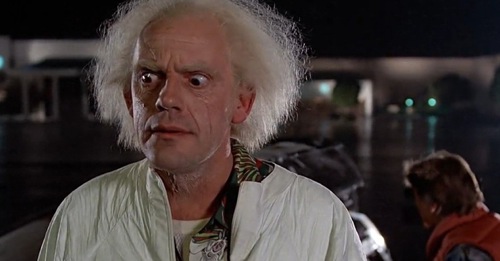
CHRISTOPHER LLOYD – BACK TO THE FUTURE (1985)
“Doc” Emmett Brown
From Taxi to The Addams Family films, Christopher Lloyd has always been one of our most inventive and underrated character actors. In Back to the Future, he put his incomparable spin on the “mad scientist” archetype and came up with something riotous and touching. Lloyd’s originality is visible in every wild gesture and bug-eyed reaction, but he can also dial it back to play the quieter moments of the genuine friendship he shares with Marty McFly. The third film in the trilogy offered him a chance to deepen the character, but nothing could top the off-kilter zaniness he brought to the original.
X
SEAN PENN – CARLITO’S WAY (1993)
David Kleinfeld
After a few years away from the spotlight, Carlito’s Way saw Penn return to mainstream film with a vengeance. Almost unrecognizable behind glasses and beneath a red Jew-fro, Penn is riveting as a slick lawyer who gets his gangster friend/client released from a 30 year jail sentence after only five served. But while Carlito (Al Pacino) tries to go straight, Kleinfeld’s path becomes increasingly crooked. The tension created as a result of his actions propels the film’s nail-biting second half, and Kleinfeld’s descent allows Penn to fly high.

X
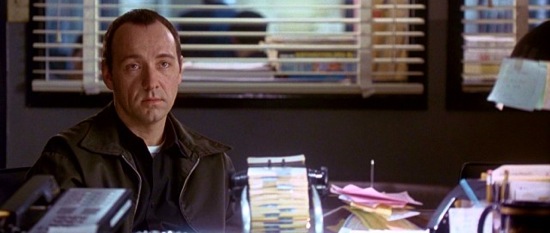
KEVIN SPACEY – THE USUAL SUSPECTS (1995)
Verbal Kint
It’s entertaining enough to watch Spacey’s wormy con man the first time around, but only with repeated viewings is it possible to appreciate the full depth and exquisite nuance of his performance, which earned him a well-deserved Academy Award. What Spacey does here ranks among the best magic tricks I’ve seen at the movies, and he requires no CGI to create the illusion. He does it all with just his voice, his expressions, his posture and his roaming eyes.
X
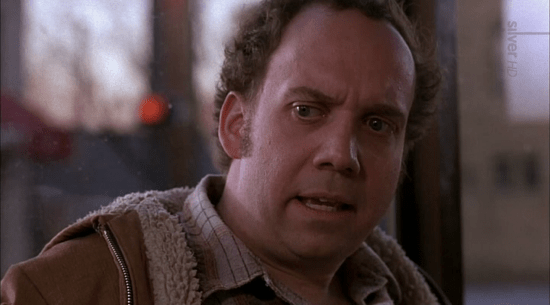
PAUL GIAMATTI – AMERICAN SPLENDOR (2003)
Harvey Pekar
Paul Giamatti has made the rare transition from supporting to leading roles, emerging over the last decade as one of movies’ unlikeliest stars, and American Splendor was a key film in that transition. It also happens to feature some of his best work, as real-life comic writer and curmudgeon Harvey Pekar. He dials into the man’s eccentricities and bleak viewpoint to create a portrait that eschews mimicry in favor of inspired interpretation. Earning heavy laughs without missing that Pekar is a lonely guy swimming against the stream, Giamatti shines in this splendidly untraditional biopic.
X
CHRIS COOPER – ADAPTATION (2002)
John LaRoche
Whoever is responsible for the inspiration of putting Chris Cooper in this role deserves an Oscar to match the one earned by the actor. It’s an unexpected choice that paid off in spades, with Cooper stealing the show as the idiosyncratic flower enthusiast who changes the lives of two lonely writers. As flat-out funny as Cooper is, what makes the performance truly great are the serious touches. LaRoche could have been played merely for laughs, but writer Charlie Kaufman created something more dimensional, and Cooper identifies the man’s grief as much as his offbeat enthusiasms. Watch him as he crouches down and surveys the damage done to his greenhouse by a hurricane, and marvel at an actor’s ability to register on his face an absolute perfect expression of pain, loss and humility.

X
SIGOURNEY WEAVER – ALIENS (1986)
Ellen Ripley
James Cameron’s respectful yet distinctive follow-up to Ridley Scott’s 1979 Alien was a gift to Sigourney Weaver. She kicks asses both human and xenomorph as the haunted lone survivor of a freighter that played host to the galaxy’s most terrifying extra-terrestrial. Reluctantly back in action and given new purpose by the discovery of a young girl, herself the sole survivor of a similar incident, Ripley remains as tough and practical as when we first met her. But Weaver gets to deepen her as well, and in doing so she cemented Ripley’s status as one of the greatest heroines in movie history. Weaver gives her the strength and confidence of a warrior and the warmth of a protective mother, overcoming the “limitations” of the film’s genre to earn a Best Actress Oscar nomination.

X
JOHN MALKOVICH – BEING JOHN MALKOVICH (1999)
John Malkovich
What I wouldn’t give to have been a fly on the wall witnessing the moment John Malkovich was first pitched this story. The actor has a field day parodying his own mystique in the incomparable story of a trio of misfits who become obsessed with a portal that takes them inside the thespian’s head for 15-minute intervals. The last third of the film, in which John Cusack’s puppeteer fully takes over Malkovich’s body, shows the versatile actor at his most brilliant. Malkovich performing Cusack performing Malkovich is a stunning example of razor-sharp comedic acting that continues to offer rewards with repeated viewings.

X
MORGAN FREEMAN – SEVEN (1995)
William Somerset
There are many great performances Freeman could be cited for, but I’m going with one of his most underrated. As a veteran detective on the brink of retirement who finds himself reluctantly drawn into a gruesome serial killing investigation with a gung-ho new partner, Freeman is at his subtle best. He captures the heart of a man consumed by solitude and cynicism, and imbues the character with simmering intelligence. Somerset’s terse exterior is a necessary shell to protect what remains of his humanity, worn away by too many years dealing with the underside of a grim metropolis, and Freeman goes a long way toward suggesting what Somerset has endured in those years. There are no specifics, but Freeman shows us how much more there is to Somerset then what we’ll be allowed to see. If you can extricate yourself from the intensity of the plot enough to really pay attention to Freeman’s work, you’ll see a heartbreaking turn by a master actor.

X
NAOMI WATTS – MULHOLLAND DRIVE (2001)
Betty/Diane
Like most of the cast in this David Lynch film, Naomi Watts was unknown when Mulholland Drive arrived in theaters. That would quickly change, thanks to her thoroughly captivating work as the goody-goody aspiring actress Betty, who follows her dreams to Hollywood and encounters an amnesiac brunette beauty who alters the course of her life in a way that can only be described as Lynchian. At first, Betty is so impossibly perfect and perky that Watts might appear to be overdoing it. But both the actress and the director know exactly what they’re playing at. If you aren’t onboard with Watts by the time her “audition” scene rolls around, prepare for a jaw-dropper. But she’s not done with us yet. We also meet Betty’s alter ego Diane, and Watts drives it all home as the troubled girl whose Hollywood dreams have disintegrated into nightmares.

X
AL PACINO – DONNIE BRASCO (1997)
Ben “Lefty” Ruggiero
Pacino’s masterful performance in this absorbing character drama ranks with the finest work of his career, worthy of mention in the same breath as titles like The Godfather, Serpico and Dog Day Afternoon. He plays a mid-level mobster teased by his buddies, ignored by the bosses and seduced by the friendship of a neighborhood jeweler who is actually an undercover FBI agent. Lefty comes to regard Donnie (Johnny Depp) as a surrogate son, and the mutual bond between the two makes the inevitable fallout all the more painful. In an era when Pacino sometimes goes big and loud, his work here, while vivid, is also wonderfully subtle, blending bravado with wounded pride.

X
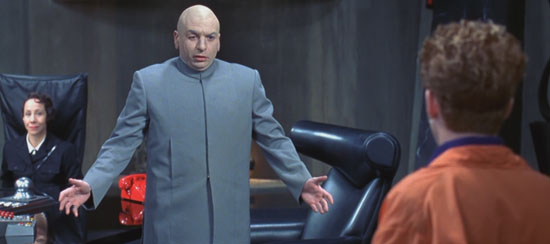
MIKE MYERS – AUSTIN POWERS: INTERNATIONAL MAN OF MYSTERY (1997)
Dr. Evil
Though physically inspired by Ernst Blofeld, the James Bond villain played by Donald Pleasance in You Only Live Twice, Dr. Evil is as original a character as they come, springing purely from the genius of Mike Myers. Though the actor is no slouch in the title role, it’s his performance as Dr. Evil that steals the movie at every turn. Whether threatening to hold the world ransom for one miiiiiillliiionnn dollars, trying desperately to relate to his teenage son or even just sitting and stroking his cat, Dr. Evil is Myers’ most inspired and hysterical creation.
X
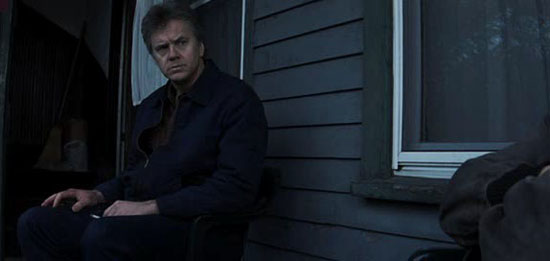
TIM ROBBINS – MYSTIC RIVER (2003)
Dave Boyle
A young boy is tricked into getting in a car with men he believes to be police officers, and over the course of four days, he is kept locked up and sexually abused. What would happen to that boy when he grew up? Tim Robbins answered that question in this outstanding, unshakable performance. Tentative in his gait, his speech and his relationships, Robbins plays Boyle like a walking open wound. He is too haunted by his past to help himself in the present, and we can only watch helplessly as his tragedy plays out. Robbins is a tall guy, but he makes us see the boy who has never been able to overcome what happened when he got into the wrong car.
X
NICOLE KIDMAN – TO DIE FOR (1995)
Suzanne Stone
Kidman took her first big step out of then-husband Tom Cruise’s shadow with this wickedly sly turn as a small-town girl who believes that “you’re not anybody in America unless you’re on TV.” The film gave Kidman the most fully developed role she’d had since crossing over to Hollywood, and she displayed acute comedic skills alongside a calculating coldness and manipulative sexiness, flawlessly demonstrating that it takes an actor of depth to create a believably shallow character.

X
KATE HUDSON – ALMOST FAMOUS (2000)
Penny Lane
I recall reading an interview with Cameron Crowe in which he said that in casting Penny Lane, he needed an actress who could light up a room. When his first choice, Sarah Polley, didn’t feel she could deliver that, Hudson – who had already been cast in the smaller role of the protagonist’s rebellious sister – asked to audition. With Hudson, Crowe got his wish and then some. Her shining turn as the seasoned Band-Aid whose wit, warmth and free spirit entrances a young journalist and a golden God of rock on a 1974 cross-country tour is the heart of the movie. She more than fulfills Crowe’s desire with her joyful performance. The movie is great from start to finish, but it’s at its best when Hudson is onscreen.

X
LEONARDO DICAPRIO – WHAT’S EATING GILBERT GRAPE (1993)
Arnie Grape
1993 was DiCaprio’s breakthrough year, beginning when he appeared opposite Robert DeNiro in This Boy’s Life. Later came What’s Eating Gilbert Grape, and a performance so authentic that the part seemed to be played by someone who really was developmentally disabled. Not a single moment Arnie is onscreen feels rehearsed or acted. While still in his teens, DiCaprio delivered an astonishing piece of work that is nearly incomprehensible in its simple power and effectiveness. Long before Romeo & Juliet and Titanic turned him into a heartthrob, Gilbert Grape proved DiCaprio was an actor of remarkable intelligence, sensitivity and depth.

X
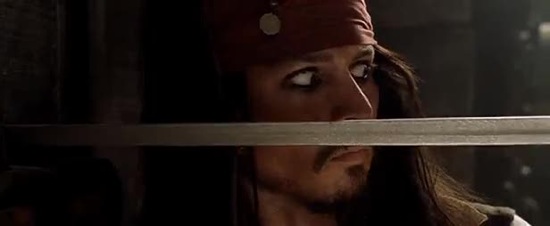
JOHNNY DEPP – PIRATES OF THE CARIBBEAN: THE CURSE OF THE BLACK PEARL (2003)
Captain Jack Sparrow
After three inferior sequels and Captain Jack Sparrow’s pop culture saturation, it would be easy to take Johnny Depp’s work for granted or dismiss just how good he is, and how much fun it was this first time out. That’s a mistake I’ll not be making. Everything about this movie was a pleasant surprise, beginning with Depp’s inspired creation of Captain Jack, which seemed to wake up the movie industry to the presence of an actor who had been doing phenomenal work for over a decade. It’s amazing what a little box office success will do. Depp’s originality and ingenuity have never been more evident than they are here, and watching him sashay and swashbuckle his way through the movie offers endless delights. The actor earned his first Oscar nomination – overdue but certainly deserved – playing, as one of the film’s characters observed, “the best pirate I’ve ever seen.”
X
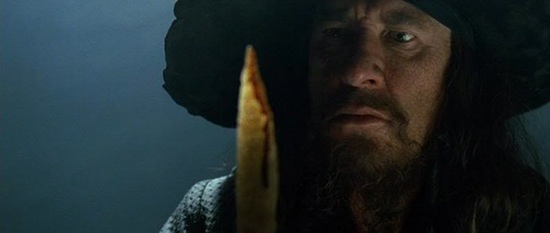
GEOFFREY RUSH – PIRATES OF THE CARIBBEAN: THE CURSE OF THE BLACK PEARL (2003)
Captain Barbossa
Geoffrey Rush is an actor who feels at home in any genre, and while I initially intended to cite his excellent work in Quills, I couldn’t resist his treacherous seafarer from Pirates of the Caribbean. Haunted by an ancient curse that holds him captive between two worlds, Barbossa nonetheless possesses a wickedly sarcastic sense of humor and insatiable lust for life, gold and mouthwatering apples. Rush can barely contain the fun he’s having bringing these various facets of Barbossa to life, and like his co-star, he brings a credibility and pedigree to the film that can’t help but make it better. Depp got the lion’s share of the attention, but overlooking Rush’s contribution would be a grave disservice to the film’s success.
X
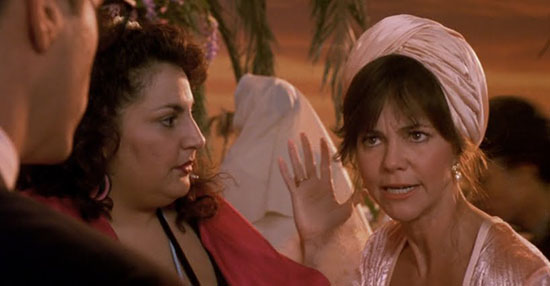
SALLY FIELD – SOAPDISH (1991)
Celeste Talbert
Sally Field’s reputation may be as a dramatic actress, but she has a deft hand for comedy as well, and those skills are on full, glorious display in Soapdish, a sorely underrated movie that goes behind the scenes of a popular daytime drama and reveals the lives of the cast and crew to be more outrageous than their television storylines. Field is the show’s long-reigning star and resident diva who faces threats from all sides. In her manic portrayal of an aging celebrity coming undone, she offers one priceless bit after another – one of my favorites being an attempt to apply eyeshadow with hands that can’t stop shaking from stress. Field’s performance is big and over-the-top, but in the best way possible and perfectly in tune with the film’s overall tone.
X
HEATH LEDGER – BROKEBACK MOUNTAIN (2005)
Ennis Del Mar
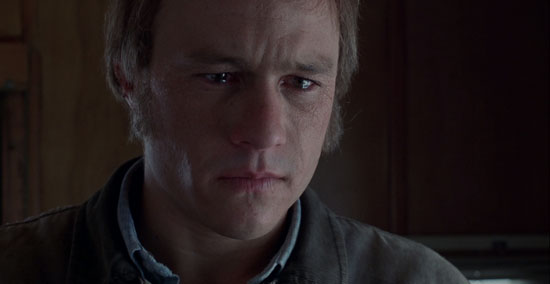
Ledger’s performance in Brokeback Mountain is one of striking economy. His chin drawn into his chest, his words seemingly fighting to escape from his mouth, his movements tight and deliberate, Ledger’s Ennis is like a clenched fist. A great actor working with rich material might be fortunate enough to deliver one, maybe two emotionally powerhouse scenes in a given film. Ledger has at least four in Brokeback. Sure, the material is there for him to play, but the raw vulnerability he brings makes your heart ache. Ledger had impressed in earlier films, but nothing he’d done previously could prepare us for the astounding work he does here.
X
BILL MURRAY – GHOSTBUSTERS (1984)
Peter Venkman
Ghostbusters finds Murray at his deadpan, wiseass best and deserves to be counted among his finest efforts. The movie has such legendary status that it’s hard to pull back far enough to acknowledge what an odd film it is, and how easily it could have failed to work. One of the reasons it does work is Murray and the way he fully commits to the character and the concept. The jokes aren’t typical and the lines aren’t always hilarious in and of themselves, but Murray puts a spin on them that absolutely kills. The whole ensemble is great, but when co-stars Dan Aykroyd and Harold Ramis wrote the script (or should I say re-wrote it, as the Venkman role was originally intended for John Belushi), they wisely saved the best role for their old friend. He came, he saw, he kicked its ass.

X
That’ll do it for today. Back tomorrow with 20 more, including a committed teacher, a compromised author and a well-dressed man.
Updated with Full Series Links:
Preamble
Part II
Part III
Part IV
Part V
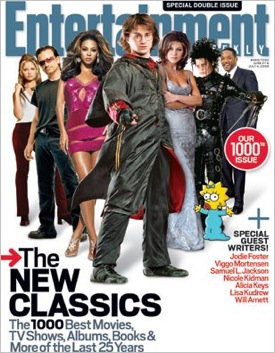 This little project has been a long time in the making, and because I’m always over-explaining things, I’ll begin at the beginning. Four years ago, in late June 2008, Entertainment Weekly published its 1,000th issue. The theme they chose was “The New Classics”: the 1,000 greatest pieces of pop culture from the preceding 25 years. They named their picks for the 100 best movies since 1983, the 100 best TV shows, albums, books and so on. Anyone who reads Entertainment Weekly, or looks at EW.com, knows that they love their lists. We can debate the point of such lists ad nauseam, but let’s face it: they’re fun. From Rolling Stone counting down the 500 greatest albums of all time to the American Film Institute naming the 100 best films ever to Roger Ebert naming his ten best films of the year, we who consume pop culture like these lists. They provoke debate and discussion amongst fans, and they point the unaware toward work they might have overlooked. Even those who decry them probably have a few of their own they’d like to share.
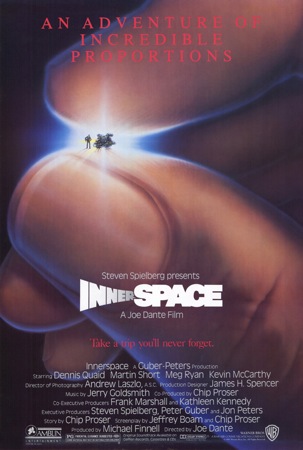 “Nuclear weapons, Jack. They mean nothing. Everybody’s got ’em, nobody has the balls to use ’em. Am I right? Space, you say. Space is a flop. Didn’t you know that? An endless junkyard of orbiting debris. Ahhh…..but….miniaturization, Jack. That’s the ticket. That’s the edge that everybody’s been looking for. Who will have that edge, Jack? What country will control miniaturization? Frankly, I don’t give a shit. I’m only in this for the money.”
 I wrote in my summer of ’87 piece that Innerspace was the first movie my friends and I went to see without any parental accompaniment, which lends it special significance for me. Being old enough to go the movies ourselves was a key rite of passage. Innerspace is one of those movies that I will always associate with a certain place and time. I even remember seeing commercials on HBO heralding its impending pay cable premiere; to this day, certain shots will pop as I watch the movie because I remember them being in those commercials. But I promise, my enduring love for the movie is no mere byproduct of nostalgia. And the movie isn’t one of those that I loved as a kid only to discover as an adult that it doesn’t hold up. Innerspace totally holds up. I have such affection for this movie, which I don’t deny is expressly tied to being 10 years old when I first saw it. This particular blend of sci-fi and comedy was perfect for me at a time when I was really getting into movies, I loved special effects and my sense of humor was taking shape. Dante is a huge Looney Tunes fan, and the comedic influence of those classic cartoons is often reflected in his work. It certainly was here, and as a Looney Tunes lover myself, it surely helped explain my appreciation for the movie. (Legendary Looney Tunes director Chuck Jones has a cameo in the film, as he did in Gremlins.) I was also getting familiar with Saturday Night Live‘s legacy at that time – watching classic sketches in rerun, and marveling that Chevy Chase, Bill Murray, Eddie Murphy, Dan Aykroyd, John Belushi, Billy Crystal and Martin Short all had that show in common…though of course for Short, the legacy really dates back to SCTV. (My family’s traditional Christmas Day movie in ’86 was Three Amigos, which also helped me understand the influence and importance of SNL.)
 If you’re unfamiliar with the movie, I should probably give you the lowdown. Set in and around San Francisco, it’s a sci-fi comedy starring Dennis Quaid as a military test pilot with the improbably macho name Tuck Pendleton, who agrees to participate in a top-secret experiment in which, manning a tightly confined flying capsule, he will be miniaturized and injected into a laboratory rabbit to run a series of experiments. Unfortunately, a case of poorly timed international espionage disrupts the procedure, and Pendleton winds up injected into a somewhat nerdy grocery clerk named Jack Putter (Martin Short), who also happens to be the world’s biggest hypochondriac. He’s a stressed out Nervous Nellie, and according to his doctor, the last thing he needs is excitement or danger. Wanna guess how that’s gonna work out? Once Pendleton establishes contact with his host, the duo have no choice but to work together and try to get the shrunken man out before his oxygen expires or other nefarious forces interfere. It’s essentially a buddy movie…in which one buddy is flying around inside the other buddy’s body. (The movie’s stellar visual effects were created by Industrial Light & Magic, and went on to win an Oscar the following year. In fact, the first Oscar prediction I ever made was that Innerspace would beat Predator for Best Visual Effects. Little did I know how deep that rabbit hole would go.) Meg Ryan, in one of her earliest film performances, also stars as Pendleton’s estranged girlfriend Lydia, a journalist who Tuck and Jack enlist for help. Without spoiling how it all turns out, I’ll say that as a kid, I always hoped there would be a sequel, as the final scene totally sets up the story to continue. But there was never any real intent to make a follow-up; it’s just meant to be a fun finale. I suppose it’s better that no sequel was made. I’m sure it wouldn’t have been as good. (Though maybe Dante could have pulled it off; he certainly did with Gremlins 2: The New Batch.)
 The role of Pendleton was originally intended for an older actor, maybe in his forties. But the filmmakers met with Quaid, who was only 32 at the time (I can’t believe that!), and felt that he was a great fit for the part. Although he and Short wouldn’t share any substantial screentime together, the buddy dynamic still had to work just as well as it does in, say, Lethal Weapon, so the part of Jack Putter was cast with that in mind. They hadn’t really thought about someone as out-and-out comedic as Martin Short, but when they met with him, and then put him together with Quaid, the chemistry was clear. I don’t know what they had in mind for Putter initially, but Short seems like ideal casting when you consider that co-writer Jeffrey Boam (who also penned Lethal Weapon 2 and Indiana Jones and the Last Crusade) envisioned the movie as a Dean Martin/Jerry Lewis comedy; what would happen if Dean was trapped inside Jerry’s body? It’s a pretty interesting relationship to create from a technical standpoint, because Tuck can see Jack’s point of view on his capsule monitor, and they can talk to each other. In order to preserve the spontaneity and improvisation that comes out of two actors working together in the moment, Quaid and Short were always on set during the filming of each other’s scenes, feeding lines to the other through a microphone. In addition, many of Short’s scenes had to be filmed twice: once with the camera on him, and once with him wearing a helmet-cam in order to capture his POV for Tuck’s monitor. Both actors are so great in the movie, and Quaid especially deserves credit for making his character so engaging when he’s stuck sitting in a tiny cockpit for nearly the full two-hour duration.
 The rest of the cast is great too. Ryan was excellent, and clearly bound for stardom. Many of the smaller parts, meanwhile, were populated by actors frequently featured in Dante’s work. Wendy Schall plays a co-worker of Jack’s, and has a moment in her first scene that spun me into a fit of uncontrollable giddy laughter when I first noticed it (it took me a few viewings of the movie before I caught what she did). She only has a few scenes, and while they’re all intended to be funny, she actually manages to add an unexpected bit of depth to the character that makes her kind of sad. Another actor worth mentioning wasn’t really an actor at all. The scientist at the lab in charge of the experiment, Ozzie, is played by John Hora, who was the cinematographer for all of Dante’s previous films. When describing the slightly absent-minded professor quality they wanted for the character, Hora was named as an inspiration, so Spielberg suggested they cast the man himself. Again, it’s a small part, but he plays it really well – funny, and like Schall, a little sad. Dante’s gallery of recurring actors are all so great I could spend time talking about each one – Robert Picardo as the bizarre stolen goods trafficker The Cowboy, Kevin McCarthy as refined villain Victor Scrimshaw – but I’ll resist the urge to mention them all. I suspect that at this point I’ve already alienated the few people who might have cared about this post to begin with. Just trust me when I say it’s a colorful gallery of characters.

 I was destroyed, racked by gushing tears, the kind that prevent you from catching your breath, and cause your words to come out in a heaving staccato. I’d been overtaken by an emotional tidal wave that I was utterly unprepared for. My parents were equally unprepared. They had no idea what to do with me. Strangers stared at them. Whispered aspersions of their parenting skills drifted around us as we made our way out to the warm air of the parking lot and walked back to my grandparents’ apartment. The movie was PG-13, but the commercials from when it had been in theaters made it seem harmless enough. It was marketed as a comedy, Tom Hanks was in it (I was already a fan of Splash and The Money Pit), Jackie Gleason was in it, it looked amusing…I’m sure my parents figured it would be fine to take me.

 As this was pre-texting and pre-Twitter – meaning that word of mouth actually was word of mouth – the movie’s commercial viability wasn’t immediately clear.
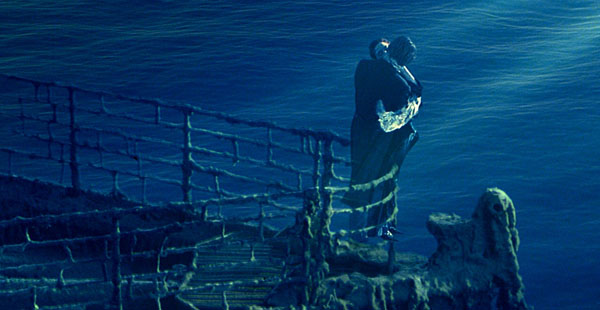
  My visceral reaction can probably be equated, in part, to the fact that I was in the throes of my own tragic love story at the time. (Tragic to me; not tragic to the girl in question, nor to anyone else. Ahh, the bitter pangs of unrequited love.) But I also saw something in the movie that I missed the first time. The love story resonated with me on a whole other level, whatever the reason. I realized that the key to the movie was the modern-day bookending sequence featuring 101 year-old Rose. Lots of movies, before and since, have opened with an elderly character recounting a tale from their youth. Edward Scissorhands, The Green Mile, Saving Private Ryan and Young Guns II are a few that leap to my mind. (That’s right – Young Guns II. Billy the Kid lives!) But the framing device is not as essential to any of them as it is to Titanic. I’ll assume that if you’re reading this, you’ve seen the movie, so you know that at the end, old Rose walks out to the deck of Brock Lovett’s ship and reveals to the audience that she has the diamond which Lovett has been seeking from the Titanic wreckage far below them. She tosses the jewel into the water, and the next thing we see is her asleep in bed, followed by a final descent to the sunken ship.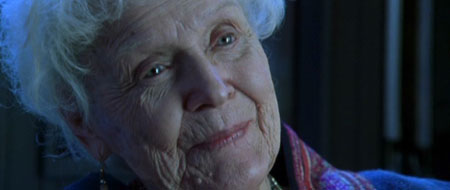


 I Am DB