
Complete List of Winners
Well, that was…interesting.
 My commentary on this subject comes late as usual, allowing me the necessary time to re-watch, reflect and comment on every little thing that crossed my mind, but the gist of it won’t be much different than what has already been said in all corners of the Oscar-watching world (though I’ll try saying it more nicely than others may have):
That could’ve been better.
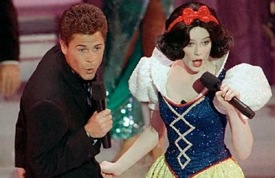
The main reason I always enjoy watching the Oscars is that I actually care who wins. Not just Best Picture and Best Actor, but Best Art Direction and Best Makeup and so on. So I’ll always enjoy the Oscars, even if the show itself isn’t that great. And this year’s show wasn’t so great. It was badly produced, badly directed, blandly written…it was, in fact, the weirdest and yes, the worst Oscars I can remember in my 20+ years of Oscar watching. To be fair, the first year I watched the Oscars was 1987, year of the infamous Rob Lowe-Snow White opening number and the dancing Oscar statuettes. That show may have been worse, but I was 10 years-old and don’t actually remember it well enough to say. Now then…let’s get into it.
THE HOSTS
James Franco and Anne Hathaway are taking a lot of the heat for this, but I’m not going to pile it on. I don’t think they’re the reason the show was bad. We all knew from the beginning that they were odd and inappropriate choices to host, and sure, it could be argued that they should have known as much and therefore deserve the blame for taking on the job. But hey, they’re professional actors who were given a rare and pretty cool-sounding opportunity, so why wouldn’t they go for it? I think they did the best they could with the poor material they were given. Well…maybe Franco didn’t do the best he could, but I’m not sure he knew what the hell to do.
Things started off promising enough. The opening video in which Franco and Hathaway traveled, Inception-style, through some of the Best Picture nominees, aided by Alec Baldwin and Morgan Freeman, was funny. Not hilarious, but funny, even if the insert-host-into-actual-movie-scene has been done a lot by now. I’m not sure why the skit came around to inserting them into a scene from Back to The Future, which would have made sense only if the piece had featured other older movies as well. But okay, it was early. No big deal. The duo finally made it onto the stage, but right off the bat it didn’t quite feel right. They just didn’t have the natural ease that comes with knowing how to stand on a stage in front of a lot of people and work the crowd. They’re not comedians. Or Wolverine. Their banter was a little awkward, but okay, that’s the natural state of award banter. Still no big deal. They did the requisite joke about being chosen as hosts in an effort to lure a younger audience, as well as the requisite joke about Franco being nominated while Hathaway was not. It all seemed stiff from the outset. The monologue was brief, the jokes weren’t great, and there was little of the typical give-and-take with the nominees and stars in the audience. Last year’s monologue by Steve Martin and Alec Baldwin featured too much pointing-to-stars, whereas this year’s featured too little. Check out almost any other recent Oscar show and you’ll find the right balance.
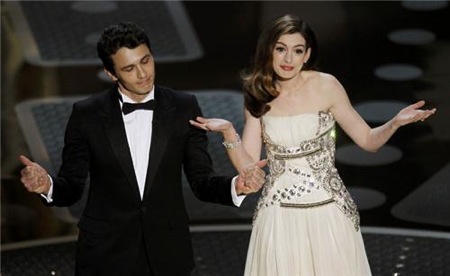
As the night wore on, things did not much improve. Hathaway’s song – an abridged and altered version of “On My Own” from Les Miserables which she sang to Hugh Jackman as a sort of follow-up to the great musical comedy bit they did during his 2008 MC gig – was the best hosting moment of the night. Hathaway’s got some genuine pipes, and this bit hinted at the playfulness that the show needed desperately but which was pretty much nowhere to be found. (Sorry, Franco’s Marilyn Monroe get-up didn’t qualify.) Other than that moment, Hathaway had only her enthusiasm to cling to. And she had that in spades, sometimes going overboard. I like Hathaway and think she’s a really good actress, but as herself she sometimes comes off like that girl in drama club who’s a little too theatrical a little too often. On the other hand, can you blame her for overcompensating, considering how little actual material she was given to work with? Also, was it just me or did she seem to be coming out solo a lot? There seemed to be a lot more of Hathaway than Franco. He was probably backstage studying for class while creating an avant-garde installation for MoMA at the same time that he was concurrently shooting and editing a film exploring the inequities between male and female performers as exemplified by Hathaway’s many costume changes, all the while writing an episode of General Hospital which he would run off to shoot during a commercial break. When Franco did show up, he looked bemused, uncomfortable, uncertain…if he was deliberately playing aloof, it was the wrong way to go. Or he just wasn’t doing it well. And it’s not like the guy can’t act. Not really sure what was going on there.
But again, I blame the writers and producers for a lot of this. The producers, Don Mischer and Bruce Cohen, made a mistake hiring Franco and Hathaway in the first place, and then gave them little to work with. Hosts need to do more than just introduce people. There were no bits for them to do, no comedy for them…nothing. It was all very puzzling, to say the least.
THE AWARDS
 -The first big prize of the night was Best Supporting Actress, and in the curious absence of last year’s Best Supporting Actor Christoph Waltz, the Academy brought out screen legend Kirk Douglas to present the award. It wasn’t pretty. At 94 years old, Douglas still seems pretty sharp, but he kept making jokes that made no sense (Hugh Jackman is laughing at him? Colin Firth isn’t laughing at him?) There was a total non sequiter that found him pretending to fight over his cane with the random young guy who was standing with him onstage. Then, after opening the envelope, he kept delaying the announcement of the winner. Did he think he was being funny? I mean, it was funny…but in a painful, awkward way that makes you want to cover your eyes. Why even have him there to present this particular award? It’s not like there was a theme of Hollywood icons presenting in other categories. That would somewhat go against the stated desire to draw a younger audience to the show, wouldn’t it? Most of today’s teens probably don’t even know who Michael Douglas is, let alone Kirk. His presence wasn’t a logical fit with the show at all. The Oscars are one of the few awards shows all season long where the presenter actually reads the nominee names themselves, rather than the task being handled by some anonymous voice, yet they didn’t have Douglas read the nominees. Why not? He barely shut up while he was there, so why couldn’t he read the names himself? Were the producers worried that people wouldn’t be able to understand him? Hearing-impaired actress Marlee Matlin did it when she presented Best Actor in 1987 (to Michael Douglas, in fact). It just stood out against the rest of the presentations, and highlighted the oddity of him being there. When he finally did announce the winner, it was Melissa Leo, and thrilled for her though I was, her “is this really happening” schtick was a little overdone, and wasn’t helped by Douglas continuing to insert himself in the moment as she accepted her award. The whole thing was just uncomfortable.
-As expected, Aaron Sorkin took the Best Adapted Screenplay award for The Social Network, and kudos to Sorkin for calmly continuing with his speech and ignoring that the orchestra was obnoxiously trying to play him off. I don’t know what their problem was. He hadn’t even been talking that long before they chimed in, and here they had an eloquent, grateful and humorous guy who has a way with words, so why no let him give his speech? Dicks. (Not really the orchestra’s fault; the show director is to blame, and that job was held by co-producer Mischer. )
-In another win for The Social Network, Trent Reznor and Atticus Ross took Best Original Score. It was the one bold choice the Academy made all night (a deserving win, though I would have preferred Inception). But you gotta love that they gave an Oscar to Reznor, the guy who sang “I want to fuck you like an animal.”
-Don’t worry Randy Newman, you were good television. One of the bright spots of the show, in fact.
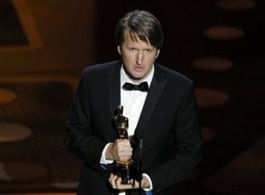 -If you’ve read my previous Oscar commentaries this season, you probably know that Tom Hooper’s Best Director win is a disappointment to me. It seems that every year, at least one Oscar needs to be given out that can go into the books as one of the all-time bad choices, and Hooper’s win is the one this year. My annoyance was heightened by the look on his face when Kathryn Bigelow said his name. See for yourself at the 1:30 mark, and tell me you don’t kinda want to punch him. (If you think he actually deserved the award, maybe it doesn’t bother you. But I wanted to punch him.) I will, however, give him kudos for his speech, which was gracious and included a nice story about how he came to direct the movie. Still, I’ll never understand how he won this award.
(By the way Academy, here’s one way you can bring your show into the modern era and maybe even cater to some of those younger viewers: let them embed your clips on their blogs instead of making them leave and view them on YouTube).
-Two years ago, each acting award was presented by five previous winners of that same award, each one saluting a current nominee. Last year, an attempt to do something similar by having a past co-star address each nominee stumbled a bit. This year was better than last, with the presentation of Best Actor and Best Actress being done solely by last year’s winners Jeff Bridges and Sandra Bullock, respectively, still speaking to each nominee directly. But where was the love for the Supporting nominees? Just like last year, they were treated like second-class citizens while the extra love was given to the leads. Why is the Academy messing with the hierarchy? If you delineate between actors, it just means everyone else gets shoved further down the food chain. Pretty soon the sound and visual effects artists won’t even be allowed in the building.
THE PRODUCTION: THE GOOD, THE BAD AND THE WEIRD
The Good:
You know…there was so much bad and weird that we should really start there, and come back around to the good in an effort to end on a positive note.
The Bad and the Weird:
-The first awards of the evening, presented by Tom Hanks, were for Cinematography and Art Direction. With imagery from Gone With the Wind and Titanic employed to striking effect – the projections grandly filling the proscenium arch – Hanks made the connection between Best Picture winners that had also won the two awards he was giving out. It was an odd way to frame the presentation, since there was no guarantee that the winning movies would go on to win the night’s Best Picture award (and in fact, neither did; Cinematography went to Inception, while Art Direction went to Alice in Wonderland). The evoking of Gone With the Wind and Titanic suggested that the show might incorporate Oscar winning classics as a theme, but the idea turned out to be half-baked. The only other films referenced in such a direct way were Shrek and The Lord of the Rings: The Return of the King, and while there’s nothing wrong with those, they aren’t exactly reaching back into the Oscar history books. How about incorporating some older spectacles, like Lawrence of Arabia or 2001: A Space Odyssey? Maybe The Wizard of Oz or Mary Poppins?
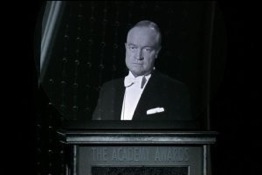 There were a few jumps back in time, but not using specific movies. Presenting the two screenwriting awards, Josh Brolin and Javier Bardem appeared as white-tuxedoed waiters in a replica of Hollywood’s Roosevelt Hotel, where the earliest Academy Award ceremonies were held. Later, a special podium was wheeled out and 18-time Oscar host Bob Hope was projected there to give the audience a glimpse of what it might have been like in the room when Hope hosted. Both segments were nice pieces of nostalgia, but the Roosevelt Hotel bit didn’t quite gel with the rest of the show, and the Bob Hope gimmick was kind of unsettling since it alternated between actual jokes as they’d been spoken by Hope and someone impersonating Hope to comment on the ceremony at hand and introduce the next presenters. It was done affectionately, and so wasn’t as offensive as Fred Astaire dancing with a vacuum cleaner or John Wayne hawking Coors Beer, but it still felt odd.
Bottom line: the theme for the show, such as it was, didn’t really come off.
-The stage was once again used to great effect for the Best Original Score presentation, which found the orchestra projected in silhouette behind the screen and the layers of the proscenium lit up in bright colors while the musicians played a medley of classic movie music from Star Wars, E.T., Lawrence of Arabia and West Side Story (as well as the famous THX sound effect). But while the orchestra proceeded to play selections from the nominated scores, accompanied by a montage of clips from each film, someone in the booth cut away to a crew member leading presenters Hugh Jackman and Nicole Kidman to a different part of the stage. Why would you do that? It was just one of many terrible cutaways throughout the show. While Oprah Winfrey was on stage making a nice point about the power and importance of documentary films, there was a cut to Joel Coen, scratching his ear and looking around like he dropped something. Who was running the booth?!? It’s like someone let their 12 year-old kid come in and direct the show. Actually, I take that back. I directed some cable access TV when I was 12, and I knew better then to cut away to something like that.
Moreover, did you notice how random the reaction shots of the audience were? Usually there are frequent glimpses of movie stars reacting to the jokes or presentations. Here, it was like director Mischer went out of his way not to show celebrities. I lost count of how many medium shots capturing a sea of unrecognizable faces in the middle of the auditorium we were treated to instead of the movie stars that most people are actually tuned in to see. All respect to recent Academy president Sid Ganis, who I saw at least three times, but I suspect people would prefer a cutaway to Halle Berry or Mark Ruffalo. Did anyone notice there was not a single shot of Natalie Portman all night until the Best Actress presentation came around? Not one shot of the star of the moment – a beautiful, pregnant actress who was the favorite to win one of the night’s top awards. Get your hands on any past Oscarcast and tell me when you’ve seen the likes of that. Forget it, I’ll save you the time: you haven’t seen the likes of that, because it doesn’t happen, because any moron can tell you that the when you have a bunch of movie stars sitting in room full of TV cameras it’s pretty much understood that you actually show some of them.

-Lest we think that Hathaway and Franco had the market on awkwardness cornered, there was plenty to go around. What was going on with Justin Timberlake and Mila Kunis during their presentation of the Animation awards? I liked Timberlake’s opening joke, hesitantly announcing to the audience that he’s actually the mysterious, never-seen graffiti artist Banksy, one of the evening’s nominees for directing Best Documentary contender Exit Through the Gift Shop. But the joke died when Kunis had no real retort, and throughout the rest of their presentation they seemed to either be sharing a private joke or dealing with an incomplete script. After pretending to use his iPhone to decorate the stage with a backdrop of Shrek‘s The Kingdom of Far Far Away, Kunis told him that he missed a spot. Then he stared at her for too long a beat, then she laughed, then he feigned being flustered and began announcing the nominees while we tried to figure out what the hell was going on.
-In a presentation similar to the one for Cinematography and Art Direction, Best Makeup and Best Costume Design were lumped together for no other reason than that both awards had once gone to Best Picture winner The Lord of the Rings: The Return of the King. One of that film’s stars, Cate Blanchett, did the honors, though the connection between the awards was even more tenuous this time since none of the Makeup nominees were among the Best Picture contenders.
Also, for what it’s worth, smarter Oscar producers would have had Blanchett present the award for Best Supporting Actor, instead of Reese Witherspoon. For whatever reason, Blanchett was not at the Oscars the year after she won Best Supporting Actress, and so was unable to carry on the tradition of the previous year’s winner presenting the award to the opposite sex the following year. Blanchett has still never presented an acting award, so given that last year’s winner Mo’Nique was unable to attend this year, it would have been the ideal time for Blanchett to get her chance of presenting to a fellow actor.
-The presentation of Best Original Song included a random “man on the street” segment of people on Hollywood Boulevard talking about their favorite songs from movies. Where did that come from? Who cares what some tourist from Nebraska thinks? If you’re going to do a segment like that, find a way to make it funny. Remember Chris Rock’s hosting gig in 2004, which featured a taped segment of Rock interviewing patrons of a Magic Johnson Theatre (all African-American, except for Albert Brooks)? That’s how it’s done. I wish I could find that clip online. So good. Anyway, this segment was yet another WTF moment. That goofball couple singing “Beauty and the Beast” to each other was just horrible. And on top of that, the interviews weren’t even filmed well! The camera was way too close to the subjects, the shots were badly framed…and then after all these average Joe’s off the street, suddenly there’s President Obama in the White House, commenting on his favorite movie song. Seriously, who put this thing together?!? Awful.
-The actual performances of the nominated songs were not without their problems either. Randy Newman was up first, battling poor sound quality (through no fault of his own, I’m sure) and clumsy staging. It was just Newman at the piano, belting out the tune, yet he was set so far back on the stage. There was a circular platform right in the center, nice and close to the audience. Why couldn’t the piano have been placed there, to create a little more intimacy? Later on, Gwyneth Paltrow performed her song from Country Strong, and while she’s proven she can sing, she didn’t look or sound all that great this time around. As for the song from 127 Hours, it’s a pretty but unconventional song that doesn’t really lend itself to a live performance.
-Following the interviews for Best Original Song, another misfire came with a joke introduced by Franco and Hathaway in which auto-tuning was applied to scenes from Harry Potter and the Deathly Hallows Part I, Toy Story 3, The Social Network and Twilight: Eclipse. A joke like this might play fittingly at the MTV Movie Awards or Broadcast Film Critics Awards, but this is the big leagues. You can do better.
-As has been the case in recent years, the In Memoriam segment, acknowledging the passing of Academy members during the past year, was accompanied by a live song performance, this time by Celine Dion (I’m surprised the Academy didn’t go for Willow Smith). However, unlike in previous years, the names of behind-the-scenes folks who weren’t necessarily familiar to most viewers flashed by without any examples of their work. Usually, the photo of the person or live footage of them is shown alongside a poster, clip or title font of a famous movie or two that they worked on, to provide some context. Not this time, meaning that most people watching the show – even those in the audience, I’d wager – had no idea who many of the people were. How hard is it to get these little things right? Had Don Mischer or Bruce Cohen ever watched the Oscars before? (I know Bruce Cohen has, because he won an Oscar for producing American Beauty.)
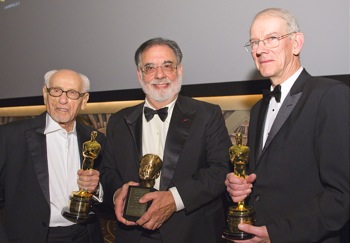
-As of last year, honorary awards are no longer given out on Oscar night, but are instead presented at the Governor’s Ball, a special ceremony held a few months earlier. This year, honorary awards went to actor Eli Wallach, director Jean-Luc Godard and film historian and preservationist Kevin Brownlow, while Francis Ford Coppola was given the Irving G. Thalberg Award. (Click here for video highlights from the ceremony.) It would be nice if the television audience was at least treated to a few moments from the Governor’s Ball, just as the Sci-Tech Awards are briefly covered each year. Instead, Coppola, Wallach and Brownlow were trotted onto the stage (Godard did not attend either ceremony) to stand awkwardly while the audience gave them a deserved standing ovation. Yet another poorly conceived moment in the show. Next year, show us some clips from the private reception and then have the recipients stand up in the audience or from special balcony seats and give a wave. That’s what happened last year, and that’s how it should go. They’ll still get their standing O, and it will feel much more natural.
-When it came time for Best Picture, clips from the 10 nominees played in a montage which used Colin Firth’s climactic radio address from The King’s Speech as a through-line. Some people felt this showed favoritism toward Speech, but I thought it was just a nice connective tissue. Didn’t bother me. What did bother me was that the montage cycled back through most of the nominees two or three times before a single clip of Toy Story 3 was shown. A big deal? No, of course not. (None of this crap is a big deal. It’s the friggin’ Oscars, not cancer research). But it was further evidence of the sloppiness that ran through the entire show. Who put that reel together? How hard is it to feature all 10 nominees once before going back and showing each one again?
-Speaking of Best Picture, couldn’t they have found someone else besides Steven Spielberg to present it? Don’t get me wrong – I loves me some Steven Spielberg. But he’s presented Best Picture three times in the last decade (and while we’re keeping score, Michael Douglas, Tom Hanks, and Jack Nicholson have each done it twice). How about having Kirk Douglas do that award? Or Francis Ford Coppola, who was there for his Thalberg win anyway? How about trying to get the retired Gene Hackman to come out and present it? There are more than a few people left in the movie business with the stature to make them worthy Best Picture presenters. Can we get a little more creative?
-Whatever the producers intended as the theme of the Oscar show, “Awkward!” proved to be the actual theme of the night, and the final moments of the show didn’t disappoint on that front. I found it a little hokey when cute kids from Staten Island’s PS22 flooded the stage to sing “Over the Rainbow,” but okay, kids are sweet and what a thrill it was for them and fine, I’ll go with it. But then all the evening’s winners walked out on stage behind the students, ambling about in a scattered assembly, some swaying and joining the song, others just standing there, all clutching their Oscars. Why, I ask you? Why?
-The show’s schizophrenia included its slate of presenters not really being ideal choices for that oh-so-desirable youth audience. Hilary Swank, Oprah Winfrey, Nicole Kidman and Tom Hanks (and again, Kirk Douglas) are not who the kids want to see. And that’s fine, because the show shouldn’t be catering to kids. These are the kind of people who should be at the Academy Awards, so the producers and Academy executives need to start acknowledging that and stop trying to turn the Oscars into something it will never be by trying to cater to an audience that will never care.
The Good, Take 2:
-Okay, I promised we’d come back around to some of the show’s good moments, so let’s get to those. Shouldn’t take long. It may have been a bizarre show, but it certainly wasn’t without its pleasures, some of which I’ve already mentioned and one of which – or four of which – were the acting winners. Although Firth, Portman, Bale and Leo were the favorites and had already won many awards throughout the season, I was no less pleased to see them emerge victorious here. For me, there’s still something special about seeing people win the Oscar, no matter how many other trophies they collect in the months and weeks prior. I’m especially thrilled for Bale and Leo, if only because my confidence in their wins was a bit shaken at this late point in the season. It was also pretty cool that Bale and Portman both began their careers as child actors. I think they were both 13 when they starred in their breakout movies, Empire of the Sun and The Professional, respectively. Both exhibited huge talent even in those early roles, and as we watched them grow up on screen we knew it was only a matter of time before they got their Oscars. Nice to see that promise fulfilled.

-The duos of Helen Mirren and Russell Brand and then Robert Downey, Jr. and Jude Law were among the few presenters who earned a laugh, though each pair was onstage only briefly. Cate Blanchett scored a great moment as well, when she was reading the nominees for Best Makeup and followed the clip of Benicio del Toro’s transformation in The Wolfman with the impromptu, sincere quip, “That’s gross.” The award did go to The Wolfman, and was shared by makeup legend Rick Baker and Dave Elsey. I liked Elsey’s comment, “It was always my ambition to lose an Oscar one day to Rick Baker. This is better.”
-I also appreciated 73 year-old Original Screenplay winner David Seidler’s comment, “My father always said to me I would be a late bloomer.”
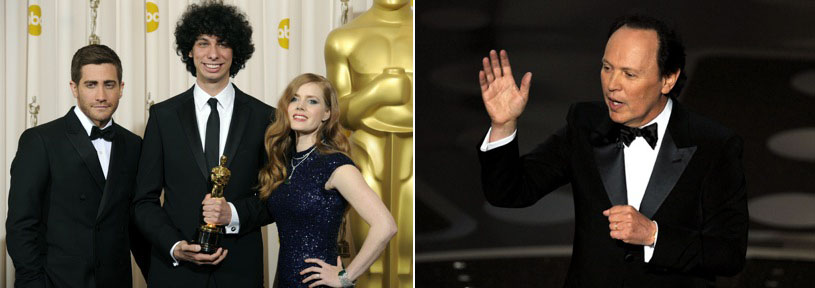
-The enthusiastic speech from Best Live Action Short director Luke Matheny demonstrated that sometimes the best or funniest moments come from unlikely sources. The first thing people probably noticed as Matheny made his way down the aisle was his mass of tangled black hair that could easily have been housing a collection of bird eggs, and his first comment upon reaching the microphone was that he should have gotten a haircut. His short speech was a charmer, as he thanked his mother for providing craft services on his film and paid sweet tribute to his girlfriend.
-One of the highlights of the night was the surprise appearance of Billy Crystal, who walked out to an enthusiastic standing ovation. Was that purely out of affection for one of Oscar’s all-time great hosts, or more because the audience was desperate by that point in the evening for someone who knew how to do the job? Hope Franco and Hathaway didn’t take it the wrong way. Billy was there to introduce the aforementioned Bob Hope bit. He did a few jokes and instantly breathed life into a ceremony that was sorely in need of it.
-Although I already questioned Steven Spielberg’s appearance as Best Picture presenter, I did love what he said when he came out. “Well in a moment, one of these ten movies will join a list that includes On The Waterfront, Midnight Cowboy, The Godfather and The Deer Hunter. The other nine will join a list that includes The Grapes of Wrath, Citizen Kane, The Graduate and Raging Bull.” There was enthusiastic applause as he continued, “Either way, congratulations, you’re all in very good company.” It was a wonderful way to frame the award, and a nice reminder that it really doesn’t matter what wins the Oscar. Great work stands the test of time, and the ultimate winners are the audiences who get to enjoy them. (Still doesn’t take the sting away when the wrong thing wins, but oh well.)
-Okay, I’m sorry, I know this is supposed to be The Good section, but thinking about Mirren, Brand, Downey Jr., Law and Crystal just makes me wonder, where was the comedy? If ever there was an Oscar show that needed an infusion of Jack Black and Will Ferrell singing a song, or Ben Stiller and Owen Wilson playfully arguing, this was it.
THE DRESSES
Thank god for beautiful women and their frocks, because this Oscarcast needed all the push-ups it could get. I’m no Joan Rivers or Mr. Blackwell, but for me, the winners of the night were Mila Kunis, Natalie Portman, Jennifer Lawrence, Marisa Tomei, Reese Witherspoon, Amy Adams and Scarlett Johansson. Thank you ladies, for doing your part to help the show.

FINAL THOUGHTS
The takeaway for me from this year’s Oscar show, and it seems like we go through this every year, is that both the Academy and TV critics and viewing audience need to accept that Oscar night should be an evening for celebrating filmmakers first and foremost, and a television show second…while still making it the best television show it can be. That means the Academy needs to stop making decisions based on a desire to get higher ratings, and the at-home audience needs to get over it if they don’t care about any but the top few awards. Everyone, even cinematographers, art directors, visual effects artists and sound designers should be given their moment to speak without being cut off (though yes, they should be encouraged ahead of time to try and avoid reading lists of names, as Randy Newman references in the clip above). The Oscars weren’t created to satisfy the public; they were created to honor achievements in filmmaking. Public interest after the first awards in 1929 led to the ceremony being broadcast on the radio, and eventually television, but us movie fans who want to be included should remember that we are invited guests. Think the show is boring? Don’t care who wins Best Film Editing? Then don’t watch. These days, you can go online the next day and find video of the acceptance speeches by the actors. If that’s all you care about, then don’t subject yourself to the whole three-plus-hour presentation.
On the flip side, the Academy has to accept that the Oscars aren’t the Super Bowl. (They’re my Super Bowl, but I’m abnormal.) They aren’t going to score Super Bowl-level ratings. There may have been a time when they did, but things have changed. The media landscape is overstuffed with information and options. The movie landscape, specifically, is more fragmented as well, with many more movies released each year and the true “event movie” now a rarity. Gone with the wind are the days when the movies the public went to see en masse were the same movies that were of high enough quality artistically to be top Oscar contenders. Now such movies – Titanic, Lord of the Rings, Avatar, Inception – are few and far between, while Oscar is more likely to shine on smaller films, indie films – Secrets & Lies, The Pianist, The Hurt Locker, The King’s Speech. The kind of films that studios hesitate to finance, and the kind of films that don’t ring up billions in ticket sales or entice the large viewership to the Oscarcast that the Academy would like to see.
But there are still millions of viewers who tune into the Oscars, so as I said earlier, stop cheapening the show by trying to attract a demographic that, by and large, isn’t interested. The Oscars celebrate a certain kind and caliber of movie, and most younger people aren’t interested in those movies. The Oscars may be a bit stodgy, a bit old fashioned, but that’s part of their appeal. So focus on creating a show that truly celebrates the nominees and winners, and be comfortable enough to recognize what the Oscars have always been and should continue to be. Then, once you’ve done that, do all that you can to make the show entertaining to the audience – in the room and at home. Hire comedians or skilled comic actors to host it. Write good material and get charismatic presenters (not every movie star is as captivating in reality as they are when playing a character). Hire a competent director to run the booth. Continue making attempts to shake it up, but don’t lose sight of tradition. The acting presentations from the 2008 ceremony – which I mentioned earlier – is the perfect example. Some liked it, some didn’t, but it was a new idea that still colored inside the lines.
My final note to the Academy: I am available to consult, produce, write or direct. Call me.
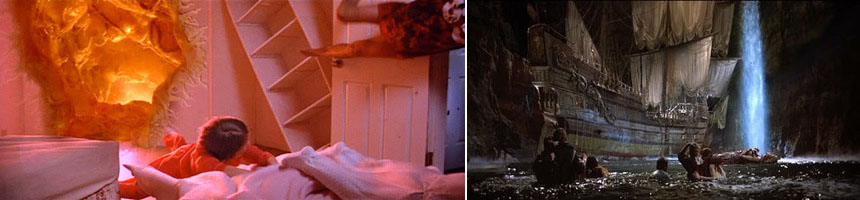
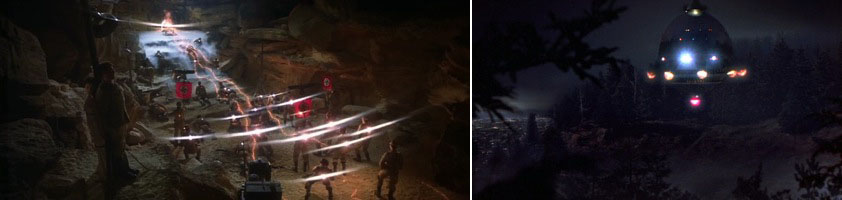
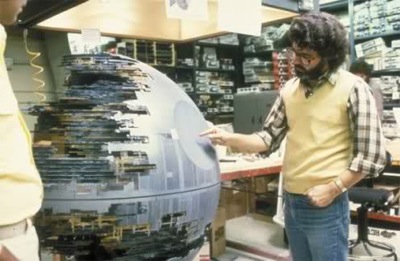 Industrial Light & Magic, the pioneering visual effects company formed by George Lucas in 1975 to realize his vision for Star Wars, was located in southern California (Van Nuys) while making that movie. When Lucas reassembled the team for The Empire Strikes Back, he moved the company up the coast, relocating to a campus of non-descript buildings in San Rafael, about a half hour north of San Francisco. The site was on Kerner Boulevard, and all the outdoor signage indicated the buildings as Kerner Optical, Kerner Optical Company or Kerner Company. ILM occupied that location until 2005, when Lucas moved it into a newly constructed facility in San Francisco’s historic Presidio. But certain departments within ILM did not make the move into the city. The model shop had to remain behind, as did the production stages where the physical effects work was shot. The model shop and stage crews usually worked hand-in-hand. The model shop built it, and the stage crew would drown it, blow it up or set it on fire. And then there were the camera engineers and technicians who in many cases designed and constructed the equipment that would allow it all to be captured properly on film.
 Before ILM’s move took place, I got to spend four and half years as an employee there. And prior to my hiring in June 2000, I had another experience on Kerner. In 1989, when I was 12 years old, my family came out from the east coast to visit relatives in the Bay Area. Like so many kids of that age and era, I was a huge George Lucas/Steven Spielberg fan. My aunt had a former colleague who worked at Lucasfilm, so she reached out to her and the woman arranged for us to have a private tour at ILM and lunch at Skywalker Ranch.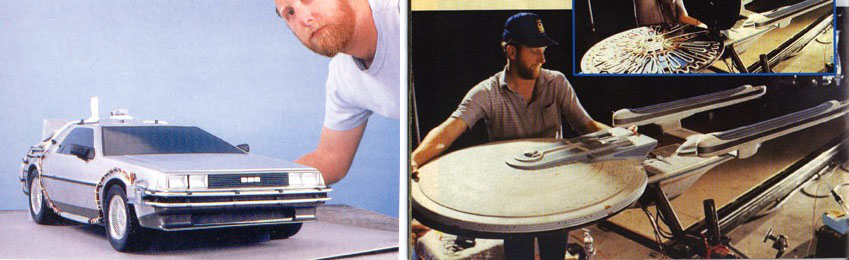




 I Am DB